University YMCA · 1001 S. Wright St., Champaign, IL 61820

Visit universityymca.org
← Program
University YMCA Archives · Program history

The history of Communiversity

For 32 years, from February 1977 to the spring of 2009, the University YMCA ran Communiversity, a "free university" of low-cost, non-credit, non-graded classes open to anyone, on the idea that anybody can teach and anybody can learn. Its catalogue offered everything from bread baking and auto repair to ballroom dance, aikido and sign language, three terms a year. At its height, around 1980, about a thousand people a term took its classes. It was the one community program the Y kept through the upheaval of 1984, and the Board of Governors ended it on April 28, 2009.
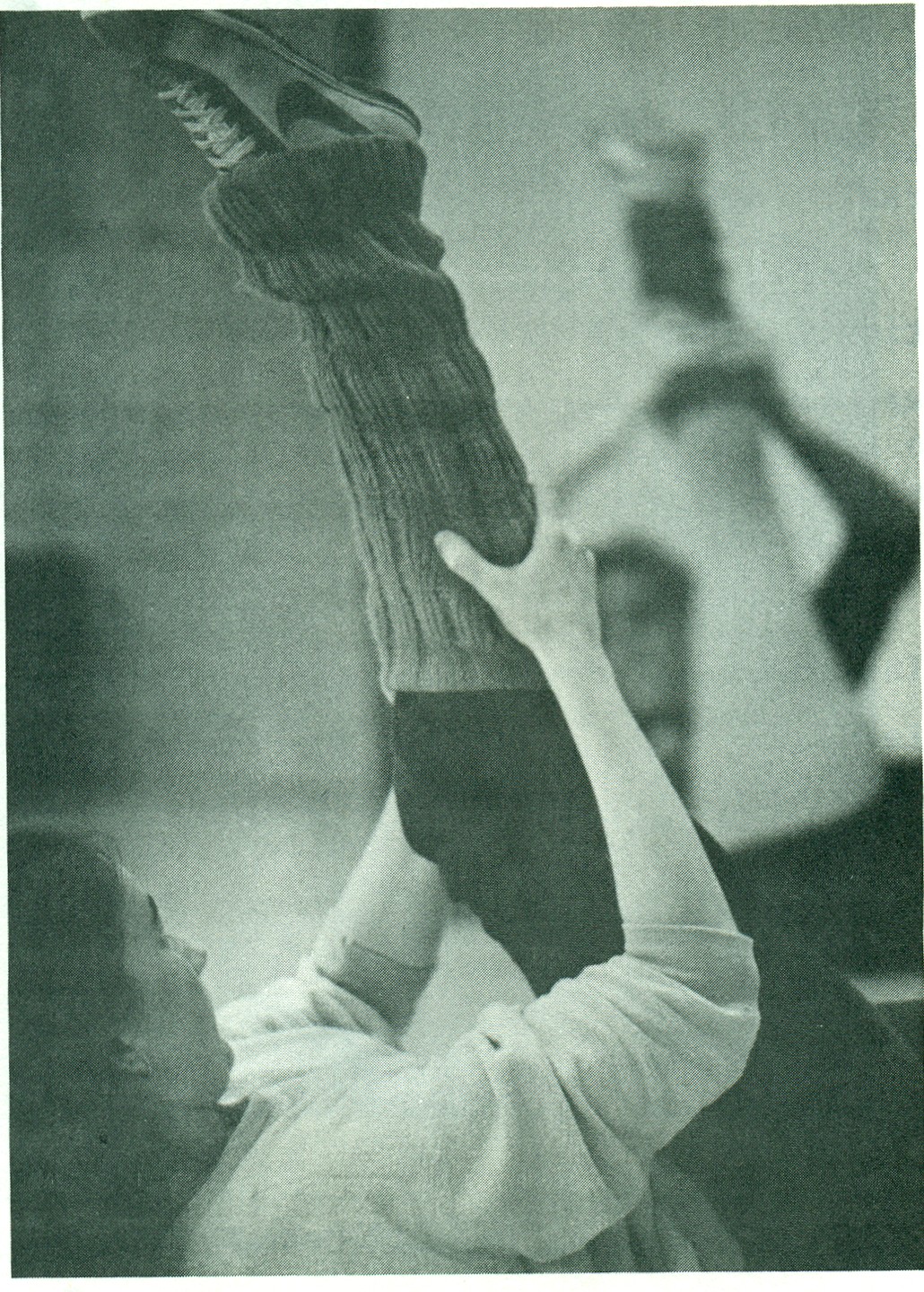
An exercise class, one of the most popular of Communiversity's offerings, from the University YMCA's 1983–84 annual report.

Origins

A free university in Kansas

Communiversity belonged to the "free university" movement of the late 1960s and 1970s: classes on anything, taught by anyone with a skill to share, with no credit, no grades and little or no cost. One of the most successful was the University for Man, begun in 1968 at Kansas State University in Manhattan, Kansas. One of its founders was Louis H. "Lou" Douglas, a professor of political science at K-State, who chaired its board until his death in 1979.12

His son, Stephen A. "Steve" Douglas, grew up in Manhattan and played basketball for Kansas State before coming to Illinois, where he took his doctorate and joined the political science faculty. He was tenured in 1971.34 He was also a member of the University YMCA's board. Scott Peters, the Y's historian, credits him with the idea for Communiversity, which he "took from his father."2

The campus free university

The idea reached the campus by more than one road. In October 1973 the student government (UGSA) opened a Learning Exchange in the Illini Union, a free telephone service that matched people who wanted to teach something with people who wanted to learn it. Within six months it listed some 250 subjects, and the Daily Illini pointed to the University for Man as the model.567 In the fall of 1975 the Learning Exchange and UGSA started Common Ground, a free university with a printed catalogue of 45 courses. Its organizers named the University for Man as their "working model," and some of its classes met at the YMCA.8910 Common Ground grew, but too few people helped run it, and in January 1977 UGSA dropped it.1112

Peters places the Learning Exchange at the YMCA in 1975.2 The Daily Illini of those years describes it as a student government project, begun in the Illini Union in 1973; it never connects it to the Y.

The Y's mini-courses

Meanwhile the Y was offering low-cost "mini-courses" of its own. Peters dates the first, in bicycle repair, car care and photography, to 1974.2 The earliest found in the Daily Illini is "Learn to Juggle," four sessions for $1.25, in April 1975. In 1976 Les Karplus's bread-baking course, run by campus program director Ted Lindberg, had a waiting list.1314

Spring 1977

Three weeks after Common Ground closed, the Y advertised a "FREE Communiversity Catalog." It listed more than 20 classes and seminars: photography, auto repair, CPR, sign language, modern dance, bread baking, watercolor, massage, quilting, cooking, leadership and New Games. Classes began the second week of February 1977, most of them at the Y, at a few dollars each, less for Y members.1516 The organizer was the Y's campus program director, Anne Heinz, who had run a free university as a student at Southern Illinois University. "Communiversity is basically an attempt to fill a need that people have in various stages of life," she told the Daily Illini. It was not meant to replace Common Ground, she said, but it was "very similar."17 A summer term followed, and 33 classes that fall.1819

How it worked

Anybody can teach

The plan hardly changed in 32 years. Anyone could propose a class. The Y supplied the room, printed the catalogue, advertised and took registrations. Classes that did not reach their minimum enrollment were cancelled, and teachers were paid a share of the fees once enough students signed up.2021 "Anybody can teach and anybody can learn," said program director Fred Mastny in 1979, and the line became the program's motto.2223 The teachers were students, faculty members, homemakers, local business people and craftsmen.19 "Our only prerequisite is curiosity," said Anne Colgan, the campus program director, in 1977.24

There were three terms a year, spring, summer and fall, each with a catalogue.25 Classes ran for two to ten weeks, usually one evening a week, and cost from nothing to about $25 in the early years.2426 Most met at the Y, in Latzer Hall and the smaller rooms, but others met in churches, campus ministries, shops and teachers' homes: auto mechanics at Gasoline Alley, bread baking at Strawberry Fields, classes at the Channing-Murray Foundation, Bikeworks and the Red Herring.2728 Communiversity belonged to the national Free University Network, later the Learning Resources Network, which had grown up beside the University for Man in Manhattan, Kansas.2930

The early years, 1977–1984

The program was run by the Y's program staff: Anne Colgan, Kent Doughty and, from 1979, Fred Mastny, with student interns.242623 The catalogue grew from 33 classes in the fall of 1977 to 49 a year later and 80 in the fall of 1980.193120 Students paid for much of it: about two-thirds of those who enrolled were University students, and the student organization fee board gave it small grants.2932 By 1983 there were more than 70 classes a semester and almost a thousand students.33

In the fall of 1983 the Y changed the program's finances so it could pay for its own staff. A registration fee, first charged in the spring of 1984, paid for a half-time Communiversity coordinator, Linda K. Varkonda.3435 An advisory committee chaired by Ron Szoke, with Steve Douglas and the ballroom teacher Aurora Villacorta among its members, produced a new catalogue that cost less and was easier to use. "Communiversity is in very good shape and will continue to be so in 1984–1985," the coordinator reported.35
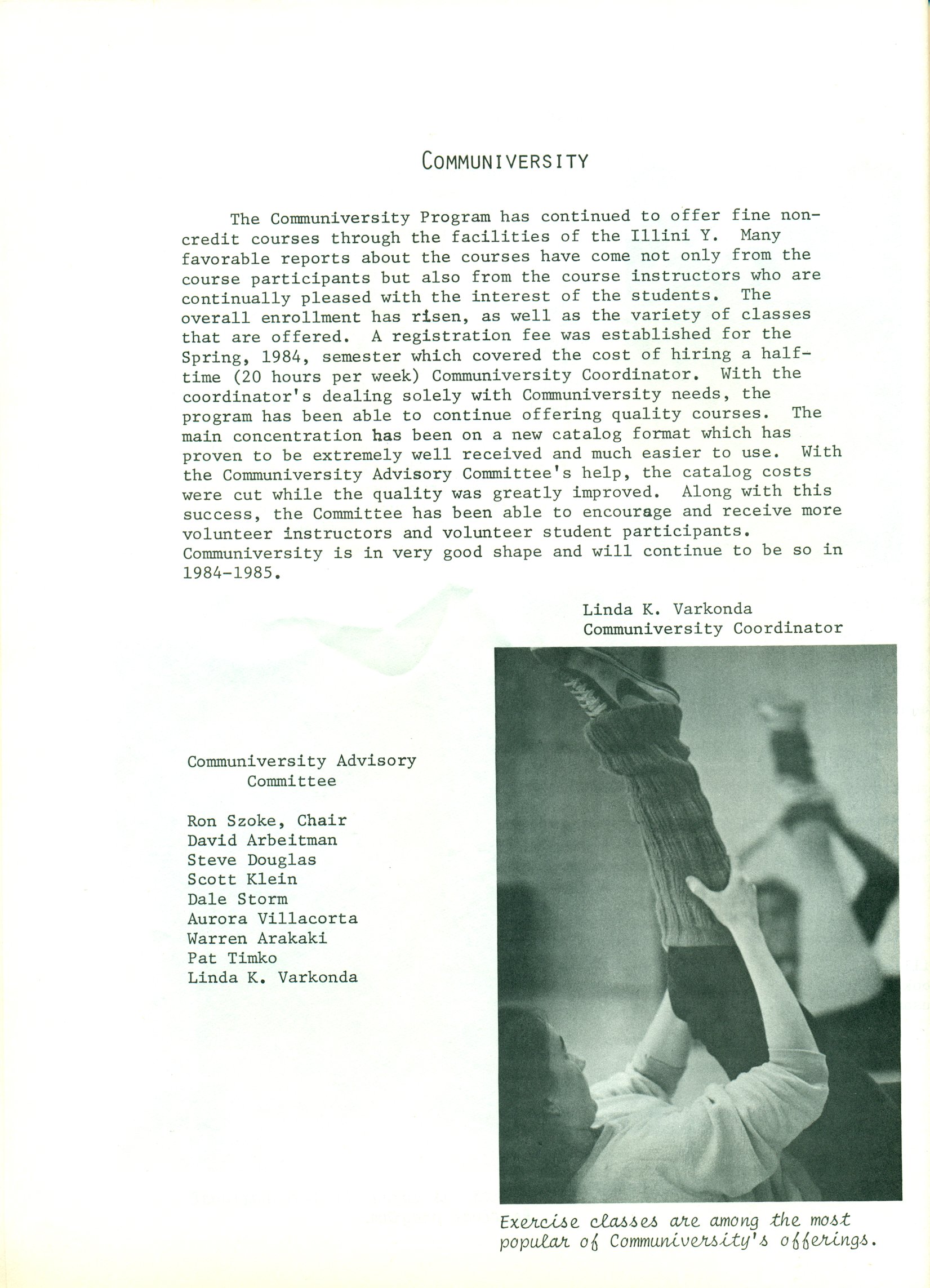
Communiversity's page in the University YMCA's 1983–84 annual report, signed by Linda K. Varkonda, the first half-time Communiversity coordinator, with the members of its advisory committee.

The middle years, 1984–2002

In 1984, when the Y gave up its other community programs, Communiversity was the only one it kept.3637 In 1985 program staff Chris Swartout and Scott Peters reported more than 700 registrations in 80 courses, with more classes at community sites and some on Cablevision's community channel. They called it "a framework for self-motivated teaching and learning in a relaxed, low-pressure environment."38 The Y advertised in 1987 for a half-time Communiversity director.39

From at least 1986 the whole catalogue ran as an insert in the Daily Illini each term, and copies were mailed and left "around town."4041 In the 1990s it doubled as the Y's program guide, with the Friday Forum and Know Your University listings.42 Ballroom dance with Aurora Villacorta, "Miss V," yoga, aikido and other martial arts, massage, languages and sign language were the staples.4344 There were also bus tours, an orientation class on American culture for international students, and public forums with the Channing-Murray Foundation.454647

A staff tally for 1992–95 counted 33 to 68 classes a term and 181 to 398 students; spring was always the biggest term.43 Peters, writing in 1997, put it at about 300 people a semester in an average of 45 classes, far smaller than in the early 1980s, but still the anchor of the Y's community work.48 In 1999 the Y was looking for teachers of English as a second language as well as dance, crafts and martial arts.49

The last years, 2003–2009

By the 2000s instructors kept half the fees for classes in the Y building and 70 percent for classes elsewhere, and the Y kept a $5 registration fee from non-members.21 Registration moved online by 2005, with gift certificates ("Does your significant other need to learn how to dance?").50 The catalogue's own description was "noncredit, short term, affordable, informal, and pressure free (no exams or homework!)."28 Executive director Steve Shoemaker taught classes himself, among them one on C. S. Lewis, and student groups taught through it too: the Campus Vegetarian Society gave a vegetarian cooking class in the fall of 2008.5152

The coordinators came and went: Frank Hassler, Sharece Johnson, Paul Heiberger, Alicia Beck, Phoebe Smith and, in 2008–09, Ann Rasmus, most of them part-time or with other duties.535455565758 The teachers stayed longer. Aurora Villacorta, who had taught dance in the University's kinesiology department before she retired, taught ballroom dance in Latzer Hall every term from at least 2001 to 2009, with a dress code and a rule against chewing gum.5928
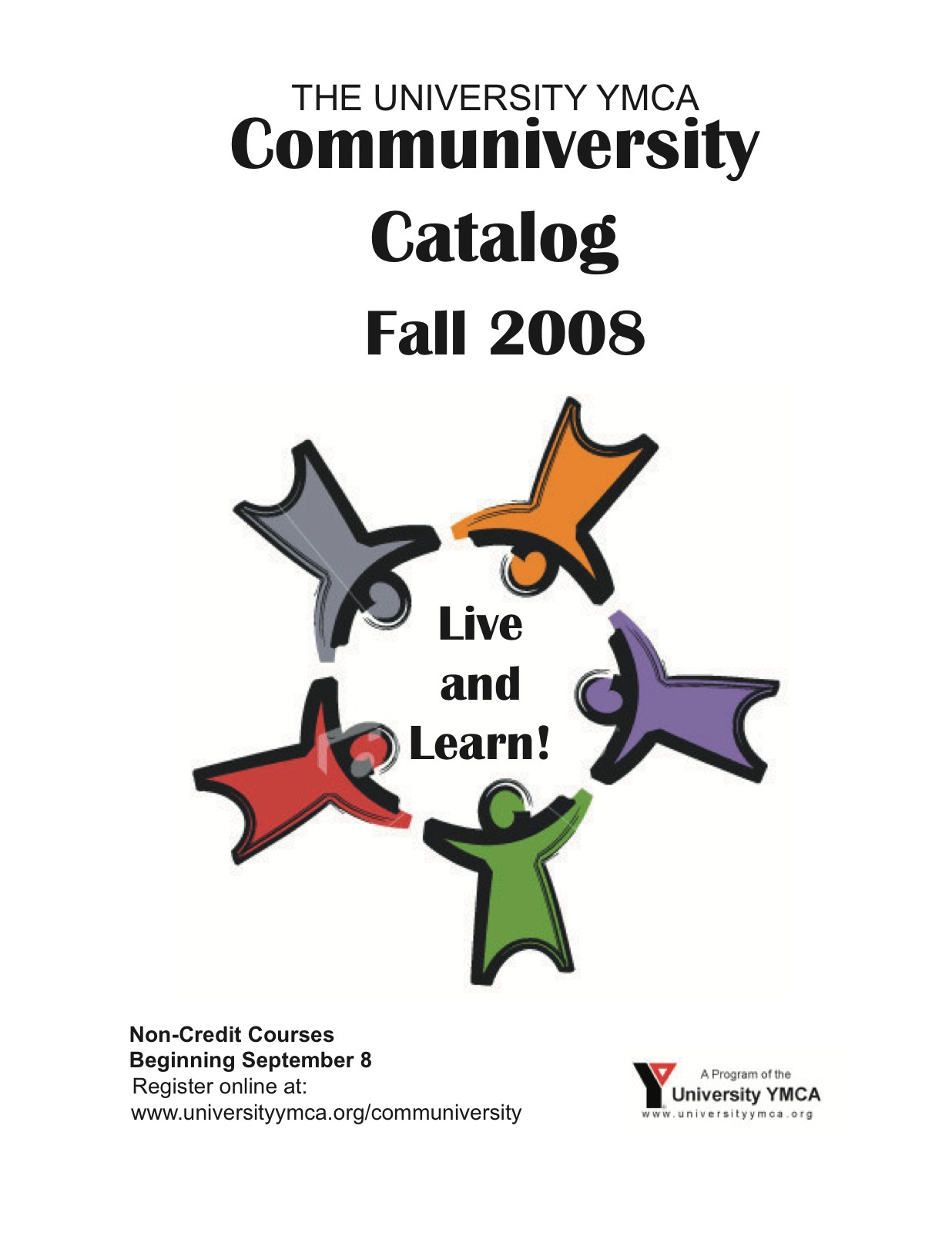
The cover of the Communiversity catalogue for fall 2008, the next-to-last term.

Achievements

Over 32 years and nearly a hundred terms, Communiversity's catalogues listed some 30 to 80 classes each. In the spring of 1979 alone about 1,050 people enrolled.29 The 1992–95 tally counted 181 to 398 students a term.43 The Y's 2009 announcement spoke of "the thousands who have benefited from these mutual learning opportunities over the last 32 years."60

It brought people into the Y who might never have come otherwise. In a 2009 survey, 61 percent of participants said Communiversity had been their first experience of the University YMCA.61 Most were students, faculty and staff of the University, but it drew townspeople too, and it gave people with a skill, from ballroom dance to auto repair, a place to teach it.6119

Some of its classes outlived it. Ballroom dance and the martial arts together drew more than half of all enrollments from 2003 to 2008.61 Ballroom classes went on at the Y in 2009 and 2010 without the Communiversity name, and the Y's budget for 2010 counted rent from "former communiversity instructors."6263 Its classes in English as a second language carried on through the English Center.64

Changes and ending

Decline

Enrollment fell by about half after the mid-1990s. From 2003 to 2008 yearly enrollments went from 476 to 233, the number of classes that actually ran from 57 to 33, and fee income from about $24,000 to $12,400.61 A Board review in 2009 traced the latest drop to 2003, when the Y went from two full-time program staff to one.61 Classes tied to the Y's mission, such as composting, "Campaign School 101" and a "toxic tour," seldom drew enough students to run. Meanwhile others had moved into the field: Urbana Adult Education, the Champaign and Urbana park districts, the Illini Union Board, Parkland College and the University's Osher Lifelong Learning Institute. "Other, larger, organizations have stepped in to fill the void that Communiversity once filled," one instructor wrote.61

The review and the vote, 2008–2009

At its retreat in September 2008 the Board of Governors discussed Communiversity "at great length" and set up a committee to review it, with staff, board members, a former coordinator and teachers.61 The spring 2009 catalogue came out in a slimmer format, advertised in Buzz instead of the Daily Illini insert.65 In February the new executive director, Mike Doyle, asked whether the Y should "rethink Communiversity or reinvest in it," and the Executive Committee suspended the summer term.6667

The committee reported on April 24, 2009. On paper the program earned $1,000 to $3,000 a year over its direct costs, but once staff time was counted it lost about $7,000, and its classes kept Latzer Hall from being rented. The committee recommended ending it, keeping the name and finding other homes for the popular classes.61 On April 28, 2009, the Board of Governors voted to end Communiversity. Spring 2009 was its last term.6869

After 2009

Ending Communiversity was part of a larger reset of the Y's programs in 2009. The same review year brought Art @ the Y, the Student Leadership Initiative, Faith & Social Justice and Alternative Orientation.64 In 2013 Mike Doyle counted Communiversity, with Know Your University, among "long-standing programs that had fulfilled their purpose."70 The Y's web page for it was empty by the end of 2010.71

People

  • Steve Douglas (1938–2022), professor of political science and Y board member, whom Peters credits with the idea, and a member of the Communiversity Advisory Committee in 1983–84.2353
  • Ted Lindberg, campus program director, who ran the Y's mini-courses in 1975–76.14
  • Anne Heinz, campus program director, who organized the first term in 1977, and Anne Colgan, campus program director in 1977–78.1724
  • Kent Doughty, Communiversity director, 1978–79.26
  • Fred Mastny, program director and later program administrator, 1979–83, whose "anybody can teach and anybody can learn" became the motto.2237
  • Linda K. Varkonda, the first half-time Communiversity coordinator, 1984, and Ron Szoke, who chaired the advisory committee.35
  • Chris Swartout and Scott Peters, program staff, 1985.38
  • Rick Boyd, Communiversity director, 1988–89.72
  • Aurora Villacorta, "Miss V," a member of the advisory committee in 1983–84 and the ballroom teacher from at least 1998 to 2009, its best-loved teacher.35736128
  • Patrick Oray (1997–2000), Frank Hassler (2001–03), Sharece Johnson (2004–05), Paul Heiberger (about 2005–06), Alicia Beck (2006–07), Phoebe Smith (2007–08) and Ann Rasmus (2008–09), coordinators.73535455565758
  • Kasey Umland, program director, who presented the review with Ann Rasmus in 2009.68

Remembered

In 1984 coordinator Linda Varkonda explained why the system worked without tests or credentials: "Students weed out the people who don't know what they're talking about."74

"What we are looking for is volunteer learners," Anne Colgan said in 1978.75 A teacher in 1980 said, "The best thing is that teachers are excited to impart their skills."20

From the 1995 catalogue's call for teachers: "You too can gain teaching experience, have a good time, and get paid for your efforts."42

When the Board reviewed the program in 2009, the strongest response was a stream of letters and calls about one teacher. "Miss V's Ballroom classes are excellent," one participant wrote. "She is caring, professional and extremely skilled."61

Sources

  1. "Lou Douglas Lecture Series," K-State Today, Kansas State University; UFM Community Learning Center, history. https://www.k-state.edu/today/students/announcement/?id=15276
  2. Peters, p. 132.
  3. "K-State Mourns the Passing of Steve Douglas," K-State Athletics, Apr. 30, 2022. https://www.kstatesports.com/news/2022/4/30/mens-basketball-k-state-mourns-the-passing-of-steve-douglas
  4. Paul Ingrassia, "Tenure system two-sided," Daily Illini, May 13, 1972. https://idnc.library.illinois.edu/?a=d&d=DIL19720513.2.48
  5. Sue Treiman, "Learning Exchange aids communication," Daily Illini, Oct. 12, 1973. https://idnc.library.illinois.edu/?a=d&d=DIL19731012.2.28
  6. Cheryl Riley, "Learning Exchange draws 300 students," Daily Illini, Jan. 17, 1974. https://idnc.library.illinois.edu/?a=d&d=DIL19740117.2.60
  7. Dave Caulk, "Exchange brings people, activities together," Daily Illini, Apr. 9, 1974. https://idnc.library.illinois.edu/?a=d&d=DIL19740409.2.10
  8. Steve Rassenfoss, "Free university program to begin this fall," Daily Illini, July 15, 1975. https://idnc.library.illinois.edu/?a=d&d=DIL19750715.2.16
  9. Bob Dal Santo, "Common Ground—the Learning Exchange grows up," Daily Illini, Nov. 1, 1975. https://idnc.library.illinois.edu/?a=d&d=DIL19751101.2.81
  10. [Common Ground], Daily Illini, Sept. 3, 1976, p. 8. https://idnc.library.illinois.edu/?a=d&d=DIL19760903-01.1.8
  11. [Common Ground], Daily Illini, Oct. 26, 1976, p. 8. https://idnc.library.illinois.edu/?a=d&d=DIL19761026-01.1.8
  12. Lisha Gayle, "UGSA tables Common Ground," Daily Illini, Jan. 13, 1977, p. 3. https://idnc.library.illinois.edu/?a=d&d=DIL19770113-01.1.3
  13. University YMCA advertisement, Daily Illini, Apr. 8, 1975, p. 12. https://idnc.library.illinois.edu/?a=d&d=DIL19750408.2.36.1
  14. "A lot o' dough: Bread-baking course rises to the occasion," Daily Illini, Feb. 7, 1976, p. 23. https://idnc.library.illinois.edu/?a=d&d=DIL19760207-01.1.23
  15. University YMCA advertisement, "FREE Communiversity Catalog," Daily Illini, Feb. 1, 1977, p. 19. https://idnc.library.illinois.edu/?a=d&d=DIL19770201-01.1.19
  16. University YMCA advertisement, Daily Illini, Feb. 9, 1977, p. 22. https://idnc.library.illinois.edu/?a=d&d=DIL19770209-01.1.22
  17. Linda Tufano, "YMCA to offer 'Communiversity'," Daily Illini, Feb. 2, 1977, p. 17. https://idnc.library.illinois.edu/?a=d&d=DIL19770202-01.1.17
  18. University YMCA advertisement, Daily Illini, June 14, 1977, p. 11. https://idnc.library.illinois.edu/?a=d&d=DIL19770614-01.1.11
  19. Barb Anderson, [YMCA fall programs], Daily Illini, Sept. 1, 1977, p. 8. https://idnc.library.illinois.edu/?a=d&d=DIL19770901-01.1.8
  20. Paul Budin, "Communiversity offers flexible way to learn," Daily Illini, Sept. 11, 1980, p. 23. https://idnc.library.illinois.edu/?a=d&d=DIL19800911-01.1.23
  21. University YMCA, Communiversity instructor letter, Jan. 2003 (Y website files).
  22. Nina Gadomski, "YM-YWCA gathers community, students into innovative school," Daily Illini, Nov. 27, 1979, p. 25. https://idnc.library.illinois.edu/?a=d&d=DIL19791127-01.1.25
  23. "University YMCA gives chance for 'worldly' to instruct classes," Daily Illini, Mar. 10, 1983, p. 11. https://idnc.library.illinois.edu/?a=d&d=DIL19830310-01.1.11
  24. "YMCA to hold open house for special courses," Daily Illini, Dec. 7, 1977, p. 11. https://idnc.library.illinois.edu/?a=d&d=DIL19771207-01.1.11
  25. Communiversity Course Catalog, fall 1991, insert in Daily Illini, Sept. 3, 1991, pp. 41–56. https://idnc.library.illinois.edu/?a=d&d=DIL19910903-01.1.41
  26. Debbie Blaylock, "YMCA school makes teachers of learners," Daily Illini, Feb. 1, 1979, p. 8. https://idnc.library.illinois.edu/?a=d&d=DIL19790201-01.1.8
  27. University YMCA advertisement, Daily Illini, Feb. 11, 1978, p. 12. https://idnc.library.illinois.edu/?a=d&d=DIL19780211-01.1.12
  28. University YMCA, The Communiversity Catalog, fall 2008.
  29. Linda Bergstrom, "Special Communiversity courses meet diverse needs," Daily Illini, May 5, 1979, p. 4. https://idnc.library.illinois.edu/?a=d&d=DIL19790505-01.1.4
  30. Karen Sundfors, "Sign-up extended for program," Daily Illini, Sept. 9, 1982, p. 11. https://idnc.library.illinois.edu/?a=d&d=DIL19820909-01.1.11
  31. Mary Rose Fabish, "Program designed for diverse interests," Daily Illini, Sept. 13, 1978, p. 29. https://idnc.library.illinois.edu/?a=d&d=DIL19780913-01.1.29
  32. [Student Organization Resource Fee allocations], Daily Illini, Oct. 31, 1979, p. 3. https://idnc.library.illinois.edu/?a=d&d=DIL19791031-01.1.3
  33. Peters, p. 133.
  34. University YMCA, General Director's statement, Feb. 1984 (University YMCA records, Y Archives).
  35. University YMCA, annual report 1983–84, "Communiversity" (University YMCA records, Y Archives).
  36. Peters, p. 136.
  37. Peters, p. 137.
  38. Chris Swartout and Scott Peters, [guest column], Daily Illini, Apr. 25, 1985, p. 14. https://idnc.library.illinois.edu/?a=d&d=DIL19850425-01.1.14
  39. University YMCA classified advertisement, Daily Illini, Oct. 23, 1987. https://idnc.library.illinois.edu/?a=d&d=DIL19871023-01.1.22
  40. Communiversity fall 1986 catalogue, insert in Daily Illini, Sept. 2, 1986, pp. 41–47. https://idnc.library.illinois.edu/?a=d&d=DIL19860902-01.1.41
  41. University YMCA, Communiversity summer 1994 advertisement copy (University YMCA files).
  42. University YMCA, Communiversity catalogue, fall 1995 (University YMCA files).
  43. University YMCA, "Communiversity Analysis 92–95" (staff tally), Apr. 15, 1995 (University YMCA files).
  44. "Enrollment for YMCA classes starts Monday," Daily Illini, Aug. 30, 1993, p. 4. https://idnc.library.illinois.edu/?a=d&d=DIL19930830-01.1.4
  45. University YMCA advertisement, "Communiversity Education on Wheels," Daily Illini, Oct. 2, 1984, p. 21. https://idnc.library.illinois.edu/?a=d&d=DIL19841002-01.1.21
  46. Dan Blunk, "Class helps students handle US culture," Daily Illini, Sept. 5, 1990, p. 7. https://idnc.library.illinois.edu/?a=d&d=DIL19900905-01.1.7
  47. [Channing-Murray and Communiversity forum], Daily Illini, Oct. 7, 1993, p. 4. https://idnc.library.illinois.edu/?a=d&d=DIL19931007-01.1.4
  48. Peters, p. 151.
  49. "YMCA will teach spring Communiversity program," Daily Illini, July 19, 1999, p. 2. https://idnc.library.illinois.edu/?a=d&d=DIL19990719-01.1.2
  50. University YMCA, Communiversity home page, Jan. 2005 (Y website files).
  51. University YMCA, Annual Report 2007–2008.
  52. University YMCA, Annual Report 2008–2009.
  53. University YMCA, Communiversity catalogue introduction, spring 2001 (University YMCA files).
  54. University YMCA, Communiversity instructor letter, June 2004 (Y website files).
  55. University YMCA, staff contact page, Dec. 2005 (Y website files).
  56. University YMCA, Communiversity instructor page, fall 2006 (Y website files).
  57. University YMCA, Communiversity web pages (Internet Archive, captured Jan. 31, 2008). https://web.archive.org/web/20080131212234/http://www.universityymca.org:80/communiversity/
  58. University YMCA, "Contact Us" page, Sept. 2008 (Y website files).
  59. University YMCA, Communiversity web catalogue (Internet Archive, captured June 2, 2001). https://web.archive.org/web/20010602042422/http://www.universityymca.org:80/Communiversity/index.html
  60. University YMCA, announcement of the end of Communiversity, May 2009; also in Annual Report 2008–2009 (University YMCA files).
  61. University YMCA, Communiversity: Program Analysis and Review, report to the Board of Governors, Apr. 24, 2009, with appendices (University YMCA files).
  62. Calendar listings, Daily Illini, June 24, 2009, pp. 19, 29. https://idnc.library.illinois.edu/?a=d&d=DIL20090624-01.1.19
  63. University YMCA, 2010 budget discussion notes, Nov. 2009 (University YMCA files).
  64. University YMCA, "Generic Descriptions: Mission, goals, history, and programs," Apr. 2010 (University YMCA files).
  65. University YMCA Board of Governors, minutes, Jan. 27, 2009 (University YMCA files).
  66. Mike Doyle, Executive Director's report, Feb. 2009 (University YMCA files).
  67. University YMCA Board of Governors, minutes, Feb. 25, 2009 (University YMCA files).
  68. University YMCA Board of Governors, minutes, Apr. 28, 2009 (University YMCA files).
  69. University YMCA Board of Trustees, minutes, Sept. 28, 2009 (University YMCA files).
  70. Mike Doyle, memo for the Board of Governors retreat, Oct. 16, 2013 (University YMCA files).
  71. University YMCA, Communiversity web page (Internet Archive, captured Dec. 20, 2010). https://web.archive.org/web/20101220170736/http://www.universityymca.org/communiversity/
  72. Jim Selle, "YMCA Communiversity offers range of 70 classes," Daily Illini, Aug. 26, 1988, p. 9. https://idnc.library.illinois.edu/?a=d&d=DIL19880826-01.1.9
  73. University YMCA, Communiversity catalogue, spring 1998 (University YMCA files).
  74. Adriana Colindres, "YMCA offers summer courses," Daily Illini, June 12, 1984, p. 3. https://idnc.library.illinois.edu/?a=d&d=DIL19840612-01.1.3
  75. Denise Polesch, [back-to-school feature], Daily Illini, Aug. 1, 1978, p. 71. https://idnc.library.illinois.edu/?a=d&d=DIL19780801-01.1.71

Works cited

  • Peters, Scott J. The Promise of Association: A History of the Mission and Work of the YMCA at the University of Illinois, 1873–1997. Champaign: University YMCA, 1997. Read the book (PDF)
Last reviewed
October 17, 2026
At the University YMCA today

Timeline

1968
University for Man
Lou Douglas, a Kansas State political scientist and father of the Y board member who later proposed Communiversity, helps found the University for Man, a free university in Manhattan, Kansas.
Oct. 7, 1973
The Learning Exchange
The student government opens a Learning Exchange in the Illini Union, matching people who want to teach a skill with people who want to learn it.
1974–1976
The Y's mini-courses
The University YMCA offers low-cost mini-courses each semester, from juggling to bread baking.
Feb. 1977
The first Communiversity
The Y publishes its first free Communiversity catalogue, with more than 20 classes open to students and townspeople, and classes begin the second week of February.
Spring 1979
About 1,050 enrolled
About 1,050 people enroll in a single term, about two-thirds of them University students.
Fall 1980
Eighty courses
The fall catalogue lists 80 courses, almost double the year before.
Spring 1984
A coordinator of its own
A new registration fee pays for a half-time Communiversity coordinator, Linda K. Varkonda.
Summer 1984
The one community program kept
When the Y spins off its other community programs, Communiversity is the only one it keeps.
Sept. 1986
The catalogue in the Daily Illini
The full Communiversity catalogue runs as an insert in the Daily Illini, as it will each term for some 20 years.
2003
Fewer staff
The Y goes from two full-time program staff to one, the point to which a later review traces the program's decline.
Sept. 2008
A review begins
At its retreat the Board of Governors sets up a committee to review Communiversity.
Apr. 28, 2009
Communiversity ends
After the review, the Board of Governors votes to end Communiversity. Spring 2009 was its last term.
Know more about this program, or have photos or papers from it? Share what you know.