University YMCA · 1001 S. Wright St., Champaign, IL 61820
Visit universityymca.orgDump & Run began as the University YMCA's "garage sale." On Sept. 5–7, 2002, the Y held its first Dump & Run in its own building, selling donated goods to raise money for its student programs. From 2003 it collected what students left behind at move-out, and in 2004 the sale moved to the U of I Stock Pavilion, where it has become one of the largest community sales in Champaign-Urbana. The Y estimates that it keeps about 30 tons of furniture, housewares and clothing out of the landfill each year. It furnishes thousands of new students' apartments and depends on more than 1,000 volunteer hours.
By 2001 the University YMCA held an Annual Garage Sale. Student programs were asked to help at it, and it was the main source of money for the Student Programs Account, from which the Y's student groups drew.12 The oldest account of how it began appeared in the Daily Illini in 2004. Joyce Schields and Betty Earle, the Y's director of operations, wanted to clear out the attic, which was full of furniture and belongings left by students who had once lived in the building. They wrote to the Y's boards proposing a sale, and the boards agreed. Schields drove her pickup truck to collect donations from people's houses.3 Later tellings put it differently: in 2013 it was a secretary who noticed the crowded attic and had heard of a similar fundraiser elsewhere, and in 2022 it was a small yard sale on the Y's front lawn on Wright Street.45
The idea of a "Dump and Run" is credited to Lisa Heller, who in 1998 was on the faculty of the University of Richmond in Virginia: students leaving campus would give away what they could not take, and it would be sold in the fall for charity.67 By 2000 Heller had founded Dump & Run, Inc., a nonprofit in Brookfield, Massachusetts, that helped colleges start such programs for a fee, and registered "Dump and Run" as its service mark.68 By 2003 it counted programs at about 15 colleges.9
In 2002 the University YMCA joined that national program and renamed its sale.69 Its first price guide was the national kit's template, and it took the kit's slogan, which the Y still uses: "When in doubt, don't throw it out."10
The first ad, in July 2002, asked: "Looking for the biggest and best garage sale on campus???"11 Donations closed on Saturday, Aug. 24. On Wednesday evening, Sept. 4, volunteers who had worked at least four hours had a preview sale of their own, with a $5 gift certificate and a green T-shirt. The sale itself ran from Thursday, Sept. 5, to Saturday morning, Sept. 7, in the Y building at 1001 S. Wright St.11121314 The goods included working VCRs and televisions, in-line skates, lawn mowers, musical instruments and board games.15
The next spring Aimee Kandrac, the Y's development officer, said the first year had made $13,000.6 (Later accounts put the first year lower, at "almost $10,000" or about $5,000 net.1617) The staff's own review of the sale, in January 2003, praised the press coverage and the volunteers' T-shirts, and it noted that the sale raised money for the Y, its student programs and its third-floor residents. But it found that items were moved too many times, storage was "a huge problem," and the work took too much staff time. "We need to be more efficient!" one staff member wrote. The review recommended holding the sale earlier and storing donations in semi-trailers.18
In 2003 the Y took donations when students moved out in May, from private certified housing, sororities, Orchard Downs and apartments as well as at the Y.9 After a week Kandrac had a semi-trailer at the Y that she could "barely fit any more into."15 The August sale, Aug. 27–29, filled Latzer Hall, Murphy Lounge, the first floor and the basement of the Y building. Admission was $1 on Wednesday evening, and Friday was a $2 bag sale.1920

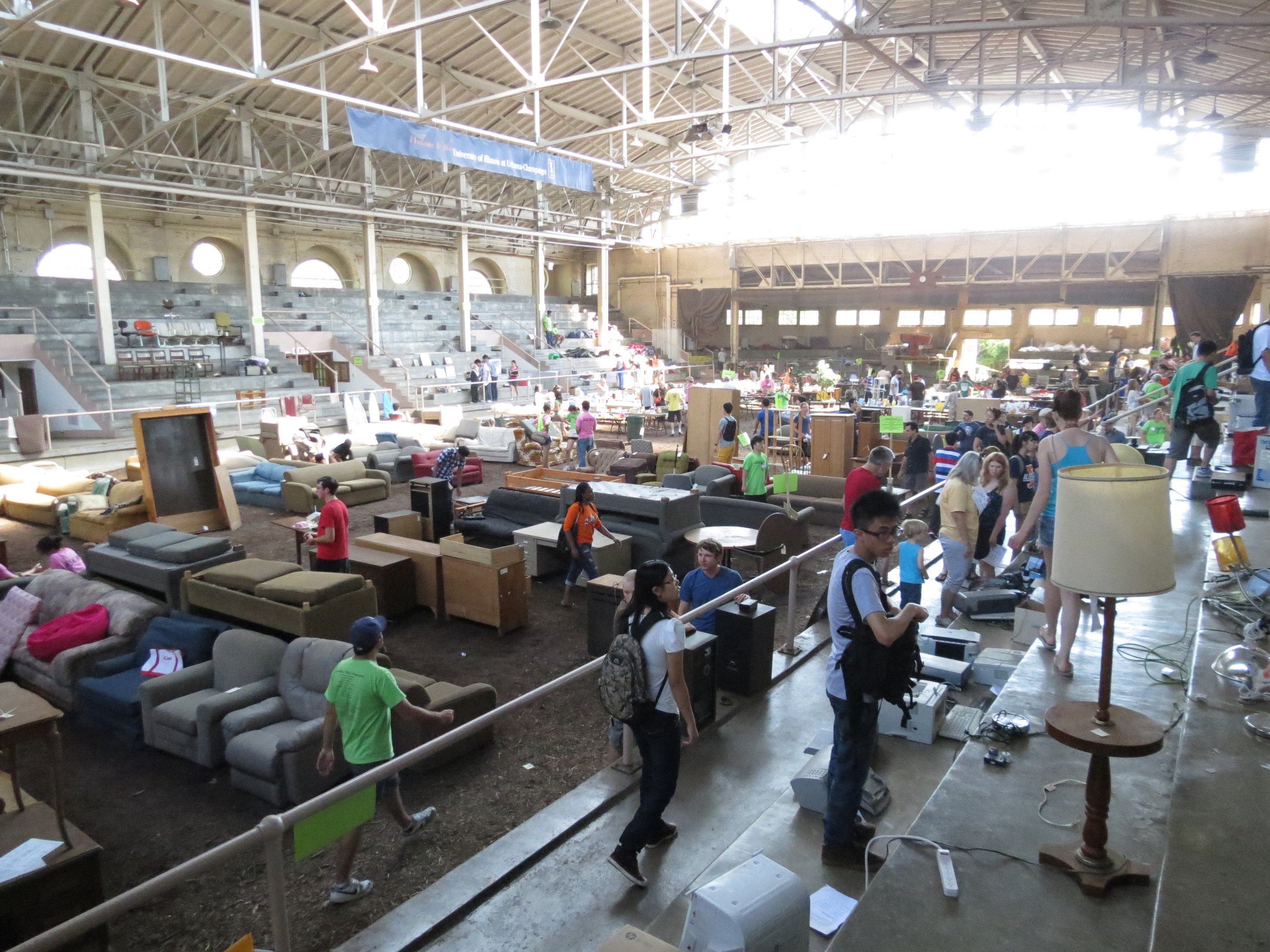
By 2004 the sale had outgrown the building. "When we started putting furniture on the lawn (the sale) got too big," Joyce Schields remembered. That August it moved to the University of Illinois Stock Pavilion, 1402 W. Pennsylvania Ave., Urbana, with four or five semi-trailers of goods.321 Executive Director Steve Shoemaker called it "probably the biggest sale in town."3 Nearly 2,300 people came through in the first four hours, with a line to Lincoln Avenue, and the sale raised about $30,000 for the Y's student programs, among them Amnesty International and Alternative Spring Break.2223 Every sale since has been held there.24
For the next 15 years, Dump & Run followed the University calendar:
International students were a large part of the reason for the sale. "Many come with just two suitcases when they arrive in this country," a 2009 article explained.37 From at least 2005 the University's Office of International Student Affairs, later International Student and Scholar Services, co-sponsored Dump & Run and gave newly arrived international students free admission tickets. On the Saturday of the 2011 sale, 360 of the 1,573 people who came in used them.303839
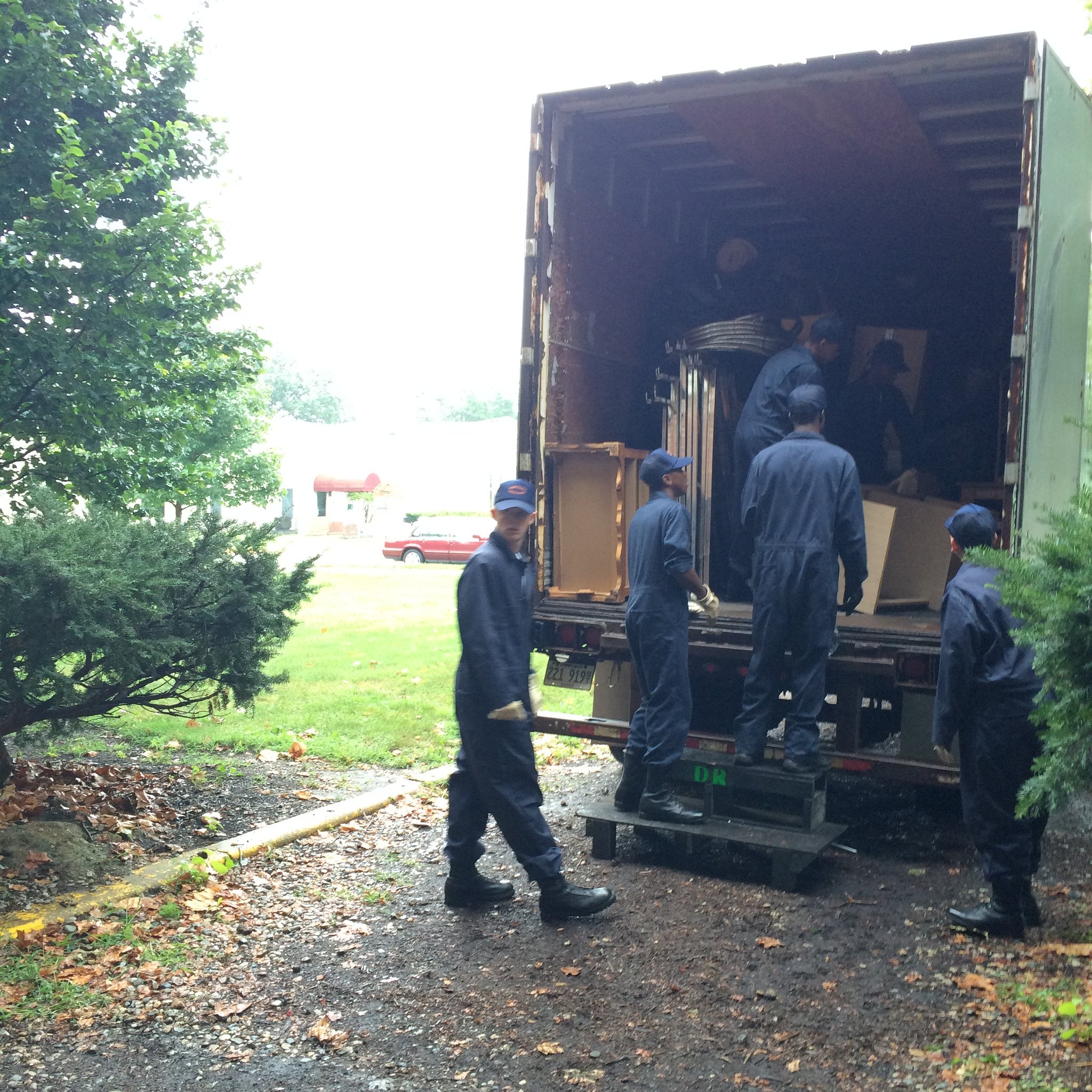
The work was done by volunteers: students from Y programs and student groups such as Red Bison and the Philippine Student Association, residents of the Y's third floor, Kiwanis members, cadets from the Lincoln's Challenge Academy in Rantoul (from 2004), and community volunteers who came back year after year.404135424327 The development director ran the program, with a summer intern or coordinator.44 In 2010, while the Y building was being renovated, the May collections were also held at the Stock Pavilion; they came back to the Y in 2011.4546 In 2011 and 2012 a volunteer committee, chaired by Ellen Dahlke, took over much of the planning.4748
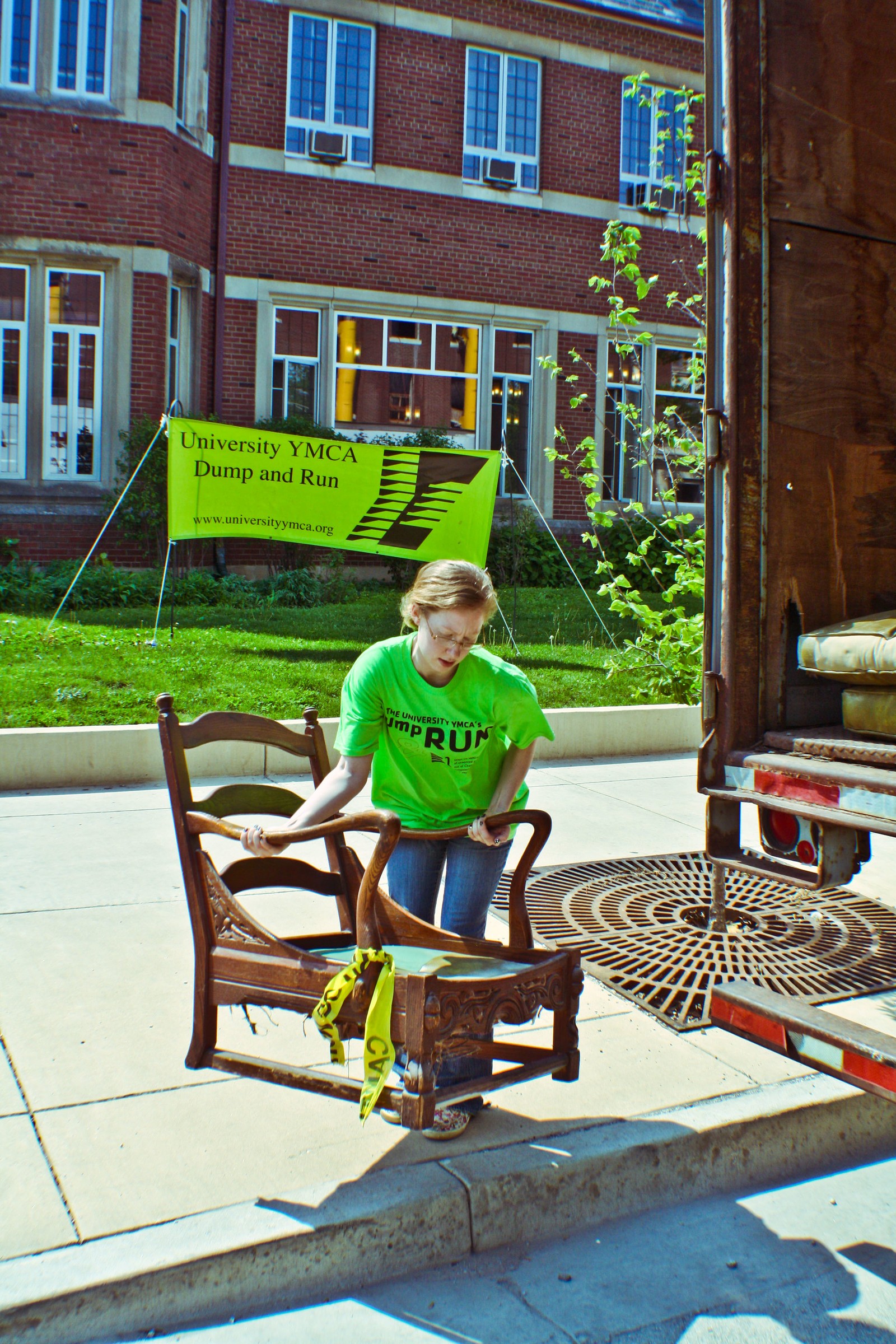
In 2012 University Housing, which had run its own Salvage Drive at move-out since 1995, asked the Y to collect from the residence halls instead.4950 Dump & Run grew quickly. In 2014 there were 55 collection boxes in about 30 buildings, most of them residence halls.51 Housing alone sent about 25,000 pounds in 2015 and more than 30,000 in 2016.52 The Y reckoned the 2015 sale saved 37 tons from the landfill and raised $29,000.53
The growth strained a small staff. "There are easier ways to make $20,000," Kasey Umland, the Y's program director, said in 2014.51 Counting staff time and the rooms the collections took over, a 2015 analysis found that the program cost the Y nearly three times what it earned.54 From 2014 the Y asked the University to share the work. A proposal to the Student Sustainability Committee was turned down that December, but the Y's leaders met with the University's sustainability staff in 2015, and University Housing shared the cost of trucking in a 2016 pilot.555652 In May 2019, when MCORE construction on Wright Street blocked the Y building, the collections moved to the Stock Pavilion, with a campus truck and driver.5758 That December the Student Sustainability Committee granted $15,020 for the campus's share, and in February 2020 Facilities & Services agreed to lead the spring collection, with the Y and Housing.5960
The pandemic stopped Dump & Run. The spring 2020 collection was called off in March, and on May 27, 2020, the Y's Board of Governors voted unanimously to cancel the sale.6162 Many of the regular volunteers were older, and sanitizing donations and limiting the crowd at the Pavilion could not be managed.63 It was the only year since 2002 without a sale.
Dump & Run came back in August 2021, with community drop-offs at the Stock Pavilion and no residence-hall collection, and an unusual Wednesday–Thursday sale on Aug. 18–19. "It was absolutely missed last year," said Marc Alexander, the Y's director of development and membership. The Y had hoped to clear $5,000 and netted almost $16,000.6465
In May 2022 the Y decided to hold Dump & Run only in August and leave the spring move-out collection to the University.6667 Since May 2023, Facilities & Services and University Housing have run that collection under the same name, with storage containers beside the residence halls and the goods given to Goodwill, Salt & Light, Habitat for Humanity and the Eastern Illinois Foodbank.6869 The two agreed in 2023 that they were separate events under one name, and Facilities & Services lends tables and a dumpster for the Y's sale.70 The Y registered DUMP & RUN as its service mark, filed on April 21, 2023, and registered on May 14, 2024 (No. 7,386,217), and the University's signs now carry the Y's ®.7172
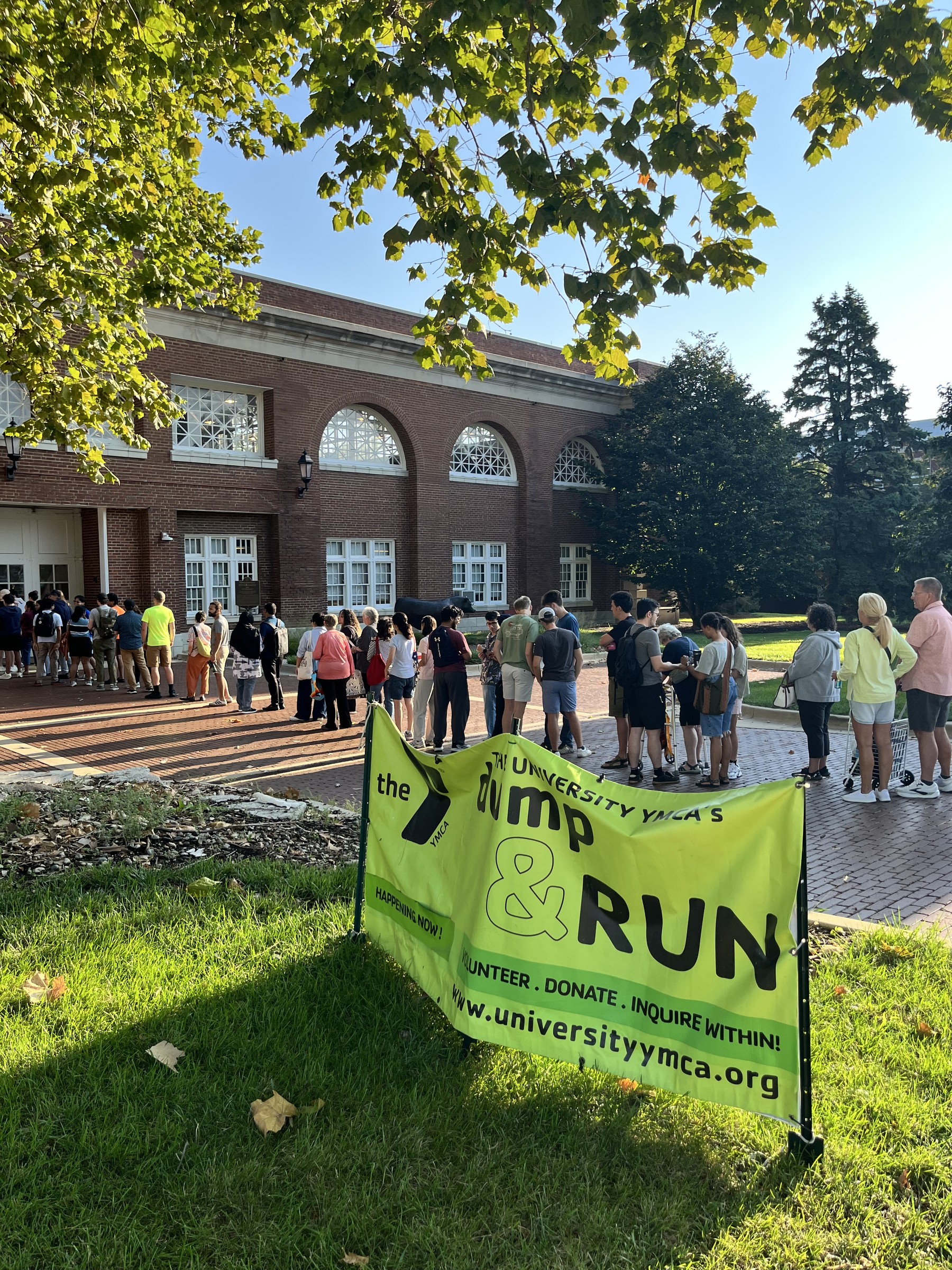
The Y's Dump & Run is now an August program. For two weeks early in the month, people drop off donations at the Stock Pavilion, and volunteers pick up furniture and bicycles on two Saturdays. After a volunteer pre-sale comes the Big Sale on move-in weekend. On Saturday it costs $5 to get in, and University of Illinois and Parkland students are free. Sunday brings the $3 bag sale, half-price furniture and the free sale at 2:30.7374 The College of ACES and the Department of Animal Sciences provide the Pavilion.7514 In 2026 Alexander described the program's "three pillars": sustainability, low-cost goods for students and neighbors, and money for the Y's programs.76
Dump & Run is still running. Its biggest changes have been of place and season. It began in the Y building and moved to the Stock Pavilion in 2004. Its collections were held at the Y until 2018 and at the Pavilion after that. From 2012 to 2019 it collected from the residence halls for University Housing, and since 2022 the Y has run only the August collection and sale, while the University runs the spring collection.3574967
The name took getting used to. A 2005 staff review listed "the name!" among the program's weaknesses, and in 2010 Becca Guyette, the development director, said: "People are finally getting past the name."2845
The Y's own descriptions have often dated Dump & Run to 2001, and its trademark registration claims first use on Aug. 15, 2001. That year belongs to the garage sale that came before it. The first Dump & Run was held in September 2002, and the Y's numbering of its sales counts from that year.7111314
Rachael Dietkus, the development director, told shoppers in 2005: "Imagine a typical garage sale times a million."22
Willard Broom, the Y's interim executive director, described the donations in 2008: "We had George Foreman grills in a stack as big as George Foreman."16
Kasey Umland, then a program director at 25, said in 2009: "I furnished my entire apartment with Dump & Run bargains, and so have several friends."91
Ruta Rauber, who ran the kitchen department for more than a decade, said of the goods: "I stand there and look at it and think this could have easily ended up in the landfill."92
Becca Guyette, looking back in 2019 on her two weeks a year in the Stock Pavilion, said: "It was hot, humid and smelly."83
Joe Guyette, accepting the Y's Distinguished Service Award in 2020, recalled "the entire stock pavilion full of furniture and all the other stuff and at the end of day one it's mostly gone."93
Dump & Run comes around every August at the U of I Stock Pavilion: two weeks of drop-offs, then the Big Sale on move-in weekend.
See this year's dates.svg)