University YMCA · 1001 S. Wright St., Champaign, IL 61820

Visit universityymca.org
← Program
University YMCA Archives · Program history

The history of the Student Employment Bureau

For more than 30 years the University YMCA ran the place where Illinois students found work. Its Student Employment Bureau, begun in 1897, canvassed Champaign and Urbana for jobs and matched students to them free of charge: board jobs waiting tables and washing dishes, furnaces to tend, lawns to mow and floors to wax. By the late 1920s it found more than 4,000 jobs a year for more than a thousand students. The University backed the bureau from 1913, and in 1932 it took the work over. The Y's last employment secretary, Dwight F. Bracken, became the head of the University's first employment office.
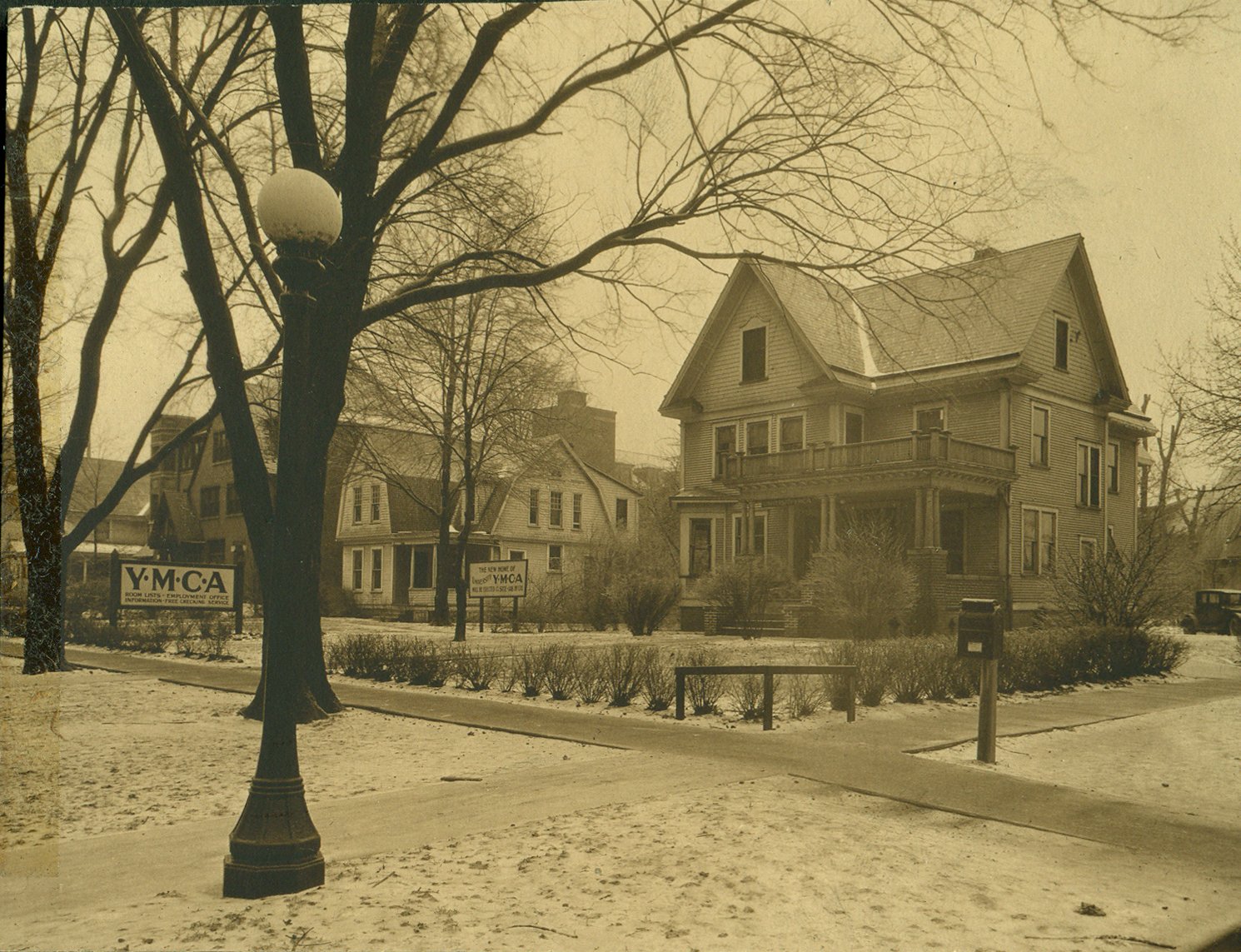
The University YMCA's temporary home at Wright and Chalmers streets, c. 1928–32. The sign at left reads "Room Lists – Employment Office – Information – Free Checking Service."

Origins

Until well into the 20th century the University of Illinois did little to house its students or to help them find work. Young men came by the thousands, Harold Hannah wrote in the Y's centennial history, "most needing rooms and many needing jobs if they were to remain in school."1 The University YMCA met the trains, kept lists of rooms from 1876, and in time began to find students work.1

The idea was in the air early. In June 1892 the Y planned an "information and employment bureau" for the opening days of the fall term, to "secure employment for all who desire it."2 By September 1896 the Y office had "constant calls … for work." Townspeople with odd jobs were asked to tell the general secretary, W. E. Durstine, in Room 1 of University Hall, and he would send a student.34 In 1897, Peters writes, the Y created an employment bureau that kept a list of local jobs.5 That September the papers told anyone wishing "to aid students by giving them employment" to apply to the Y in Room 1 of University Hall.6 In 1898 his successor, W. W. Dillon, put the case on the front page of the Champaign Daily News under the headline "Give the Boys a Chance": many young men could not attend the University without work, and could care for lawns, furnaces, horses and cows, offices and stores.7 A year later the paper reported that finding work for students was "very largely in the hands of the University Y. M. C. A."8

In 1899 the Y moved into the Association House, its first home of its own, and in later years it counted its organized employment work from that school year.910 It counted 25 men helped that year and 35 in the first two months of the next.1112 In August 1901 it began a "systematic canvass for employment" of both towns, alongside its yearly canvass for rooms, and that October it placed its first newspaper advertisement: "Competent student help for all kinds of work may be secured free of charge through the employment bureau of the Y M C A."1314 The Chicago Tribune called the bureau "a feature of recent development."15 The University's catalog first mentioned it in 1901–02: "The employment bureau helps to find work."16

Peters, who worked from the Y's own records in the University Archives, dates the bureau to 1897. Hannah gives 1900, when the service began "on a serious basis," and in 1932 the Y counted from 1899–1900.519

Student YMCAs across the country were starting employment bureaus at the same time. In the fall of 1899 Illinois College and Illinois Wesleyan opened theirs "for the first time," and that spring a national YMCA secretary had held up Minnesota's student Y, which found permanent work for 49 men in a year.1718

How it worked

A student committee, 1897–1913

For its first dozen years the bureau was a student committee. A student "Director of Employment Bureau" sat on the Y's cabinet, with the general secretary behind him.1920 Each fall the committee canvassed the two towns for jobs before the term began, and in the opening days, while other members met the trains and handed out room lists, it signed up students who needed work.1321 Letters came in all summer from students who could not come unless they found work; they were told to arrive a week or ten days early.2221

There was no fee. The Y's 1912 Students' Handbook called the Employment Department "one of the most important phases" of its work and said a small deposit might be asked, refunded when the man reported back on the job.21 The bureau worked from the Association House until 1908 and then from Association Hall, the Y's new building at Wright and John streets.1023

It grew steadily. The bureau helped 73 men in 1901–02 and 130 in 1902–03.24 In 1904–05, 300 men earned $7,200 through it.25 By 1910–11 it helped about 500 men in a year, "equal to the number helped during the five years from 1899 to 1904."22 A new student wrote that fall that "the Young Men's Christian Association found me a room and a good job," and the Daily Illini called the bureau the most deserving of all the public services that student groups had started.2627

A joint bureau with the University, 1913–1926

In 1913 the bureau became a staffed department. Lloyd C. Douglas, the Y's secretary, announced that the Y would "specialize this season" in finding work for students and had hired "a man whose sole business it is to supervise" it, Ben S. Fisher.28 The University gave $300 toward the work, and that fall the Students' Employment Bureau was "for the first time being conducted by the University and the Y.M.C.A. jointly."2930 Until then, the Champaign Daily Gazette explained, the University and the Y "have both offered all assistance possible but have operated independently."31

From then on the Y ran the desk and the University stood behind it. Dean of Men Thomas Arkle Clark's Facts for Freshmen described the bureau as "under general direction of the University" (1914) and then "of the office of the Dean of Men" (1916).3233 A Daily Illini editorial put it plainly in 1916: "The employment bureau is housed by the Y.M.C.A., but it is supported and supervised by the office of the dean of men."34 In 1919 a University notice sent all men students looking for work to "the employment bureau of the University operated through the Y.M.C.A."35

A student employment secretary ran the office each year: Leslie G. George, A. Ledru Bevis, Willard O. Wilson and Lyman C. McCaskill among them.36 The bureau advertised for work in all the local papers: "Employment of any sort for students who must work their way through the University."37 Not everyone welcomed the appeals. "Will you please hold your tongue at begging for work for the students?" one townsman wrote in 1914, arguing that local men needed the jobs.38

The bureau also tried to see that students were fairly paid and fairly worked.

  • Wages. It issued a uniform wage scale in 1917: 20 cents an hour as the standard, 22 to 25 hours of work a week in exchange for board, and more for clerks, chauffeurs and stenographers.39 Odd jobs paid 35 cents an hour in the spring of 1920 and about 40 cents that fall.4041
  • Fair hours. With Dean Clark it named boarding houses, sororities and fraternities that overworked their student waiters, and in 1919 it set a standard of three hours a day for a student's meals.4243

The office moved with the Y. In 1915 it went upstairs to Room 238 of Association Hall, because "many students are reluctant to tell of their financial worries when there is a long row of students waiting their turn," and that summer it moved to the main floor.4445 During World War I, when the Army took the building, the Y worked from the old President's House on Green Street.46 From the fall of 1919 until it burned in December 1923, the Y's home was the Hut at Wright and Green, a frame building put up for the Students' Army Training Corps. A Daily Illini editorial called it "a serviceable but none the less homely, green hut of army camp style."464748
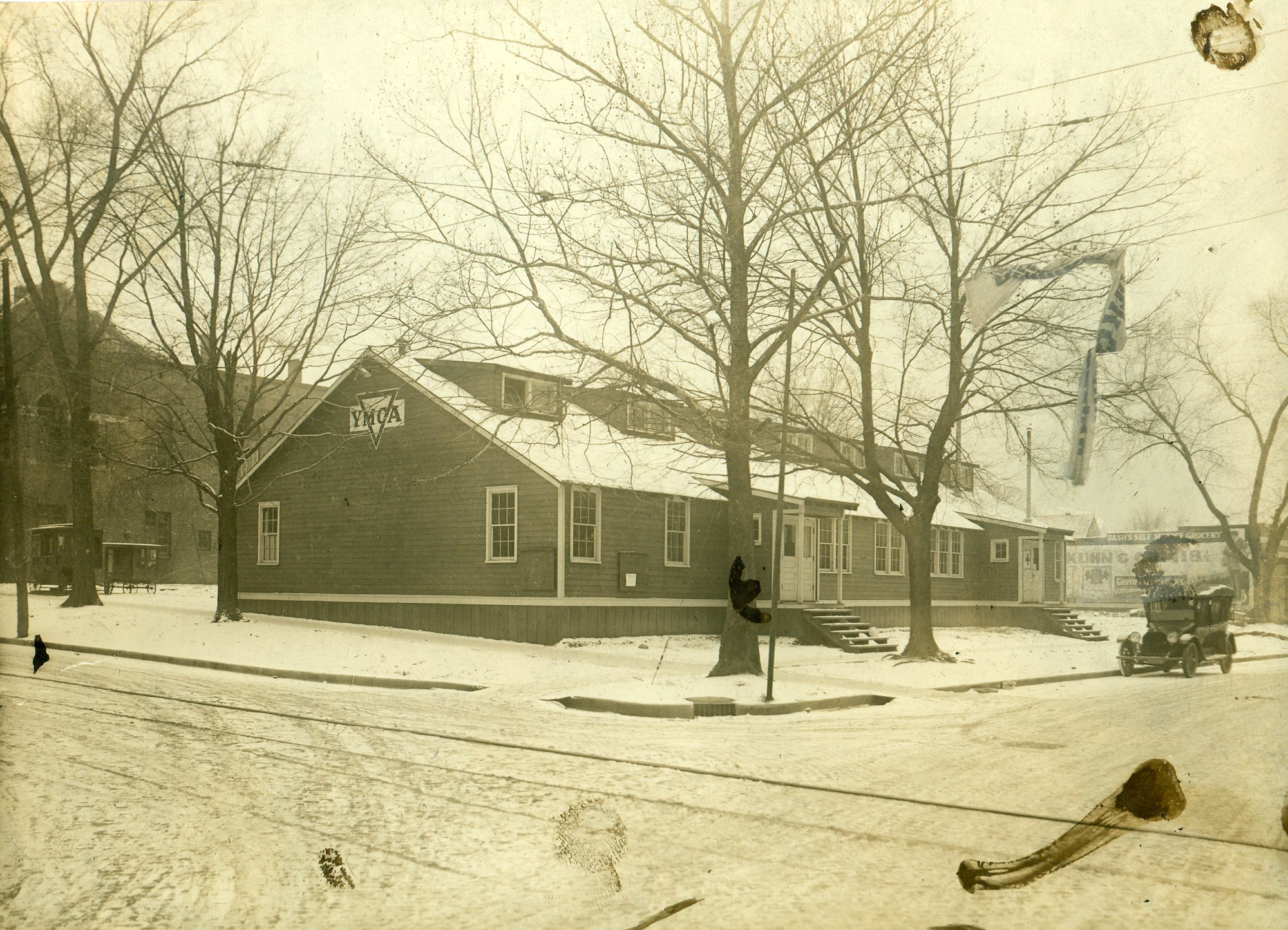
The Hut at Wright and Green streets, the Y's home from 1919 until it burned in December 1923. Mic Coldwell remembered hundreds of students lining up here for jobs.

The years after the war were the busiest yet. Mic Coldwell, who "had full charge" of student employment from 1919, worked from the Hut, where "literally hundreds of students used to line up … for jobs at thirty cents an hour."491 In November 1919 the general secretary, Henry Wilson, reported that more than 700 men had applied that fall. A third found permanent jobs and as many again temporary work, and it "took all the ingenuity possessed by several well-qualified canvassers to open up new sources of employment."5051 In 1919–20, up to April 1, 1,101 students earned $86,770 through the bureau.40 When jobs were short, as in the fall of 1922, Coldwell asked students who could manage without work to leave the jobs to those who could not, and the bureau served "the neediest first."52

After the Hut burned, the office moved to Hughes Hall on Green Street and in 1924 to its old quarters in Association Hall, which by then was the Illini Union building.4753 There Ernest R. Hilgard, a recent graduate and later a distinguished psychologist, ran the employment office in 1924–25. In his first semester it found 1,008 jobs, "probably the largest number of jobs ever secured by the Y in any one term."5354

The Employment Committee, 1926–1932

In 1926 J. G. "Jack" Cattron became employment secretary and rebuilt the student committee. It grew to 35 and then 40 working students, who for the first time did most of the job-finding themselves.5556 They canvassed the towns for jobs and met once a week to compare notes and keep the job list up to date. Someone was at the desk from 8 in the morning until 6 at night, six days a week.56

Each applicant filled in a card with his class schedule, the kinds of work he wanted and had done, and his finances. The employment secretary interviewed him before sending him out. Students could sign up a week ahead to work a day, a half day or a weekend.56 Most jobs were odd and temporary: washing windows, cleaning blackboards, gardening, cutting wood, tending furnaces, and painting beehives (with, as one list noted, the "bees not at home"). The most prized were dishwashing or waiting tables in exchange for meals.57581

There were always more applicants than jobs, so the committee screened for need.56 The Y's report for 1926–27, Working His Way, said that 150 students who did not need full-time work had given it up "in order that more needy men might have them."58 That year the bureau found 3,342 jobs for 962 students, who earned more than $140,000.5955 The Y's retiring president, A. M. Rubeck, called the Employment Committee "the outstanding development" of the year.55

In 1928 the Y published a brochure, What Price Education — A Story of Eight Boys Who Work. One of them, Ken Schlusser, had been on his own since he was 13 and came to the University with $200, his life's savings. The committee found him a meal job, another job to pay for his room, and odd jobs at 40 cents an hour, and he graduated.6056

That August the Y moved into two frame houses on its building site at Wright and Chalmers. The employment office was on the second floor of 1001 S. Wright, with a waiting room beside it.61 In 1928–29 the bureau broke all its records: 1,254 students, 4,118 jobs, and more than $200,000 in earnings.6263
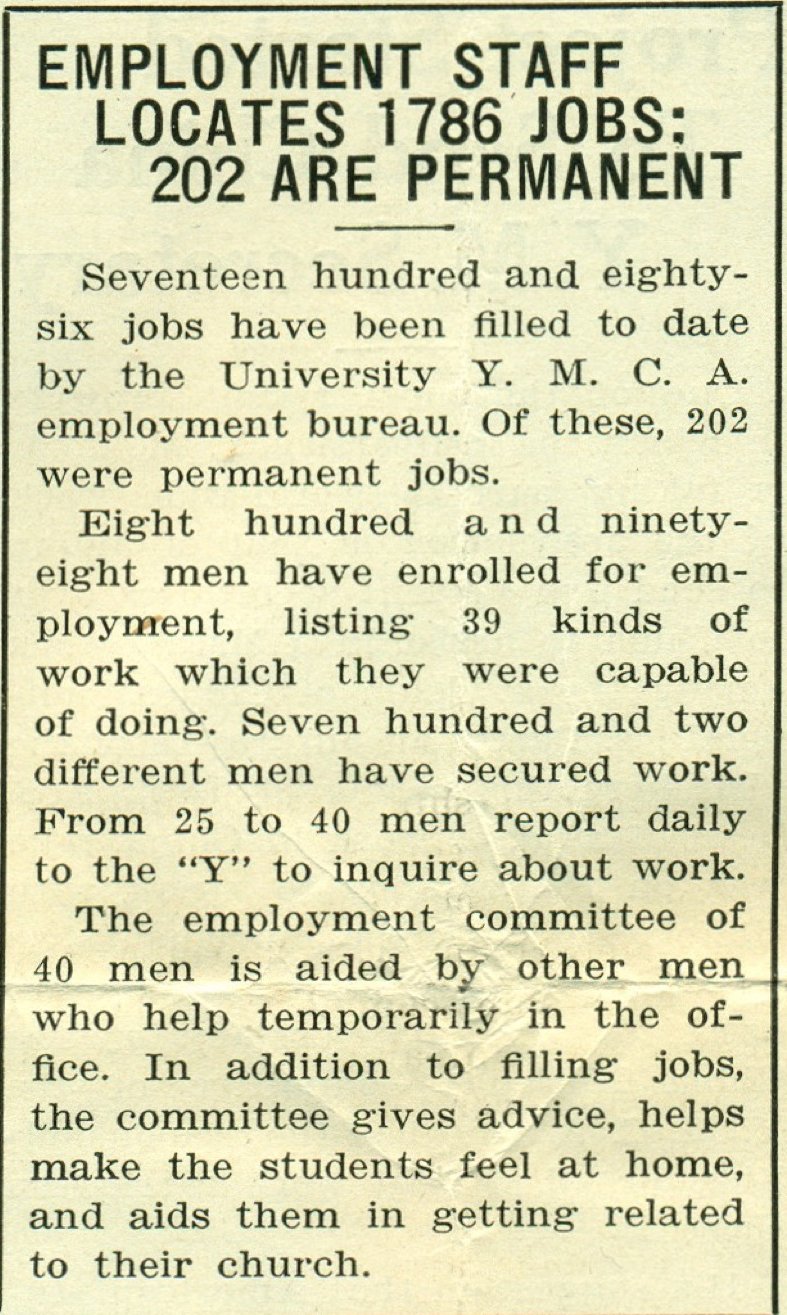
"Employment Staff Locates 1786 Jobs," The Y's Indian, Nov. 20, 1929. The committee of 40 students "gives advice, helps make the students feel at home, and aids them in getting related to their church."

Cattron left in the summer of 1929. His successor, Dwight F. Bracken, was an Illinois alumnus who had served on the Y's cabinet as a student and then spent several years in YMCA work in Colombo, Ceylon.6465 The Depression came with him. Fewer townspeople could afford to hire help, and in 1930–31 the committee decided that unemployed local family men should have preference over students.66 By Sept. 10, 1931, the bureau had 552 applications, against 150 on the same date a year earlier.67 That winter the committee persuaded employers to keep their student workers, and kept "at least 87 known men in school."68
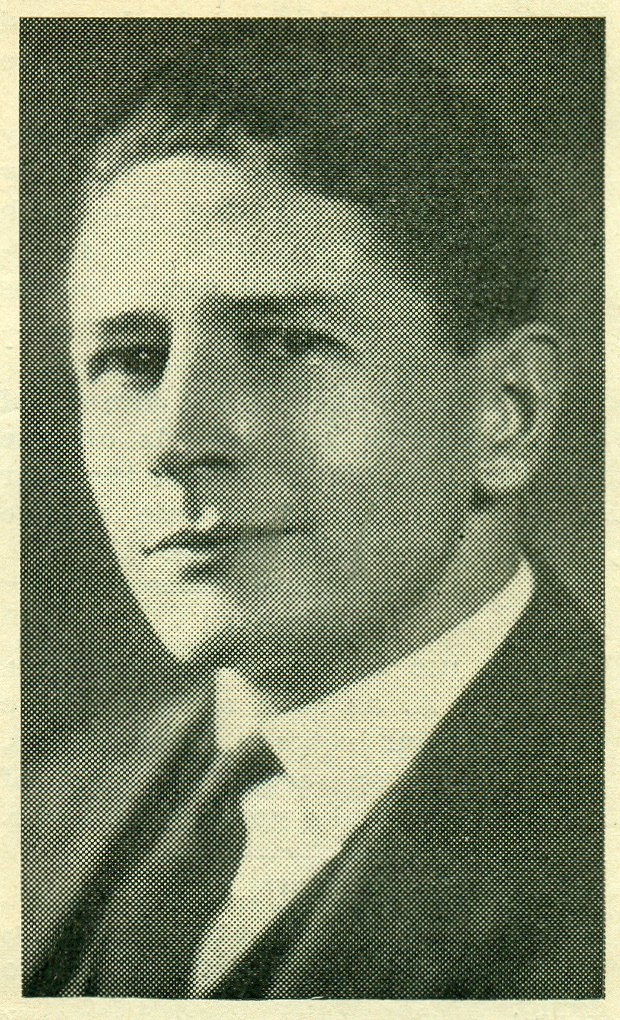
Dwight F. Bracken, the Y's employment secretary from 1929 and the University's first director of student employment, 1932–37. From The Y's Indian, Sept. 5, 1929.

Achievements

For more than 30 years the Student Employment Bureau was the main way Illinois students found work. In 1926 it was still "the only employment bureau for needy men students on the Illinois campus."69 Cattron's three years alone gave 11,123 jobs to 3,866 students, who earned some $590,000.64

The Y counted its success in students kept in school. In 1915–16 it found 740 jobs, and "one hundred thirty boys were actually kept in school by such employment."70 In 1920 the Daily Illini credited the bureau with keeping some 500 men in classes.71 Coldwell could say in 1919, "To my knowledge no student has returned home because he was unable to find work."72

The bureau set the rules that student employment at Illinois long kept: no fees, the neediest first, fair pay and fair hours. The University's own office kept them after 1932, assigning work by need and ability "rather than the order of application."73

It was also the seed of a University service. "Thus the YMCA spawned the University Employment Service and the University Housing Division," Hannah wrote. "These activities … would no doubt have been born without the intervention of the Y, but the Y led the way."74

Many of its student leaders went on to distinguished careers. Coldwell named several, among them W. C. Rappleye, the committee's chairman in 1912 and later dean of medicine at Columbia University.7421

Changes and ending

The University's share in the work grew over the years. It joined the bureau in 1913, and by 1928 an assistant dean of men, G. Herbert Smith, was placing more than 125 students a year from his own office. "It is true that the Young Men's Christian Association does a good part of this," Dean Clark wrote.75 In October 1931, with applications at a record, a Daily Illini editorial called for a single University job exchange.76

In the summer of 1932 the University took the work over. Its budget for 1932–33, adopted on July 13, named "D. F. Bracken, Assistant Dean of Men (in charge of employment)." Dean of Men Fred H. Turner announced the appointment on July 23, and Bracken began on Aug. 1.7778 The office moved from the Y to the dean of men's office in the Administration Building. In former years, the Daily Illini explained, it "was located in the University Y.M.C.A. building and was operated jointly by the University and the Y, with Mr. Bracken as the director."79 The University called it its "first official employment office."80 In its first year it served 989 students, with 354 permanent and 4,009 temporary jobs.81

The Y's paper said the University had taken the work over "in part." The Y's student committee, under A. H. Malo, was to keep canvassing for jobs in cooperation with the new office, "in maintaining the elements of service and individuality in employment work."9 That committee is not heard of after 1932–33.82 Hannah writes that the Y leadership understood the change was inevitable, but worried that at the University "concern for the individual would be less and the whole program would become impersonal."74
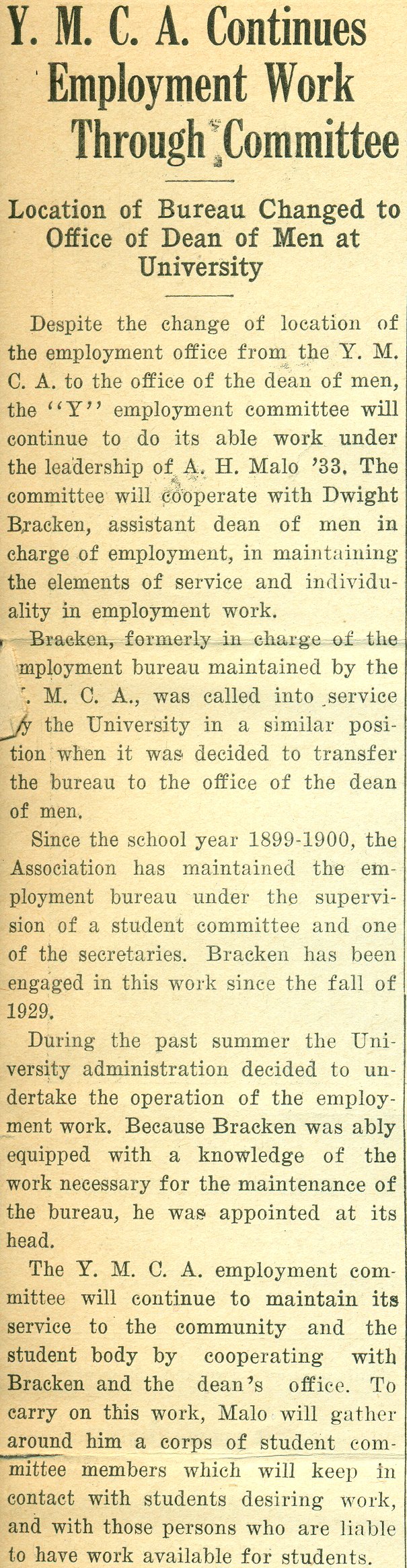
"Y. M. C. A. Continues Employment Work Through Committee," The Y's Indian, September 1932: the bureau moves to the office of the dean of men.

Bracken ran the University's office until 1937. He added the federal student work programs of the New Deal, FERA and then NYA, and helped more than 7,200 students to some 23,100 jobs before leaving to start a placement bureau at Fordham University.8384 His successor, Gerald W. Peck, had been his chief clerk.83 The office came under the Dean of Students in 1943, and by 1949 the Office of Student Employment was in Illini Hall, the building the Y had put up in 1908.8586 Student employment at Illinois is run today by the Office of Student Financial Aid.87

The Y kept pointing students to the University's office; in 1938 its freshman paper sent them to the "Student Employment Office at 236 Student Center."88 It returned to job-finding in a new form in the 1970s, when its Youth Service Clearinghouse ran a Youth Employment Project and then Youth Employment Supportive Services for young people in Champaign-Urbana.8990

People

  • W. E. Durstine (general secretary in 1896), W. W. Dillon (1898–1900) and Philip A. Conard (1900–04), the general secretaries who ran the first job service.3712
  • Student directors of the bureau, among them A. M. Dunlap (1902–04), Stanley P. Farwell (1906–07), W. K. Galeener (1910–11) and W. C. Rappleye (1912–13).20912221
  • Lloyd C. Douglas, the Y's secretary who made the bureau a staffed department in 1913, later the author of The Robe.28
  • Ben S. Fisher, the bureau's first full-time manager, 1913–14.30
  • Employment secretaries: Leslie G. George (1914–15), A. Ledru Bevis (1915–16), Willard O. Wilson (1916–17), Lyman C. McCaskill (1917–18) and Ambrose A. Arnold (1918–19).36
  • M. I. "Mic" Coldwell, who had charge of employment from 1919 to 1926 and stayed on the Y's staff for many years after.4992
  • Ernest R. Hilgard, the Y's president in 1923–24, who ran the employment office in 1924–25.5354
  • J. G. "Jack" Cattron, employment secretary 1926–29, who built the student Employment Committee.5564
  • Dwight F. Bracken (1897–1980), the Y's employment secretary 1929–32 and the University's first director of student employment, 1932–37.7893
  • Student chairmen of the Employment Committee, among them G. A. Hardacre, Paul McCluer, Walter E. Bonness, W. F. Gerdes, J. W. Ferguson, L. B. Askin, Adolph A. Klautsch and A. H. Malo (1920–33).9495929
  • Henry Wilson, general secretary 1916–1946. He told the Board in 1928 that the bureau was worth keeping only if it cared for students' personal needs; if it came down to passing out jobs "in a perfunctory way," the Y "could save time and money by giving it up."96
  • Thomas Arkle Clark and Fred H. Turner, deans of men, who supervised the joint bureau and then took it into the University.3378

Remembered

"Literally hundreds of students used to line up in the old 'Green Hut' … for jobs at thirty cents an hour, and it was a cause for rejoicing when we got it up to thirty-five cents per hour." One young man Coldwell sent to wax the floors of Dean Clark's house later wrote that the experience helped him win the Johnson Wax advertising account. — Mic Coldwell, recalling the early 1920s, in Hannah174

"My year as Secretary was spent primarily in the old Illini Union Building where I was in charge of the employment office." — Ernest R. Hilgard, in Hannah53

"Many students are reluctant to tell of their financial worries when there is a long row of students waiting their turn." — the Daily Illini, on the office's move to a private room, 191544

"More romance is crowded into these brief incidents than one finds usually in fiction." — What Price Education, the Y's 1928 brochure on eight working students56

"Help me get a board job and I will stretch what money I have out far enough to get through." — a student at the employment desk, as the Y's Indian reported it, 192963

"If a student takes a job which he does not need he will force some other student to go home." — Dwight F. Bracken, 193097

"When did you have your last meal?" — one job seeker to another in Bracken's waiting room, 193280

Sources

  1. Hannah, p. 28.
  2. "Y.M.C.A. Farewell Meeting," The Illini, June 8, 1892. https://idnc.library.illinois.edu/?a=d&d=DIL18920608.2.15
  3. "Association Notes," The Illini, Sept. 25, 1896. https://idnc.library.illinois.edu/?a=d&d=DIL18960925.2.15
  4. Champaign Daily Gazette, Sept. 23, 1896, p. 1. https://idnc.library.illinois.edu/?a=d&d=CDG18960923-01.1.1
  5. Peters, p. 25.
  6. Champaign Daily News, Sept. 8, 1897, p. 5. https://idnc.library.illinois.edu/?a=d&d=CDN18970908.1.5
  7. "Give the Boys a Chance," Champaign Daily News, Sept. 8, 1898, p. 1. https://idnc.library.illinois.edu/?a=d&d=CDN18980908.1.1
  8. "Students Want Work," Champaign Daily News, Aug. 29, 1899, p. 11. https://idnc.library.illinois.edu/?a=d&d=CDN18990829.1.11
  9. "Y. M. C. A. Continues Employment Work Through Committee," The Y's Indian 13, no. 1 (Sept. 1932): 4; and "Employment," p. 2.
  10. "The Y.M.C.A. House," The Illini, Oct. 9, 1899. https://idnc.library.illinois.edu/?a=d&d=DIL18991009.2.19
  11. "Growth of the Y.M.C.A.," Daily Illini, March 18, 1906. https://idnc.library.illinois.edu/?a=d&d=DIL19060318.2.41
  12. "Y.M.C.A. Work of September and October," The Illini, Nov. 5, 1900. https://idnc.library.illinois.edu/?a=d&d=DIL19001105.2.2
  13. Champaign Daily News, Aug. 26, 1901, p. 4. https://idnc.library.illinois.edu/?a=d&d=CDN19010826-01.1.4
  14. "Business Announcements," Champaign Daily News, Oct. 31, 1901, p. 7. https://idnc.library.illinois.edu/?a=d&d=CDN19011031-01.1.7
  15. Champaign Daily News, Aug. 28, 1901, p. 4, quoting the Chicago Tribune. https://idnc.library.illinois.edu/?a=d&d=CDN19010828-01.1.4
  16. University of Illinois, Annual Register, 1901–1902, "Christian Associations." https://archive.org/details/annualregister19011903univ
  17. The Intercollegian 22, no. 2 (Nov. 1899): 45–46. https://archive.org/details/sim_intercollegian_1899-11_22_2/page/n16
  18. "The College Y.M.C.A.," The Illini, April 7, 1899. https://idnc.library.illinois.edu/?a=d&d=DIL18990407.2.4
  19. The Illio 1904 (vol. 10), Y.M.C.A. officers. https://archive.org/details/illio1904univ/page/n254
  20. The Illio 1905 (vol. 11), Y.M.C.A. officers. https://archive.org/details/illio1905univ
  21. Students' Handbook, University of Illinois (Y.M.C.A. and Y.W.C.A., 1912), pp. 11, 19–20. https://uihistories.library.illinois.edu/cgi-bin/rview?REPOSID=8&ID=9248
  22. "Y.M.C.A. Employment Department Finds Work," Daily Illini, April 9, 1911. https://idnc.library.illinois.edu/?a=d&d=DIL19110409.2.3
  23. "Dedication of New Y.M.C.A. Building," Daily Illini, Oct. 6, 1908. https://idnc.library.illinois.edu/?a=d&d=DIL19081006.2.1
  24. "Work of the Y.M.C.A.," Daily Illini, Jan. 14, 1903. https://idnc.library.illinois.edu/?a=d&d=DIL19030114.2.1
  25. "Y.M.C.A. Annual Report," Daily Illini, Nov. 29, 1905. https://idnc.library.illinois.edu/?a=d&d=DIL19051129.2.5
  26. Daily Illini, Sept. 20, 1911. https://idnc.library.illinois.edu/?a=d&d=DIL19110920.2.3
  27. "Student Employment," Daily Illini, Sept. 22, 1911 (editorial). https://idnc.library.illinois.edu/?a=d&d=DIL19110922.2.26
  28. "Douglas Talks of Y.M.C.A.," Champaign Daily News, Aug. 25, 1913, p. 7. https://idnc.library.illinois.edu/?a=d&d=CDN19130825.1.7
  29. "University Aids Employment Bureau," Fortnightly Notes (University of Illinois), vol. 1 (fall 1913). https://archive.org/details/fortnightlynotes13101913151915univ/page/n90
  30. "Three Hundred Desire to Work Through School," Daily Illini, Sept. 23, 1913. https://idnc.library.illinois.edu/?a=d&d=DIL19130923.2.5
  31. Champaign Daily Gazette, Sept. 18, 1913, p. 3. https://idnc.library.illinois.edu/?a=d&d=CDG19130918-01.1.3
  32. Thomas Arkle Clark and Arthur Ray Warnock, Facts for Freshmen Concerning the University of Illinois (1914). https://archive.org/details/factsforfreshmen1914clar
  33. Thomas Arkle Clark, Facts for Freshmen Concerning the University of Illinois (1916). https://archive.org/details/factsforfreshmen00clar
  34. "Student Labor," Daily Illini, April 11, 1916 (editorial). https://idnc.library.illinois.edu/?a=d&d=DIL19160411.2.18
  35. "[Departments Offer Work to Students]," Daily Illini, Sept. 24, 1919. https://idnc.library.illinois.edu/?a=d&d=DIL19190924.2.48
  36. Champaign Daily News, Sept. 12, 1914, p. 3; Daily Illini, Feb. 11, 1915; Sept. 24, 1916; May 29, 1917; The Illio 1922, senior biographies. https://idnc.library.illinois.edu/?a=d&d=DIL19150211.2.54
  37. "Too Late to Classify," Daily Illini, Sept. 30, 1914. https://idnc.library.illinois.edu/?a=d&d=DIL19140930.2.15
  38. "Against Students Working," Daily Illini, Sept. 26, 1914. https://idnc.library.illinois.edu/?a=d&d=DIL19140926.2.52
  39. "Y.M. Employment Bureau Issues Uniform Wage Scale," Daily Illini, March 6, 1917. https://idnc.library.illinois.edu/?a=d&d=DIL19170306.2.36
  40. "Odd Job Supply Exceeds Demand," Daily Illini, May 6, 1920. https://idnc.library.illinois.edu/?a=d&d=DIL19200506.2.9
  41. "Y.M.C.A. Answers Call of 440 Men Seeking Jobs," Daily Illini, Sept. 29, 1920. https://idnc.library.illinois.edu/?a=d&d=DIL19200929.2.12
  42. "Three Sororities Are Guilty of Imposing on Employees," Daily Illini, Jan. 11, 1916. https://idnc.library.illinois.edu/?a=d&d=DIL19160111.2.26
  43. Daily Illini, Oct. 7, 1919. https://idnc.library.illinois.edu/?a=d&d=DIL19191007.2.40
  44. "Y.M.C.A. Employment Bureau Moves to New Apartments," Daily Illini, Feb. 11, 1915. https://idnc.library.illinois.edu/?a=d&d=DIL19150211.2.54
  45. "University Y.M.C.A. to Be Remodeled," Urbana Daily Courier, July 3, 1915.
  46. "'Y' in Hut Quarters Opens Biggest Year," Daily Illini, Sept. 24, 1919. https://idnc.library.illinois.edu/?a=d&d=DIL19190924.2.35
  47. "Open Temporary 'Y' Headquarters," Daily Illini, Dec. 23, 1923. https://idnc.library.illinois.edu/?a=d&d=DIL19231223.2.6
  48. Daily Illini, April 7, 1920 (editorial). https://idnc.library.illinois.edu/?a=d&d=DIL19200407.2.31
  49. Champaign Daily News, Aug. 9, 1919, p. 3. https://idnc.library.illinois.edu/?a=d&d=CDN19190809.1.3
  50. Hannah, p. 40, quoting Henry Wilson in The Intercollegian, Nov. 1919.
  51. Henry E. Wilson, "Starting on High," The Intercollegian 37, no. 2 (Nov. 1919): 8. https://archive.org/details/sim_intercollegian_1919-11_37_2/page/n7
  52. Daily Illini, Sept. 19, 1922. https://idnc.library.illinois.edu/?a=d&d=DIL19220919.2.2
  53. Hannah, p. 57, quoting a letter from Ernest R. Hilgard.
  54. "'Y' Got Students 1008 Jobs During First Semester—Hilgard," Daily Illini, Jan. 30, 1925. https://idnc.library.illinois.edu/?a=d&d=DIL19250130.2.28
  55. A. M. Rubeck, President's report for 1926–27, with the General Secretary's report of Oct. 1, 1927, YMCA Board of Directors minutes, 1927–28 (University of Illinois Archives, RS 41/69/320).
  56. Hannah, p. 50.
  57. Peters, p. 60.
  58. Peters, p. 61, citing Working His Way, Annual Report of the University YMCA Employment Department, 1926–27.
  59. Daily Illini, June 9, 1927. https://idnc.library.illinois.edu/?a=d&d=DIL19270609.2.7
  60. Hannah, p. 49.
  61. "To New Site," Daily Illini, Aug. 2, 1928. https://idnc.library.illinois.edu/?a=d&d=DIL19280802.2.9
  62. Daily Illini, April 30, 1929. https://idnc.library.illinois.edu/?a=d&d=DIL19290430.2.7
  63. "Employment Bureau Aids Needy Men" and "Statistics Reveal Wide Scope of University Y. M. C. A.," The Y's Indian 10, no. 2 (Sept. 24, 1929): 1.
  64. "Employment Bureau Head Will Assume New Duties," Daily Illini, Aug. 6, 1929. https://idnc.library.illinois.edu/?a=d&d=DIL19290806.2.21
  65. The Y's Indian 10, no. 2 (Sept. 24, 1929): 2.
  66. Frederick Worden, "Job Scarcity, Yet 'Y' Finds Student Work," The Y's Indian 11, no. 2 (Jan. 15, 1931): 1.
  67. "Students Rush Y Employment Bureau for Jobs," Daily Illini, Sept. 10, 1931. https://idnc.library.illinois.edu/?a=d&d=DIL19310910.2.20
  68. "Employment Committee Keeps Men in School," The Y's Indian 12, no. 4 (Feb. 1932): 1.
  69. "Y.M.C.A. Warns Students Who Work for Good Time," Galena Daily Gazette, Sept. 18, 1926, p. 3. https://idnc.library.illinois.edu/?a=d&d=GG19260918-01.1.3
  70. "Y.M.C.A. Employment Bureau Asks Positions," Champaign Daily News, Sept. 16, 1916, p. 9. https://idnc.library.illinois.edu/?a=d&d=CDN19160916.1.9
  71. Daily Illini, Sept. 30, 1920 (editorial paragraphs). https://idnc.library.illinois.edu/?a=d&d=DIL19200930.2.42
  72. "Y Meets Problem of Student Work," Daily Illini, Oct. 3, 1919. https://idnc.library.illinois.edu/?a=d&d=DIL19191003.2.63
  73. University of Illinois, Annual Register, 1936–1937, "Student Employment," p. 92. https://archive.org/details/annualregister193637univ
  74. Hannah, p. 29.
  75. Thomas Arkle Clark, The Organization of the Office of the Dean of Men (University of Illinois, 1930), p. 6. https://uihistories.library.illinois.edu/cgi-bin/rview?REPOSID=8&ID=9483
  76. "Aid for the Job Hunter," Daily Illini, Oct. 30, 1931 (editorial). https://idnc.library.illinois.edu/?a=d&d=DIL19311030.2.87
  77. University of Illinois Board of Trustees, minutes, July 13, 1932 (1932–33 budget), p. 10. https://www.trustees.uillinois.edu/trustees/minutes/1932/1932-07-13-uibot.pdf
  78. "Dwight Bracken to Help Students Find Employment," Daily Illini, July 24, 1932. https://idnc.library.illinois.edu/?a=d&d=DIL19320724.2.11
  79. "Uni Employment Office Finds 195 Jobs: 878 Apply," Daily Illini, Sept. 13, 1932. https://idnc.library.illinois.edu/?a=d&d=DIL19320913.2.22
  80. Daily Illini, Oct. 16, 1932 (profile of Dwight F. Bracken). https://idnc.library.illinois.edu/?a=d&d=DIL19321016.2.78
  81. Daily Illini, Aug. 11, 1933. https://idnc.library.illinois.edu/?a=d&d=DIL19330811.2.7
  82. The Illio 1933 (vol. 40), Office of the Dean of Men and Y.M.C.A. pages. https://archive.org/details/illio193340univ
  83. "Bracken Resigns; Peck Appointed," Daily Illini, Oct. 3, 1937. https://idnc.library.illinois.edu/?a=d&d=DIL19371003.2.24
  84. Chicago Daily Tribune, Nov. 1, 1937, p. 30. https://archive.org/details/per_chicago-daily-tribune_1937-11-01_96_261
  85. "Turner Named Dean of Students," Daily Illini, Sept. 1, 1943. https://idnc.library.illinois.edu/?a=d&d=DIL19430901.2.2
  86. Facts for Freshmen Concerning the University of Illinois, 1949–50. https://archive.org/details/factsforfreshmen4950clar
  87. University of Illinois Archives, Student Affairs, Student Employment and Student Financial Aids record series (RS 41/4), box lists. https://files.archon.library.illinois.edu/uasfa/4104001.pdf
  88. "Campus Jobs for Needy Illini Only," The Y's Indian 19, no. 1 (Sept. 1938): 3.
  89. Peters, p. 134.
  90. Peters, p. 135.
  91. The Illio 1908 (vol. 14), Y.M.C.A. officers. https://archive.org/details/illio1908univ/page/n306
  92. The Illio 1932 (vol. 39), Y.M.C.A. https://archive.org/details/illio193239univ/page/n333
  93. McLean County Museum of History, Bracken Family Collection, finding aid. https://mchistory.org/research/finding-aids/bracken-family
  94. The Illio 1922 (vol. 28), "The Cabinet" (Y.M.C.A.), p. 195. https://archive.org/details/illio1922univ/page/n215
  95. The Illio 1923 (vol. 29), Y.M.C.A. cabinet. https://archive.org/details/illio1923univ
  96. Henry E. Wilson, General Secretary's report, March 14, 1928, YMCA Board of Directors minutes, 1927–28 (University of Illinois Archives, RS 41/69/320).
  97. Daily Illini, Sept. 1, 1930. https://idnc.library.illinois.edu/?a=d&d=DIL19300901.2.6

Works cited

  • Hannah, Harold W. One Hundred Years of Action: The University of Illinois YMCA, 1873–1973. Champaign: University YMCA, 1973. Read the book (PDF)
  • Peters, Scott J. The Promise of Association: A History of the Mission and Work of the YMCA at the University of Illinois, 1873–1997. Champaign: University YMCA, 1997. Read the book (PDF)
Last reviewed
October 21, 2026
At the University YMCA today

Timeline

No items found.
Know more about this program, or have photos or papers from it? Share what you know.