University YMCA · 1001 S. Wright St., Champaign, IL 61820
Visit universityymca.orgThe New American Welcome Center began with students. In 2010 and 2011 La Colectiva and the University YMCA started a Spanish-language helpline, La Línea, and the monthly meetings that became the C-U Immigration Forum. In 2017 YMCA of the USA chose the Y for its national network of welcome centers, and within five years the center had become the Y's largest program, with legal services, family case work, a countywide Welcoming Plan and help for thousands of immigrants each year.
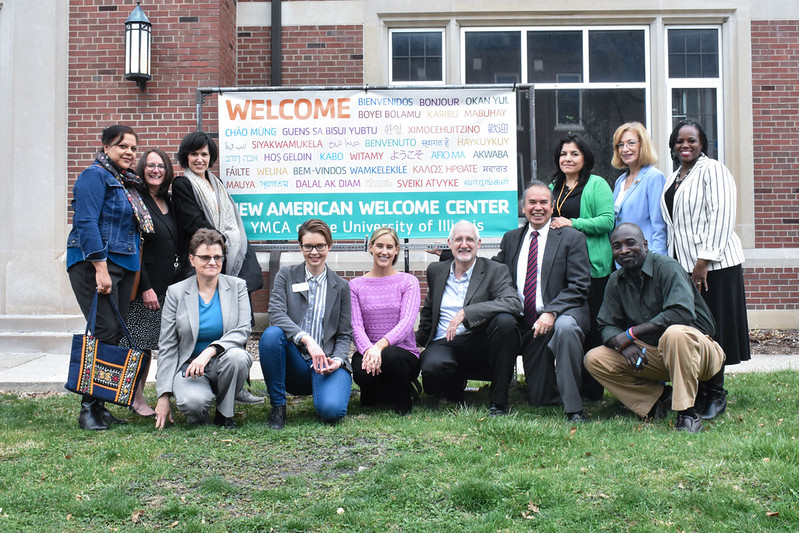
La Colectiva, a Latino student group that worked for immigrant students and for the DREAM Act, joined the University YMCA as a student program in the spring of 2010.1 Its leaders, Jesse Hoyt among them, told executive director Mike Doyle that their campus rallies felt "like a bubble": they were not connected to the immigrant families they were organizing for.2 That summer the students interviewed 30 to 40 people across Champaign County and then called a meeting in the Y's K Room. About 35 people who worked on immigration came. Doyle remembers it as the first meeting of the C-U Immigration Forum.2 The Y's own records first show such a meeting on Jan. 18, 2011, when it convened 25 people to talk about the needs of Spanish-speaking immigrants, and from 2011 it held them monthly.34
In August 2010 the Y hired Aaron Johnson-Ortiz, an AmeriCorps member placed through the Urbana-Champaign Independent Media Center, as its community engagement coordinator. His first assignment was La Colectiva.562
Johnson-Ortiz also began a telephone helpline for immigrants. In January 2011 it had five volunteers, and by early April it was answering calls.78 (The Y's later newsletters and the helpline's own website date it to 2010, when the planning began.910) In September 2011 Francisco Baires, a new AmeriCorps member, took it over, and it was relaunched as La Línea, a Spanish-language helpline run by student volunteers.1112 Its Facebook page was created on Oct. 11, 2011. Renamed in 2019, it is the New American Welcome Center's page today.13
La Línea connected callers with lawyers, clinics, food pantries, schools and other services. Students in the University's Spanish community-service courses answered the phones and called people back.14 Lisa Sink, a social worker, directed it from about 2013 to 2015.910 By 2016 it took calls in Spanish and French, kept Wednesday office hours at the Urbana Free Library, and had helped 257 people in a year.15 Its number, 217-417-5897, is still the center's helpline.10
The Forum's first campaign was against the federal "Secure Communities" program, which sent the fingerprints of everyone booked into the county jail to immigration authorities. The Y's board voted to co-sponsor a public forum, and on Dec. 1, 2011, more than 175 people filled the Champaign Public Library auditorium to hear the Forum's recommendations.16171819 In March 2012 Sheriff Dan Walsh stopped the county's participation, and by 2013 Champaign was one of 14 counties in the country with such an agreement.2021
The work grew. In 2012 the Y trained more than 50 volunteers to help about 100 young people apply for Deferred Action for Childhood Arrivals (DACA). It organized an Immigrant Justice Month with a dozen congregations, joined marches for immigration reform, and was named a "Global Center of Excellence" by YMCA of the USA.2022 In 2013 the Catholic Campaign for Human Development withdrew a promised $60,000 because the Y would not leave the Illinois Coalition for Immigrant and Refugee Rights (ICIRR), which had supported marriage equality. The board voted unanimously to stay, and an ICIRR grant of $37,500 and gifts from local donors made up the loss.232425
From 2014 the C-U Immigration Forum held annual Immigrant Welcome Awards, which later became part of Welcoming Week.26 Asked in January 2015 what Champaign-Urbana lacked, Ricardo and Lisa Diaz of the Forum answered: "A welcoming center."27 In February 2016 the Y led the county's first application to the Gateways for Growth Challenge. It was not selected, but it started the conversation among the cities, the University and employers that the center would build on.2829
YMCA of the USA had begun a network of New American Welcome Centers in large cities in 2016. In December 2016 it chose the University YMCA as one of six Ys to open centers in 2017, joining 11 already open, with a $40,000 seed grant and, later, two AmeriCorps VISTA members.153031 Doyle remembers the call coming the day after the November election, during a board meeting.2 The national YMCA saw the Y, with La Línea and the Forum behind it, as a model for smaller communities.32
The center was announced at a press conference in the Y's board room on March 27, 2017, as "both a physical and virtual space" based at the Y, 1001 S. Wright St.3334 Its advisory committee included both mayors, state legislators, the University, the county's economic development corporation, faith leaders and leaders of the Latino, Congolese and Maya communities. Ricardo Diaz, a Y board member who had helped build the Forum, chaired it.3531 Gloria Yen joined the staff that April as program coordinator for immigrant services and became the center's founding director.2936 About 35 people came to the advisory committee's first meeting on April 28 and formed five working groups, one for each of the national YMCA's "pathways": language and education, economic opportunity, health and well-being, citizenship and civic engagement, and community development.37
The center's first projects came out of those working groups:
In 2020 the center trained its first Community Navigators, outreach leaders and volunteers from the Chinese, Congolese and Latino communities.49 When COVID-19 closed workplaces that spring, it became an emergency responder. The Immigrant Relief Fund, begun in April 2019 with a gift from the Chapel of Saint John the Divine, helped families who could not get federal relief. In its first months it received 236 applications asking for more than $240,000, and from March 2020 to March 2021 it paid out $293,150.495051 Calls to the helpline rose from 268 people in 2019 to 719 in 2020. The center added tutoring for immigrant children, food deliveries, census outreach and vaccine outreach with other agencies.52 In 2020 the state named it an Illinois Welcoming Center.53
The grants it secured rose from about $280,000 in fiscal 2019 to $1.3 million in 2022 and $1.7 million in 2023, and the staff grew to about 19.5455 By then the center had separate teams for immigrant family services, legal services and outreach, with community workers for the Chinese, Korean, French-speaking and Latino communities and trained interpreters in Q'anjob'al, a Maya language spoken by many Guatemalan families in the county.5657 Champaign County gave $250,000 in federal pandemic relief in 2022, later raised to $500,000, and the City of Urbana $450,000 in 2023.5758
From 2018 the center gathered the views of hundreds of immigrants and service providers through surveys and listening sessions.44 The result, the Champaign County Welcoming Plan, was released at the I-Hotel on Sept. 15, 2021.5960 It sets goals in five areas: language access, public safety, economic opportunity, citizenship and civic engagement, and health and well-being. Each has a "community of practice" of local agencies.5661 With the center's help, Champaign became Illinois' first Certified Welcoming community on Nov. 7, 2023.62
Gloria Yen left in July 2023 after six years. Akua Forkuo-Sekyere, the Y's director of student engagement, succeeded her on July 1.63 The same day the center moved from the Y building to about 3,500 square feet at Lincoln Square in Urbana, a site that clients could reach more easily by car, bus or on foot. It had opened a weekly office in Rantoul that January, which is still open.64636566
When Forkuo-Sekyere announced in December 2024 that she would leave, Ricardo Diaz became interim director.67 In February 2025 the Y's board adopted a policy on responding to immigration enforcement at its three sites.68 Francisco Baires, who had run La Línea as an AmeriCorps member and then as the Y's community programs director from 2011 to 2014, became director on July 1, 2025, with Daniela Vergara as associate director.6970
The center is still running. Its biggest changes have been of name and place. The La Línea name dropped out of use in 2019, when its Facebook page took the center's name; the helpline itself continues as part of the center's immigrant family services.1356 In 2023 the center left the Y building for Lincoln Square in Urbana.64 Its staff, which peaked at about 19, was planned at 14 positions for fiscal 2027, as federal pandemic money ended and the center relied more on state grants.55 The center's tenth anniversary is in 2027.
Mike Doyle, looking back at the Y's 150th Founders Day in 2023, traced the center to La Colectiva's students, who came to him in 2010 wanting to work with immigrant families off campus: "It all really started with those students who wanted to do something."2
Zoë Foote, the center's legal services director, told a 2021 webinar that "our immigrant helpline has been around really since 2011, when it was started by a student group at the Y called La Colectiva." It predated the welcome center, she said, and laid its foundation.78
Nick Frillman, a student in a Spanish community-service course, described his weeks on La Línea for a 2015 Y video: "I'm actually a phone operator here, so I take the hotline calls." He took calls about lawyers, food pantries and medical care and was part of the outreach team.14
Akua Forkuo-Sekyere, two months into her time as director in 2023, described the center's aim: "We co-create a community where all immigrants can thrive and flourish." She noted that people who came to volunteer had become staff members.56
At the Y's 150th anniversary in 2023, Urbana Mayor Diane Marlin said the University YMCA was now "officially known among many things as the home of the New American Welcome Center."79
.svg)