University YMCA · 1001 S. Wright St., Champaign, IL 61820
Visit universityymca.orgWhen the 26th Amendment gave 18-year-olds the vote in 1971, Champaign County's clerk still would not let most University of Illinois students register where they lived and studied. Students organized at the University YMCA formed the Coalition for Voter Registration, went to court, and lined up at the courthouse. On Jan. 26, 1972, a federal judge ruled that the county could not hold students to a separate standard, and in the next ten days 3,872 new voters registered.
The 26th Amendment, ratified on July 1, 1971, gave the vote to 18-year-olds. It did not say where a student could cast it. In Illinois the answer rested on "permanent residence." Since a 1924 case about Eureka College students, Anderson v. Pifer, the courts had presumed that a student's home was the parents' house.1 The new state constitution of 1970 left "permanent residence" for the General Assembly to define, and it had not done so.2
In a college town the stakes were plain. In the spring of 1971 Rep. Charles Clabaugh, a Champaign Republican, pushed a bill in Springfield to curb the registration of students in university communities, and the mayors of Champaign and Urbana planned to go to the capital to support it.3
In Champaign County, registration was in the hands of the county clerk, Dennis R. Bing, a Republican who had taken office in December 1970. Students who came to the courthouse in Urbana were asked whether they were students and were told to bring driver's licenses and tax records.4 Later they were also asked whether their parents supported them, whether they lived in University housing, and whether they kept bank accounts in their parents' town. Bing would not accept a student ID or a University housing contract as proof of residence.56 In September 1971 John Briggs, chairman of the Graduate Student Association, said: "It will take a lawsuit to force a modern interpretation of the residency requirements." The GSA had joined a new coalition of student voters, and "the American Civil Liberties Union and the YMCA also expressed interest and support," he said.4
The Coalition for Voter Registration (CVR) took shape at the University YMCA in the late summer and fall of 1971. In August, Jim Young, then on the Y's program staff as a conscientious objector, announced a fall drive to register young voters, led by the Center for Nonviolent Social Change, which met in the Y.7 He and student Keith Patten went from group to group at the University, at Parkland College and in town. "By the middle of October, we had a little over 40 groups," Young remembered in 2024. They met in Latzer Hall, and the Y's student program office became the coalition's working room.8
On Oct. 12, 1971, CVR announced its registration drive at a press conference at the Y. Patten was chairman and John Boyer secretary. Jim Clemans chaired the legal committee, and Young was membership chairman. The GSA gave $200 toward legal costs and the county Democratic Party $100.910 The coalition called itself nonpartisan, but no Republican group joined.11 The Y's bulletin reported that Patten and Peggy Henderson had urged the County Board of Supervisors to adopt deputy registrars, and that students would lobby the legislature in December for "a good definition of permanent residents."12
The coalition went to court and to the courthouse at the same time. On Oct. 15 it asked the Champaign County Circuit Court for writs ordering Bing to register two students: Mary Ellen Janik, whose registration had been marked "incomplete," and Richard Pope, who had been refused when he offered his University ID.13 On Nov. 18 Judge Frederic S. Green ruled for Janik on a technicality, because her application had been accepted when she made it. He ruled against Pope under the old permanent-abode cases. "I expected to lose," Pope said. "I'm disappointed, but I'm going to try to register again."2 CVR's first registration drive, Nov. 1–5, fared no better. On its first day Bing's office processed 24 students in three hours, and it turned away those with only a student ID or a nine-month housing contract.6
On Oct. 19, 1971, Jorgen Phillips went to the courthouse to register. He was a 30-year-old veteran living in Scott Hall, financially independent, with no plans to live anywhere else. Bing's office asked his age, whether he supported himself, and for proof of residence. It refused his housing contract and told him to come back with a driver's license showing a local address. Jim Clemans of CVR had gone with him. "This case only makes it too clear that the reason Bing did not register Phillips to vote is that he is a student," Clemans said.14
On Nov. 8, 1971, the American Civil Liberties Union filed a class action in the U.S. District Court at Danville. It was brought for seven University students "and all Illinois college students," and drafted with CVR over several months. The plaintiffs were Jorgen Phillips, David Gilliland, William Morrow, Brian Parker, Doug Traver, Edward Devereaux and Sidney Martin. It named Bing and Attorney General William J. Scott and challenged four of Bing's practices:15
"I think the suit goes right to the heart of the matter," Clemans said.15 On Dec. 13 Judge Henry S. Wise dropped Scott from the case. Bing testified that he used special standards for students.16
On Jan. 26, 1972, while students were away for semester break, Judge Wise ruled. "This court is of the opinion that such presumption against residency is violative of the students' right to equal protection under the law." Bing could no longer impose special requirements, questions or procedures on students. He said it was "my intention to fully comply with and abide by the court's decision in all respects," and struck the student questions from his form. CVR called the ruling "the first major victory in our efforts to open up the electoral process to young people in Champaign County."17 By Feb. 10 the clerks in Coles, McDonough and Jackson counties, home to Eastern, Western and Southern Illinois universities, had changed their own rules.18 The case, Phillips v. Bing, was never published, but a federal court in Texas cited it two months later as a case of "discriminatory misapplication of residency statutes by local officials."19
Registration had been closed since Jan. 10 for the County Board primary. It reopened on Thursday, Feb. 10, 1972, and would close again on Feb. 21, four weeks before the March 21 state primary. That left ten business days.620 On the first, Bing accepted a University ID as proof of residence, and 237 people registered, nearly all of them students. About 100 more were still in line when the office closed at 4:30. "This is my home and I am interested in what goes on here," said one of them, Michael Golubski.5 CVR ran buses from the YMCA to the courthouse, at first hourly and then without a break.621
The lines were long, and Bing would not shorten them. He refused the League of Women Voters' offer to serve as deputy registrars.5 He also refused a group of local clergy, who offered 38 volunteers and eight places on campus to register students, and the clergy picketed the courthouse. Telegrams urged him to speed up: from Lt. Gov. Paul Simon, Sen. Adlai Stevenson III and Rep. Abner Mikva, and from the McGovern and Muskie campaigns, which offered 100 volunteers.2211 "Mr. Bing seems to think that students should come down here to register at his convenience," Patten said. On Feb. 16 the ACLU went back to Judge Wise, asking him to order more registrars, longer hours and registration on campus.22
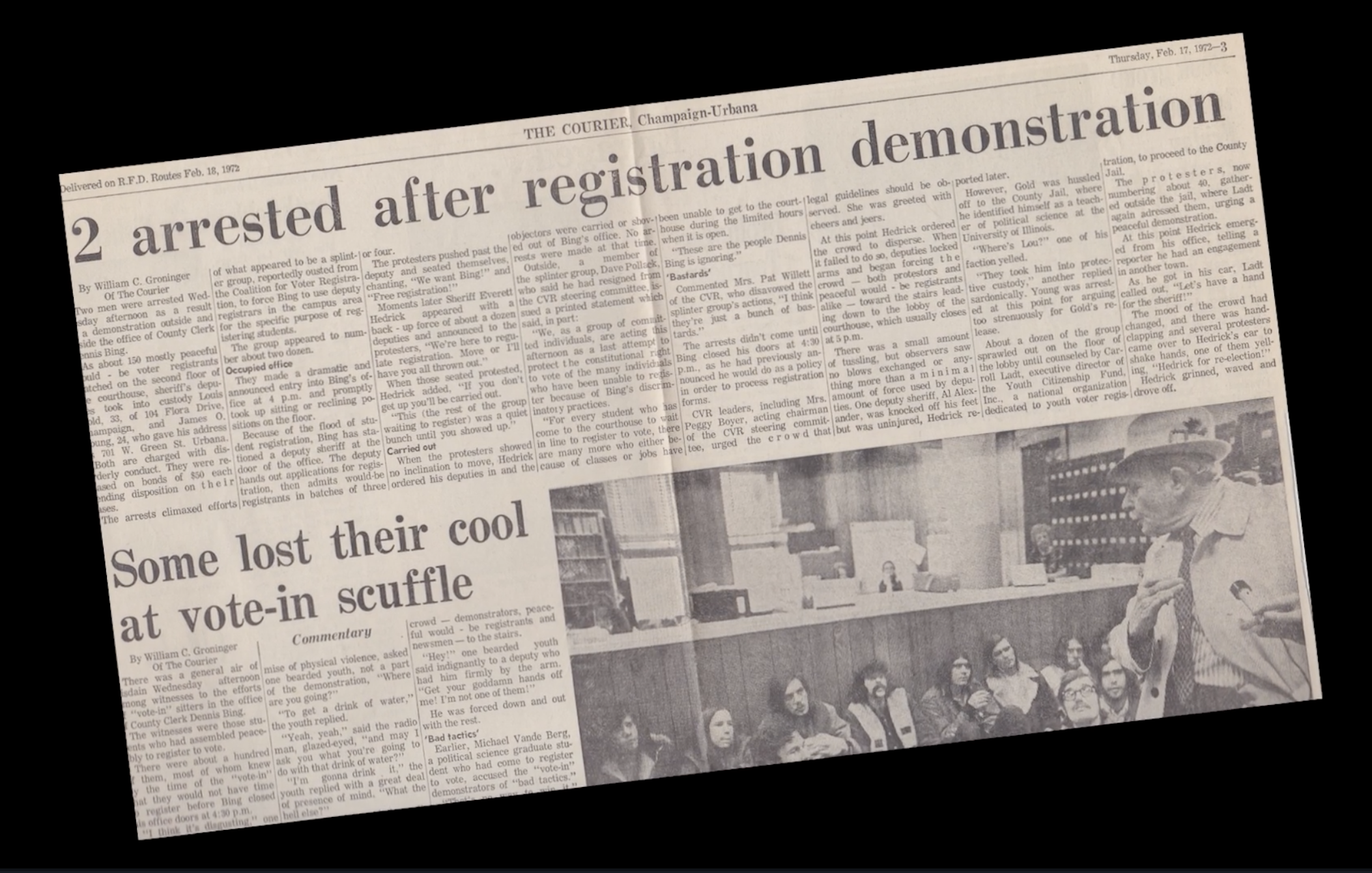
That same afternoon, Feb. 16, about 20 people sat in at Bing's office to demand registrars on campus. Young called it "a vote-in, not a sit-in." Sheriff's deputies pulled the protesters out of the office while, by Young's later count, three or four hundred students waited in line. Two were arrested for disorderly conduct as they left: Jim Young and Lou Gold, an instructor in political science. Each was released on $100 bond.238
The tactic split the coalition. Patten, Young and Howard Diamond had resigned from CVR just before the sit-in, and Peggy Boyer became acting chair. "The steering committee has voted twice not to pursue this type of action," she said. "CVR will continue to pursue legal action, which has proven to be successful."23 Young and Gold went on with a new group, People for Local Voting Rights, which kept up the pressure at the courthouse with folk songs.2425
On Feb. 18, after a three-hour hearing, Judge Wise denied the emergency motion. He found there had been "adequate time" to register and said, "I'm concerned that some people are doing this to get publicity and to get their pictures on television."20
The last day, Monday, Feb. 21, was Washington's Birthday. A student dressed as George Washington carried a sign: "My birthday wish—Keep the courthouse open." Bing let in the 130 people still in line at closing time, and a record 1,367 registered that day. In ten days 3,872 new voters had registered. Young called the late hours "a small victory for students. Next time, we're going to demand registration on campus."25
The argument over tactics went on in the Daily Illini's letters page. Kimball R. Anderson and Karen Q. Gatsis wrote to give "credit to those who deserve it." It was CVR, they wrote, "who went to court three times," who spent $700 to carry two to three thousand students to the courthouse, and who negotiated with Bing and State's Attorney Lawrence Johnson to keep the doors open on the last day. They called the sit-in "highly counter-productive." Another student, Jerry Finney, answered the paper's own editorial against the sit-in: by its reasoning, he wrote, workers, suffragists and civil rights marchers should all have waited for the courts.26 Bing wrote that he would work with CVR's "new leadership" but would never meet with Young and Gold's group. On March 2 he sent a mobile registration unit to campus. John Boyer of CVR left the last word open: "Who can separate out what good demonstrations and our negotiations did?"27
The new voters were felt at once. On April 4, 1972, Champaign County elected its first County Board, and students voted locally in numbers for the first time. "All nine of the Democrats in those three districts where a lot of students registered, won," Laurel Prussing remembered, "and I believe in two of the districts, the new votes made the difference." Prussing, later a state representative and mayor of Urbana, won her own first race by a single vote.8
That fall the coalition was back at work from its office in the YW-YMCA on Wright Street. Kimball R. Anderson, now CVR's co-director, wrote in September that "a University ID is sufficient to register to vote here in Champaign County." The coalition ran a car shuttle to the courthouse and pressed for evening and weekend hours.28 By the Nov. 7, 1972 general election Champaign County had a record 76,605 registered voters. The Daily Illini estimated that 10,000 to 12,000 of them were University students.29 In June 1973 Bing began to use deputy registrars.30 Across the country, courts were settling the same question, and in 1979 the U.S. Supreme Court let stand a ruling that students at Prairie View A&M in Texas could vote where they studied (Symm v. United States).31
The coalition worked out of the Y, but the Y itself stayed out of party politics. On Oct. 12, 1971, as the coalition was getting under way, the Y's Board adopted a policy, "The U. of I. YMCA and Controversial Issues." It urged members to debate and act on social problems. It also warned that some actions, among them partisan political support, "may not be proper for the U. of I. YMCA or its constituent programs to make or to encourage or to sponsor."32 Registering voters fit within that line. Endorsing candidates did not. That winter the Center for Non-Violent Social Change, a Y-sponsored group that Young had helped found, endorsed candidates for the County Board. "It was mutually agreed that the YMCA should no longer be its sponsor," Harold Hannah wrote in 1973, and the Center left the Y in March 1972.3332 Students for Environmental Concerns faced the same test that winter over its "Environmental Dirty Dozen" list of legislators, and agreed to find "alternative" ways to report its findings.32
In October 2023 Champaign County Clerk Aaron Ammons spoke at the Y about voting. Jim Young was in the audience, and afterward he introduced himself.8 Young later brought the clerk's office his own clippings and flyers from 1971 and 1972, so well kept, Ammons said, that there wasn't a crease on them. Ammons, born in 1971 and in 2018 the first African American elected Champaign County clerk, credited the students of the early seventies.34 "There's no way I couldn't show my appreciation for those efforts of those students in the early seventies," he said.8
His office made a film of the story, We Were Made for This: Students Organized for Change, which premiered at the Spurlock Museum on Sept. 23, 2024.35 Young, by then a Trustee of the University YMCA, walked the filmmakers through Latzer Hall and the old program office.8 On Oct. 4, 2024, he introduced Ammons at the Y's Friday Forum. Three days later the film was shown twice at the Y during a student voter registration drive.34
