University YMCA · 1001 S. Wright St., Champaign, IL 61820
Visit universityymca.orgIn 1955 a Champaign banker, Fred S. Bailey, left two-thirds of the income of his estate to the University YMCA, to be given as scholarships to "worthy moral students" at the University of Illinois. The Y made its first awards in the spring of 1957, and it has made them every year since. For half a century the Bailey Scholarship was a quiet source of financial aid for thousands of students. Since a review in 2009 it has become a program for student leaders in service and social action, with undergraduate scholarships, a graduate fellowship and awards for unpaid internships.
Fred Sumner Bailey was born in Champaign on April 19, 1871. His father, Capt. Edward Bailey, was a founder of the Champaign National Bank, which opened on Dec. 1, 1882, and its president for some 40 years.123 Fred finished Champaign High School in 1889 and went on to the University of Illinois "until failing health obliged him to leave."1 He joined his father's bank as a clerk in 1894 and became its cashier in 1905, vice president in 1909 and, in 1926, after his father's death, its president, as he remained until he died.245367
In 1901 he married Mabel Bennett. They had no children. She died in 1941 and his sisters by 1944, and when he died his only heir was a cousin.89 He was a longtime friend of Henry Wilson, the Y's general secretary from 1916 to 1946, and a longtime contributor to the Y.101112
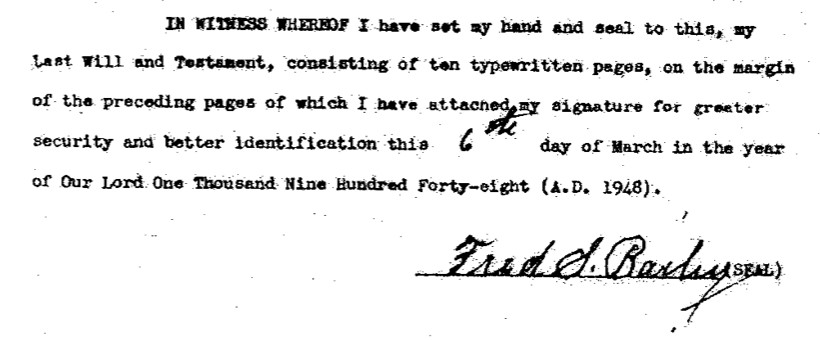
Bailey signed his will in Champaign on March 6, 1948.13 After gifts to three Champaign churches, to Bradford Junior College in Massachusetts in memory of his sister, and to friends and employees, he left the rest of his estate in trust with the Harris Trust and Savings Bank of Chicago, to be "held in perpetuity." One-third of the income went to the University of Illinois for a chair in money, banking and finance. The other two-thirds went to the "Young Men's Christian Association of the University of Illinois," to be paid out by its Board of Directors "as scholarships to worthy moral students at the University of Illinois (either undergraduate or graduate)." The scholars were to be chosen "on the basis of moral character, intelligence, leadership and scholarship," in any field of study. If the Y ever ceased to function at the University, the scholarships would pass to the University's trustees.1310
Bailey died at his home on April 27, 1955, at 84. He was buried in the family mausoleum at Mount Hope Cemetery in Urbana.614 When the will was filed that May, the gift surprised everyone. The University's president, Lloyd Morey, called it "wholly unexpected" and "a magnificent, living memorial."15 John E. Cribbet, chairman of the Y's Board of Directors, said the bequest "undoubtedly grows out of" Bailey's long friendship with Wilson.10
In February 1956 the conservator of Bailey's cousin contested the will. The University and the executors fought the suit, and in November 1956 the court dismissed it, with $1,000 for the cousin's legal fees.1617 The estate was reported at about $1,044,000, in stocks, bonds and a 230-acre farm.18 After the bank stock was sold and expenses paid, $788,928.85 and the farm passed to the trust in March 1957.1920
For years there had been rumors that Bailey would leave the Y a large gift, and some hoped it would end the Association's money troubles. It did not. The will restricted the money to scholarships, and none of it could go to the Y's programs or budget.11 "Mr. Bailey did not leave a single dollar to help the YM with its regular program and expenses," the general secretary, Harold Ingalls, told the Daily Illini in 1956.21 At first none of it could even pay the costs of running the scholarships, until the Y won a court ruling that let a share of the income cover them. The Y, Peters writes, was "simply to act as the fund's 'custodian.'"11
The Y had never had a scholarship program, and Cribbet called it "a new line of activity."10 A committee that included Cribbet, later the University's chancellor, and the law professor Robben Fleming drafted guidelines, and the Board approved them on June 25, 1956. They set a goal the program would come back to half a century later: the scholarships "shall have a special significance and shall not become just another scholarship program."22 The first check from the trust, $24,455, arrived in November 1956.22
In March 1957 Tom S. Hamilton, chairman of the Y's awards committee, announced the first Bailey Scholarships, for 27 students; 24 more followed that month.2324 That September the Y announced 69 scholarships for 1957–58, of $200 to $500 for undergraduates and $500 to $1,200 for graduate students, to students from 40 Illinois towns, four other states and seven countries.22 Counting renewals each semester, the first full year came to about 140 awards and some $34,000.2526
A committee of the Y's board chose the scholars each spring, and awards could be renewed. In 1961 the Y hired Harold W. "Hal" Colvin to run the fund. He had joined the University YMCA's staff in 1919 to lead its boys' work and came back after 42 years in YMCA work elsewhere; he was still its director in 1975, interviewing every applicant himself.27282930
Awards were made "without regard to race, creed or nationality," and each year's list included students from abroad.3132 From 1964 two special awards went to outstanding student leaders, a man and a woman, the forerunners of today's Leadership Awards.33 The Y made between 68 and 124 awards a year in the 1960s, at $17,000 to $33,000 a year.26 Hannah counted more than $30,000 available in 1972–73.34
"Funds for the scholarships never will run out," the Y's general secretary, J. Frederick Miller, told the Daily Illini in 1959. The trust was meant to last forever.35
In 1979 Ed Nestingen, who had retired as program director, came back to direct the fund part time. He ran it until August 1991.3637 David Eisenman, who had served on the Bailey committee, then directed it for 19 years, until June 2009.3839
In these years the Bailey Scholarship was above all financial aid. In the 1980s the Y made 140 to 173 awards a year, worth $80,000 to $94,000.26 By 1983 some 1,600 students had held a Bailey award.26 Applicants needed a grade average of 2.5, community involvement and family income under $50,000, and the program worked closely with the University's Office of Student Financial Aid.4041 Eisenman, the Y said later, "dramatically increased the number of minority students, particularly African Americans," among the scholars.39 Betty Earle, the Y's director of operations, was one of the scholars who had come through it: "I was able to complete my education because of this scholarship."40 But applications fell, and in 2007–08 the Y raised the top award to $3,000 and dropped its deadline to draw more students.42
In 2009 the Board of Governors set up a committee, chaired by Tom Seals, to look at the program. Its report of Oct. 21, 2009, found that Bailey had become "largely a financial aid program over the past twenty years," cut off from the rest of the Y, and it went back to the 1956 guidelines' call for something more than "just another scholarship program."22 The Board adopted its plan:2243
Kasey Umland, the Y's program director and later its associate director, took charge of the program and led it until the end of 2020.444546 The first 25 Bailey Scholars and Leaders were chosen under the new rules, and the first awards ceremony was held on Sept. 20, 2010, with University President Michael Hogan.4347 In the first online round, in the spring of 2010, more than 40 volunteers read 117 applications, most of them from students who had never applied before.43
The trust paid the Y only its dividends and interest, about 3 percent of its value by 2010, and the Y could fund only about one applicant in five.48 In 2010 it asked the trustee to convert the fund to a "total return" trust, which pays out a fixed share of its value each year. In November 2011 the YMCA and the University petitioned the Circuit Court of Cook County, and the court converted the trust, effective Jan. 1, 2011. It now pays 5 percent of its average value over the previous three years.4849
The new income paid for more scholars and for new awards:
When the pandemic closed the campus in March 2020, the Board set up emergency grants of up to $500 for scholars, paid for by gifts rather than trust income.5758 The travel award became Global Scholars, with an online course in service learning.51
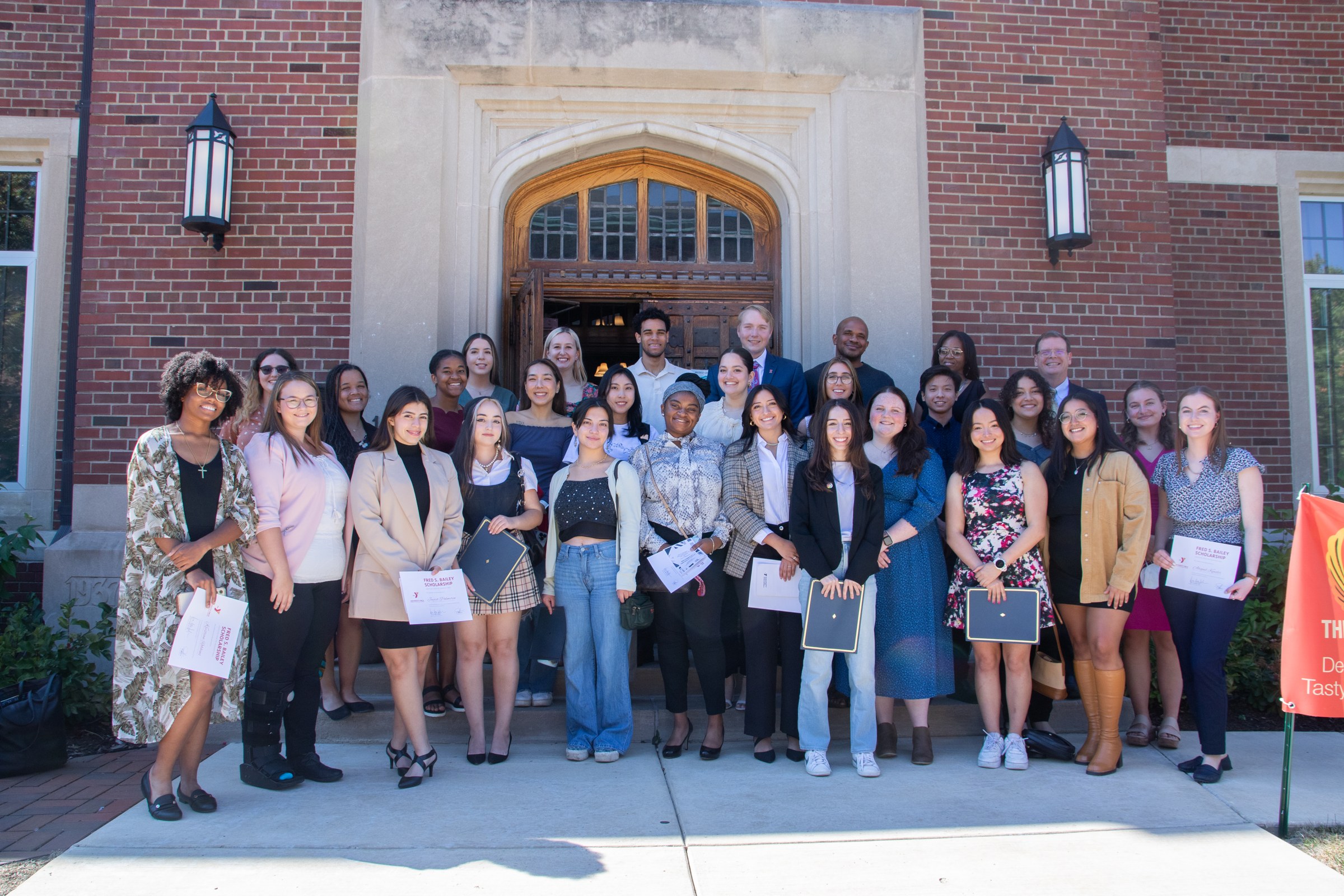
Since 2023–24 the program has made three awards: an Undergraduate Scholarship of $4,000, renewable, with a $2,000 Leadership Award added for four rising seniors; the Graduate Fellowship of $14,000; and the Unpaid Internship Scholarship of $1,500 or $3,000.5960 Volunteers read every application without names. Since 2022 a Bailey Program Steering Committee has recommended the awards to the Board of Governors.6162 In 2025–26 the Y awarded $211,000 to 46 students.63 The University's third of the trust still supports the Bailey chair in its Department of Finance.49
Since 1957 the Bailey Scholarship Program has given more than $5.5 million to more than 3,100 students.2546
In 2009 a Board committee counted it among the ten largest scholarship programs for Illinois students outside the University itself.64 From the first year its scholars included women and students from abroad, and in Eisenman's years many more Black students.226539
Since 2009 it has tied the scholarship to the Y's mission. Scholars take part in leadership workshops and service, and former scholars have come back as readers, committee chairs, board members and staff. In 2024 the chair of the Board of Governors and the staff director who oversees the program were both Bailey alumni.555666
The Bailey Scholarship Program has never ended. Its main changes:
The trustee is now BMO Private Bank, the successor of Harris Trust.49 The Y plans to mark the 70th anniversary of the first awards in 2027.67
When Bailey's will was read in 1955, John Cribbet said the Y's board was "deeply gratified by Mr. Bailey's confidence in the Association."10
The trust's banker, W. O. Heath of Harris Trust, praised the University in 1956 for fighting the will contest "for a principle and not rushing in to settle a shakedown."18
"I was able to complete my education because of this scholarship," Betty Earle told the Daily Illini in 2002. David Eisenman said of another former scholar that "the Bailey Scholarship really made a bet on her."40
Kasey Umland, at the 2017 reception, credited Mike Doyle with the effort to "take this little scholarship and make it more in line with our mission."45
An Unpaid Internship Scholar wrote in 2019: "My internship went above and beyond my dreams in both an educational and professional sense."69
The Bailey Scholarship Program offers undergraduate scholarships, a graduate fellowship and awards for unpaid internships each year to Illinois students who lead in service and social action.
See this year's awards.svg)