University YMCA · 1001 S. Wright St., Champaign, IL 61820
Visit universityymca.orgStudents for Environmental Concerns (SECS) began at the University YMCA in 1968, as Students for Environmental Controls, and is the oldest environmental organization at the University of Illinois. It ran Champaign-Urbana's first Earth Day teach-in, helped save Allerton Park, won scrubbers for the University's Abbott Power Plant, proposed the student fees that pay for campus sustainability, and has pressed the University to divest from coal and then from all fossil fuels. After a few years apart, SECS and the Y came back together in 2024–25.
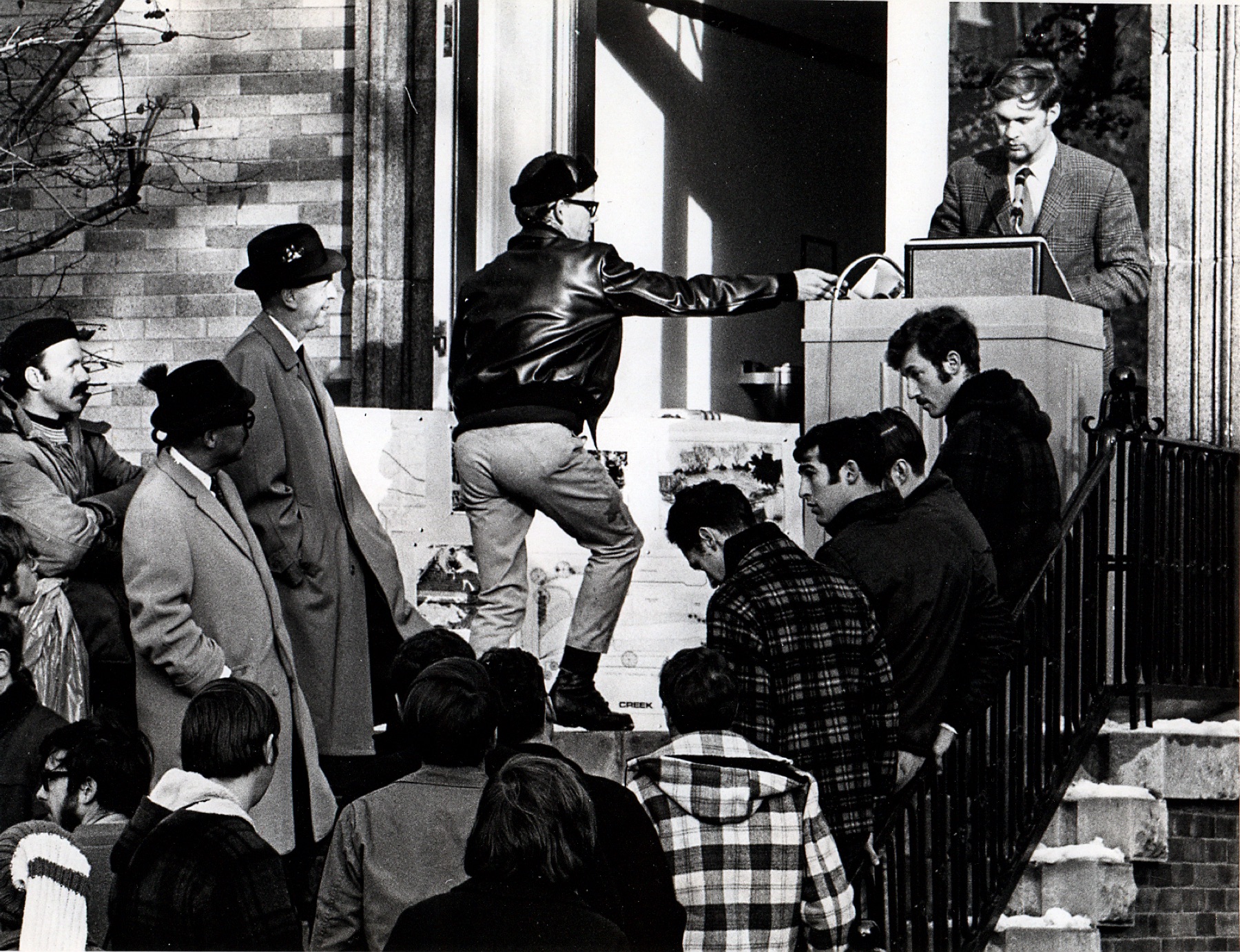
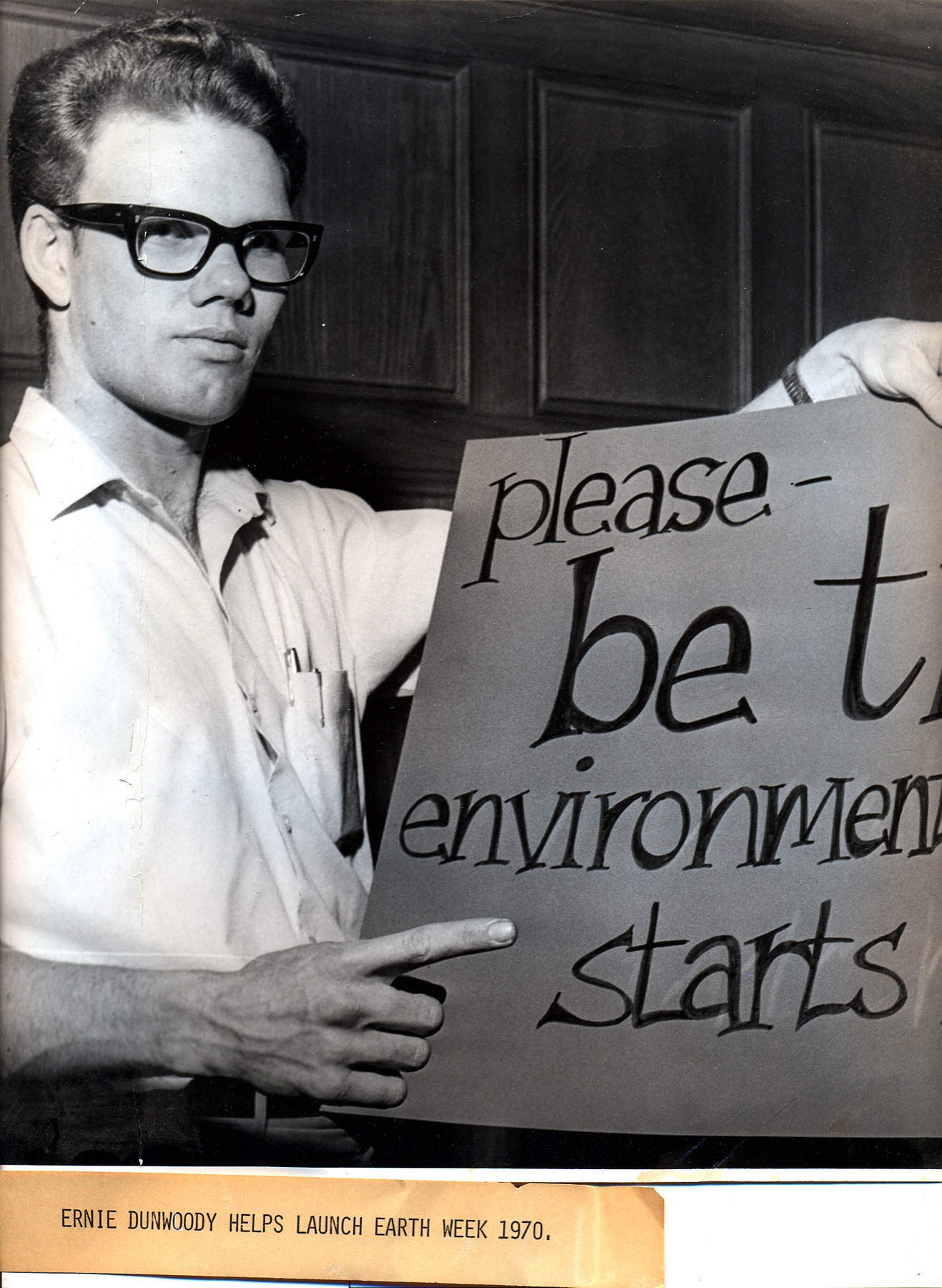
SECS began at the Y in 1968. That fall, in the Y's account, two graduate students, Herman Sievering, in atmospheric sciences, and Ernie Dunwoody, an Australian in cell biology, with an undergraduate, Don Yon, went to Ed Nestingen, the Y's program director, about organizing students to act on the environment, and he suggested they meet at the Y.123 Nestingen was with them from the start: Sievering remembered that he told them to hold a meeting and use the Y's space, and the founders worked for months from an office the Y provided.45 In 1978 the Daily Illini called Nestingen "the guiding force" behind SECS.6 Peters writes that SECS "was meant to be a vehicle for linking the campus environmental groups that existed at the time."7
The group went public in the fall of 1969, when the YMCA-YWCA Faculty Forum gave its whole season to the environment. Eight Friday lectures, "Beyond Technology: Our Human and Natural Environment," ran from Oct. 3 to Nov. 21, and Sievering led a weekly seminar on the environment at the Y alongside them.89 Students asked to meet four of the speakers in the afternoons. "Out of these meetings," the Y's 1976 history of the Forum says, "the Students for Environmental Concerns took shape and Earth Week 1970 was planned."10 Dunwoody had been organizing since August, and the first notice of "Students for Environmental Controls" called a meeting in the Y's Parr Lounge on Oct. 9, 1969.311 By December Sievering was chairman and Dunwoody vice chairman.12
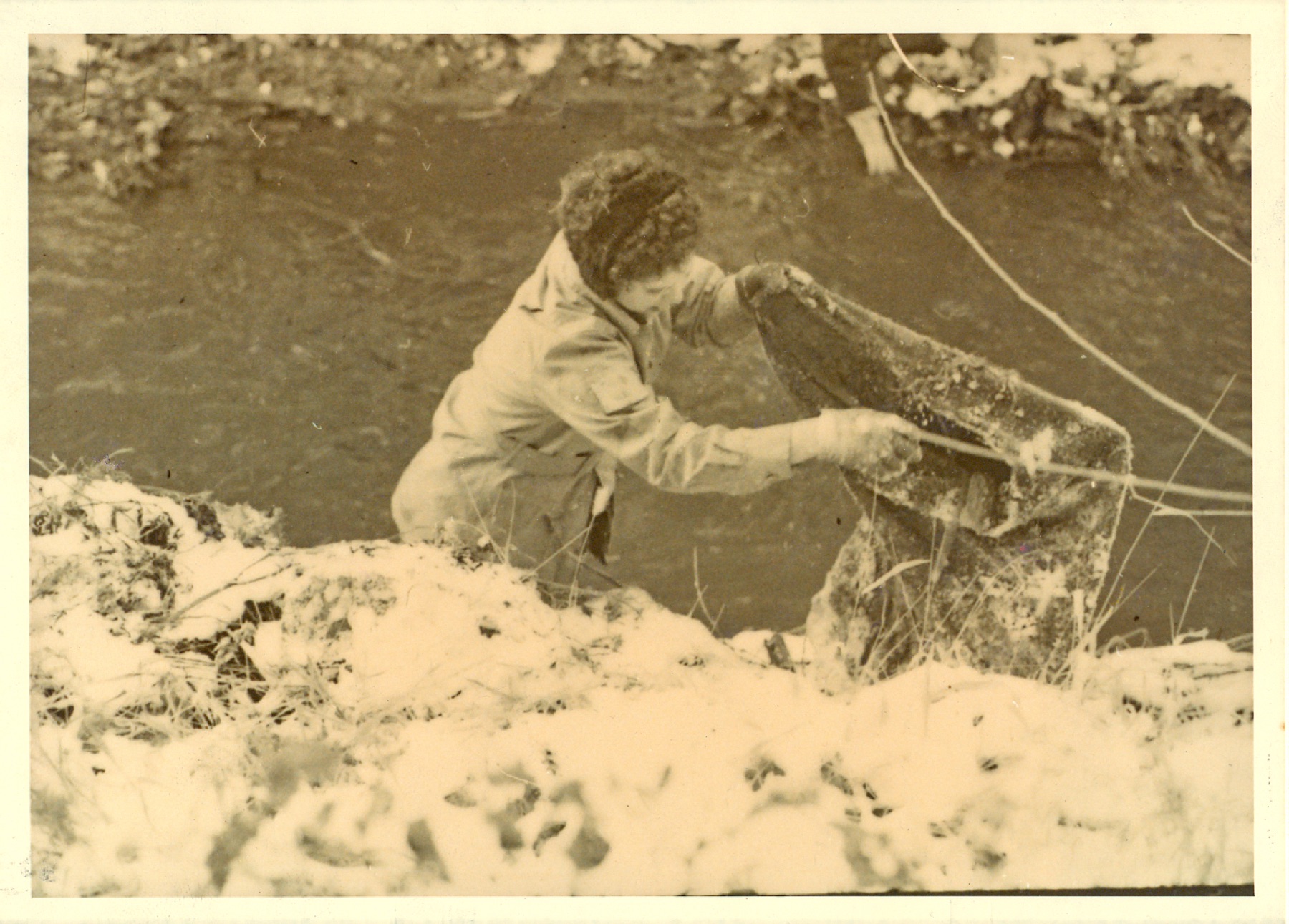
Its first act was a cleanup. On Nov. 21, 1969, the day of the series' last lecture, William Rutherford's "Conservation in Illinois," about 100 students in hip boots and wet suits waded into Boneyard Creek with engineering students of CERB, whose faculty sponsor was Bruce Hannon; both mayors came, and city and sanitary-district trucks hauled away "at least six full loads of junk."1314 Peters counts seven truckloads of tires, bedsprings and steel barrels.7
The name changed a year later. In October 1970 the Daily Illini wrote of "Students for Environmental Concerns, (SECS) formerly called Students for Environmental Controls," and the group's own papers later spelled it "ConcernS" to account for the acronym.1516 The Y has counted SECS's anniversaries from 1968, its 25th in 1993 and its 50th in 2018; SECS's websites ("Safe SECS since '69!") and the Y's 40th-anniversary note in 2009 counted from 1969, the year the group first appeared in print.211718
SECS spent its first winter preparing for the first Earth Day. It was the local sponsor of the national environmental teach-in, and its Environmental Crisis Week, April 16–24, 1970, brought 45 speakers to campus.1219 Ralph Nader, Illinois Attorney General William Scott and Alan Guttmacher of Planned Parenthood were announced in February, and Robert Jay Lifton opened the week and gave the Friday Forum.2019 On Earth Day itself Sievering chaired an evening symposium on food and the environmental crisis.21 The week cost "well over $20,000," raised from conservation groups, industry and private donors and from a Tom Rush benefit concert that drew about 800; Peters names Caterpillar and the University among the givers.192223 SECS's position paper for the week said: "We must be practical; we must do the impossible."24 Thousands took part, and the Daily Illini put SECS seventh on its list of the year's top campus stories.2523
SECS was run by its students, with a coordinator or chairman, committees and an office in the Y, where its mail went and where people came for petitions and kits.262728 Donald Walker, a professor of landscape architecture, was its faculty adviser in 1972.29 At its height in the mid-1970s it had about 250 to 300 volunteers in as many as 13 committees, on water, wildlife, rivers, solid waste, land use, energy and politics.3031 In its first few years, Peters writes, it "broadened its focus from clean-ups to recycling drives and legislative action campaigns."23
The wave did not last. "There's been a sharp drop in the number of SECS members since the first Earth Day in 1970," its coordinator said in 1978.57
SECS's best-known victory came over the University's own power plant. The University planned to convert Abbott from natural gas back to coal, and SECS's energy committee, chaired by John Thompson, a senior in engineering who had been the Y's student president, worked with a faculty Abbott Study Group that included Bruce Hannon to press for scrubbers to cut its sulfur dioxide.58596050 The campaign brought SECS more than 200 new members before Quad Day 1981.61 That September about 50 members with homemade signs met Gov. James Thompson when he landed at Memorial Stadium, and in February 1982 they met him again outside WILL-TV.6263 The Y's Board of Governors passed a statement endorsing SECS's position.50
On Feb. 27, 1982, the governor came to campus and announced $11.5 million in state coal-development bonds for dry scrubbers at Abbott.64 "We have a governor who has his priorities straight," said John Thompson, by then SECS's president; the governor said the students had "finally persuaded me."65 The Daily Illini said SECS had taken away "the last shred of evidence for the cockeyed contention that students can't make a difference."66 That year the Illio described a 400-member SECS, run by students and "housed and supported by the University YMCA."67
SECS's newsletters and ads of the 1980s called it "a program of the University YMCA." At the start of 1984, Peters writes, it was one of only four ongoing programs of substance the Y had, with the Friday Forum, Know Your University and Communiversity.686970 It worked on the University's new garbage incinerator, using Freedom of Information Act documents (1984); on protecting the Middle Fork of the Vermilion as a wild and scenic river; and on recycling, where a SECS referendum for a campus recycling program passed with 93 percent in December 1987.716972 The task force that followed drew up a plan that the University's 1989 recycling program "almost exactly follows."7374 In 1988 the Y's offices switched to recycled paper with SECS, "whose headquarters are in the Y," and SECS's first phone-book drive collected thousands of directories.7573
In the fall of 1988 SECS began a journal, Environmental Perspectives, paid for by the student organization fee and the Y; it was renamed Resources in 1990.7677 Its committees then were Clean Air, Hazardous Waste, Newsletter, Parking, Recycling, Solid Waste and Special Projects.73 Membership grew with a new wave of interest in the environment, and for Earth Day 1990 SECS gave the University a "model university" proposal; that spring the Trustees passed a recycling resolution and the University adopted a policy of buying recycled products.7778
That fall SECS hosted Catalyst, the national conference of the Student Environmental Action Coalition, on Oct. 5–7, 1990. Illinois was chosen "because it has a very strong environmental group," and more than 7,000 students came to hear Robert Redford, César Chávez, Jesse Jackson and others and to march from the Assembly Hall to the Quad.798081 An energy policy SECS drafted after a 1991 student referendum went to Chancellor Morton Weir in March 1992, and in April he agreed to an energy-conservation committee and efficiency rules for University purchases and buildings.82
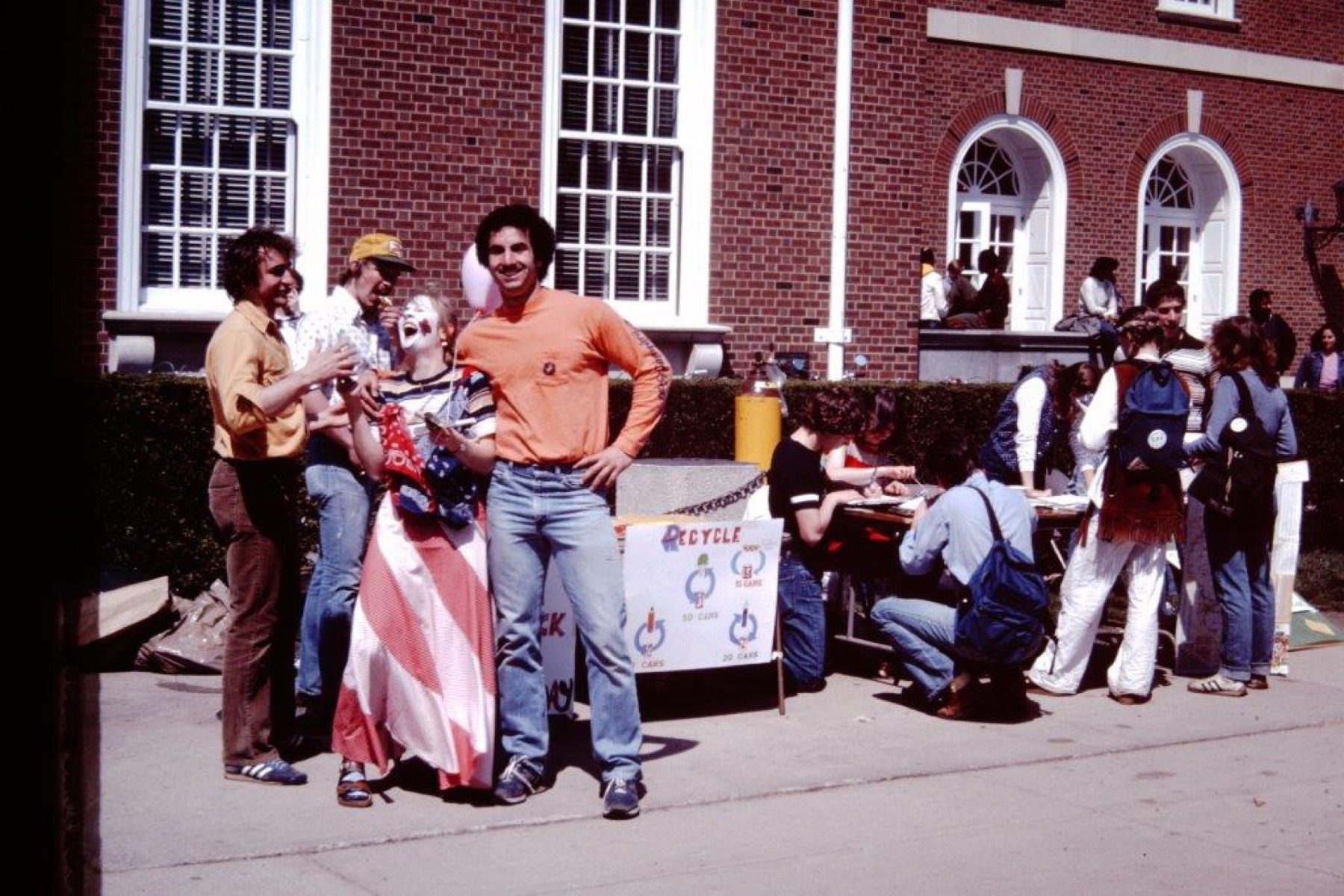
Out of SECS came Red Bison, which restores prairie and woodland; in 1999 it was both its own student organization and a SECS committee, "sharing meetings, members and office space."8384 Numbers fell again in the early 1990s, to about 75 members in 1992 and 30 active ones in 1993.8586 SECS put the first recycling bins on the Quad in 1995–96, ran Earth Day on the Quad each spring, and met every Wednesday at 6:30 p.m. at the Y.8716
In the 2000s SECS turned the student body's money to the environment. It petitioned, with about 3,000 signatures, for a $2 Cleaner Energy Technologies Fee, held an energy conference at the Y on March 1, 2003, and saw the fee pass in that spring's student election.8889 Four years later it proposed the $5 Sustainable Campus Environment Fee, which students passed 6,997 to 1,854 in March 2007; the University's Trustees noted that the fee "was proposed by the Students for Environmental Concerns."90 Joe Teng, SECS's president and the Y's student president in 2006–07, led that campaign, and in 2010 SECS won an increase to $14 with 77 percent of the vote.9192 The fees, managed by the Student Sustainability Committee, paid for projects across campus; a planned wind turbine at the South Farms, which the first fee had been meant for, was cancelled in December 2008, despite SECS's protests.9318
Other work grew into organizations of its own. In 2005 Molly Stephey (now M.J. Altman) turned SECS's newsletter, by then the campus-wide Environmental Resources, into the Green Observer magazine.9194 CORE (Community Organized Recycling Efforts), "originally a small committee within SECS," began in 2006–07 with recycling in fraternity and sorority houses and became a nonprofit in 2008; SECS members helped persuade Champaign to offer recycling to apartment buildings in 2009.95969798 With the Horticulture Club SECS started iCompost in 2008, and in 2009 two of its projects won Clinton Global Initiative University awards.9918
On March 10, 2010, SECS, the Sierra Club and Prairie Rivers Network launched a Beyond Coal campaign in front of Abbott, asking the University to switch the plant from coal to natural gas.100 From the fall of 2011 the campaign, "an organization within Students for Environmental Concerns" that met at the Y, asked the University to divest its endowment from coal.101 Students voted for coal divestment by 86 percent in November 2013, and on April 4, 2016, after a rally by Beyond Coal, the Academic Senate urged the Trustees to divest from coal.101102 The campaign reached the Y too: beginning in 2014, prompted by Student Board president Nate Lawrence, a SECS leader, the Y reviewed its own endowment, and in 2016 it moved to socially responsible investing.103104 Jim Young moved the Trustees' motions to take up SECS's request.104 In 2019 students voted by about three to one for the University to divest from all fossil fuels, and that Sept. 20 SECS led a campus climate strike of more than 500.105106
In these years SECS described itself as "the oldest and largest environmental RSO on campus." It had five committees in 2015, Political Action, Beyond Coal, Sustainable Business, Education and Earth Week, and its fall Environmental Action Night, held at the Y from about 2000, brought the campus's environmental groups together.107108 The Y named SECS its Outstanding Student Program in 2009–10, the first year of the award, and again in 2016.109110
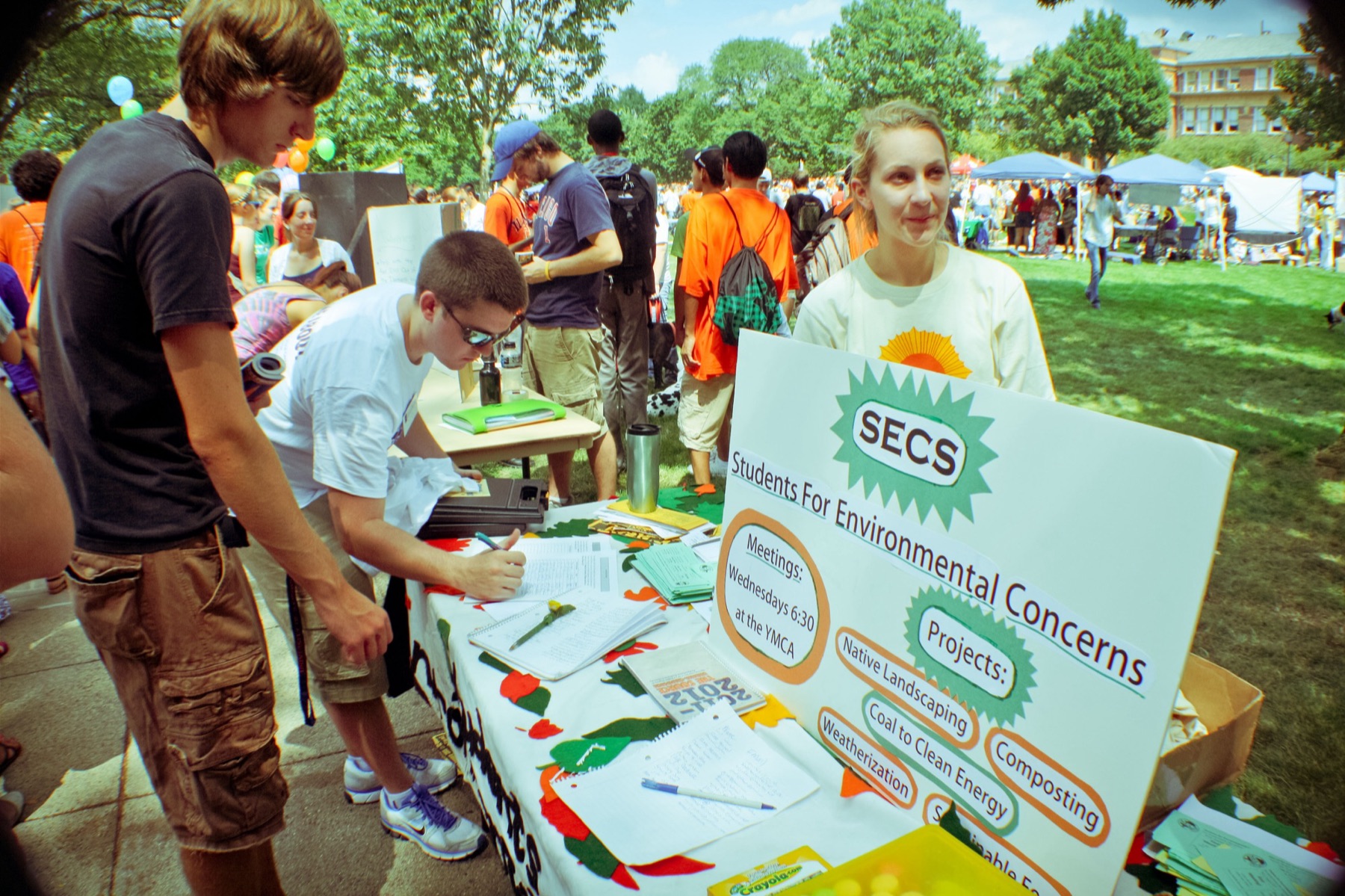
The Y celebrated SECS's 50th anniversary in April 2018. Earth Week opened on April 13 with Bill McKibben at the Friday Forum, and Latzer Hall held a "Meat-Free Monday" dinner.111112 Alumni came back for a weekend, April 20–22: Sievering gave three short talks, alumni and students gave lightning talks, they rallied for divestment from Abbott to the Alma Mater, and on Saturday night the Y's Annual Dinner, with more than 225 guests, was given over to "Celebrating 50 Years of Environmental Action." Jeremy Hays, of the Catalyst generation, was its Nestingen Distinguished Alumnus, and on Sunday Red Bison held a workday.111113114 For the anniversary the Y recorded interviews with Sievering, Hannon, John and Diane Marlin and others.113
SECS has lasted longer than any other student organization at the Y, and it has changed the campus it works on. Its first Earth Week made Champaign-Urbana part of the national teach-in. It helped keep the Oakley Dam out of Allerton Park, got the University to put scrubbers on Abbott, and helped found the Community Recycling Center.475064 Its 1987 referendum led to the University's campus recycling program, and its 1992 energy policy to the Chancellor's energy-conservation rules.727482 The two student fees it proposed, in 2003 and 2007, created the money that the Student Sustainability Committee still spends on campus projects.8890 Its divestment campaigns won three student referendums, in 2013, 2019 and 2025, and the support of the Academic Senate.101105115102
It also made leaders. Peters calls it "a major source of some of the best student leadership in the Association."47 Its members included the Y's student presidents John Thompson, Joe Teng and Nate Lawrence; the founders of the Green Observer, CORE and Red Bison; and Diane Marlin, later mayor of Urbana.509111633 "It's where I really learned about the power of civic action," M.J. Altman told a Friday Forum in 2018.117
SECS carries on. It has been Students for Environmental Controls (until 1970) and Students for Environmental Concerns, and it has given rise to, or absorbed, a family of groups: the Community Recycling Center (1978), Red Bison (about 1990), the Green Observer (2005), CORE (2007) and the Beyond Coal campaign (2010).55839196100
For most of its history SECS met at the Y: in Parr Lounge in 1969, in its office there through the 1970s and 1980s, and every Wednesday at 6:30 p.m. in the Student Programs Office from the 1990s into the 2010s.116816107 In 2021 SECS and the Y parted, and in 2024–25, with the leadership of the Student Board, the Y "welcomed back Students for Environmental Concerns" as an affiliated organization, and in 2025 SECS absorbed two younger Y student organizations, Grow2Give and vermiCUlture.118119 As of 2026, it meets weekly at Channing-Murray, but it holds programs and its annual prom at the Y and keeps a garden bed there.120105
Today SECS works through six working groups, the Green Observer among them, and a weekly newsletter and podcast.118105 In January 2025 the ACLU of Illinois asked the University to reconsider its discipline of SECS and its members after their September 2024 climate march, and the Y shared the news on its website.121122 A student referendum for fossil-fuel divestment passed again with 72.94 percent in February 2025, and that April SECS presented its case at the Friday Forum.115123 In September 2026 it led a "Resist Data Centers" rally from Foellinger Auditorium to the Alma Mater.124
"We must be practical; we must do the impossible." — SECS position paper for Environmental Crisis Week, 197024
"Ed was synonymous with the Y in those days and worked tirelessly to help us as students." — Ernie Dunwoody, 2017128
"It was dangerously stupid ... but that's what you had to do." — Diane Marlin on the glass drives of the 1970s, 202333
"I thought it would take me about six months to stop the dam. It took twelve years." — John Marlin, 201846
"We have a governor who has his priorities straight." — John Thompson, SECS president, 198265
"We can't afford time to celebrate." — Steve Frankel, at SECS's 20th-anniversary talk, 1991129
"Every time something important happened, there would be a meeting at the Y." — Suhail Barot, SECS treasurer in 2010–11, 2017130
"We were right. And we have been right." — Grayson Hodson, SECS action coordinator, at a climate strike, 2025131
