University YMCA · 1001 S. Wright St., Champaign, IL 61820

Visit universityymca.org
← Program
University YMCA Archives · Program history

The history of Freshman Camp

For nearly 50 years the University YMCA met entering freshmen before classes began and spent three days with them at camp, getting to know student leaders and faculty and talking about what college would ask of them. More than 10,000 Illinois students went to Freshman Camp between 1926 and 1973, and more than 40 colleges copied the idea.

The leadership planning group for the 1939 Freshman Camp at Camp Seymour. From left: Albert Mueller; Dean Leeper, chairman; Garrett Loy; Louis Hauptfleisch; Monroe Walter; Raymond French; John Buyers; Louis Briggs; and Edwin Guernsey. From Harold W. Hannah, One Hundred Years of Action (1973).

Origins

The YMCA had looked after new students at Illinois almost from its start. Hannah dates its welcome for freshmen to 1876, when members met incoming trains and helped new students find lodgings from a list of rooms they had gathered.12 From 1884 the Y gave new students a handbook, the "I Book," with campus customs, organizations and advice.3 By 1923 its Freshman Fellowship committee ran about 80 small weekly discussion groups for freshmen, led by upperclassmen.4

The driving force behind that freshman work was M. I. "Mic" Coldwell. A former Kansas schoolteacher and football coach, he came to Illinois in 1918 as a YMCA worker with the Student Army Training Corps and joined the Y's staff that year.5 Coldwell believed that reaching freshmen mattered more the larger the University grew.4 He had a hand in starting Freshman Fellowship, the Fireside Forums and the Faculty Forum, but Harold Hannah judged Freshman Camp his most significant contribution.6

In the spring of 1926, Coldwell and the Y's Freshman Program Committee, chaired by Harry Schlenz, concluded that the orientation the staff gave freshmen one at a time should reach a larger group in an organized way. Rather than wait, they wrote to YMCA secretaries in towns across Illinois to announce a camp for that fall and ask for applicants. By the time the first camp opened in early September, it was oversubscribed.6 On Sept. 13, 1926, 106 men of the class of 1930 left the Union Building in three motor buses for Camp Seymour, near Decatur. Dean of Men Thomas Arkle Clark, Dean A. J. Harno of the College of Law and J. G. Thomas, assistant to the dean of men, were among the speakers.78 The same year the University began registering freshmen ahead of upperclassmen, which the Y had long urged.9

How it worked

The camp years, 1926–1956

The camps were held just before Freshman Week, the University's own orientation, and ran three days. They grew so popular that two were held each fall.6 The Y advertised them with folders showing a freshman, suitcase in hand, looking out over the whole University. Posters went to high schools across the state, and city YMCA secretaries recruited campers. In 1937, 3,000 freshmen applied for 300 places.6
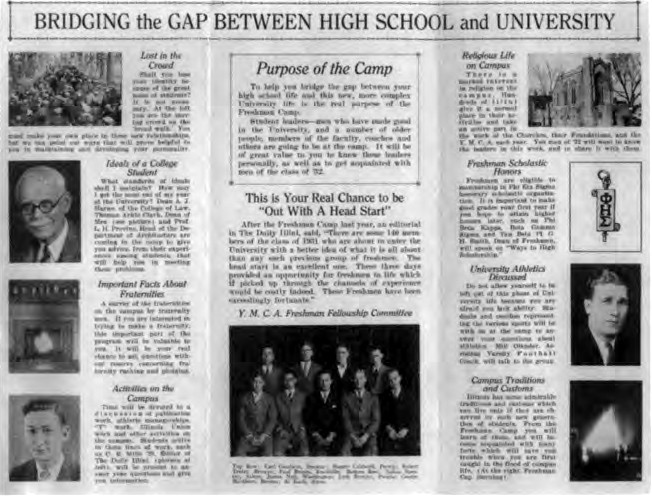
Inside the 1928 Freshman Camp brochure, published by the YMCA Freshman Fellowship Committee. From Scott J. Peters, The Promise of Association (1997).

A brochure from 1928, issued by the YMCA's Freshman Fellowship Committee, sets out the program under the heading "Bridging the Gap Between High School and University." It promised campers the chance to know student leaders and faculty members personally and to meet others in their class. Its sessions covered:10

  • the ideals of a college student, with Dean A. J. Harno of the College of Law, Dean of Men Thomas Arkle Clark and Prof. L. H. Provine of architecture
  • fraternity rushing and pledging
  • campus activities, from publications and athletic managerships to Y work and the Illinois Union
  • religious life on campus
  • scholastic honors, with G. H. Smith, dean of freshmen11
  • athletics, with assistant varsity football coach Milt Olander
  • campus traditions and customs

The brochure quoted a Daily Illini editorial written after the 1927 camp: some 140 members of the class of 1931 would enter the University with a better idea of "what it is all about" than any earlier group of freshmen.10

Deans, coaches, faculty members and student leaders came willingly.6 Peters notes that the YMCA always described its freshman work as religious work, focused on character, even as it gave practical help with study and campus life.12 Like the YMCA's summer conferences at Lake Geneva, the camp mixed recreation with serious talks on faith, higher education and social issues.13

From the first camp in 1926 they met at Camp Seymour, a permanent YMCA camp about ten miles southeast of Decatur.8141516 In 1935 Dean of Men Fred H. Turner called the camp "one of the most helpful events sponsored by the Y.M.C.A."17 In 1939 General Secretary Henry Wilson reported to the Board that the Freshman Camps were "highly successful," the campers "high-grade, fun-loving, human fellows" and more serious than usual.18 That year's planning group was chaired by Dean Leeper, later president of the Y.15
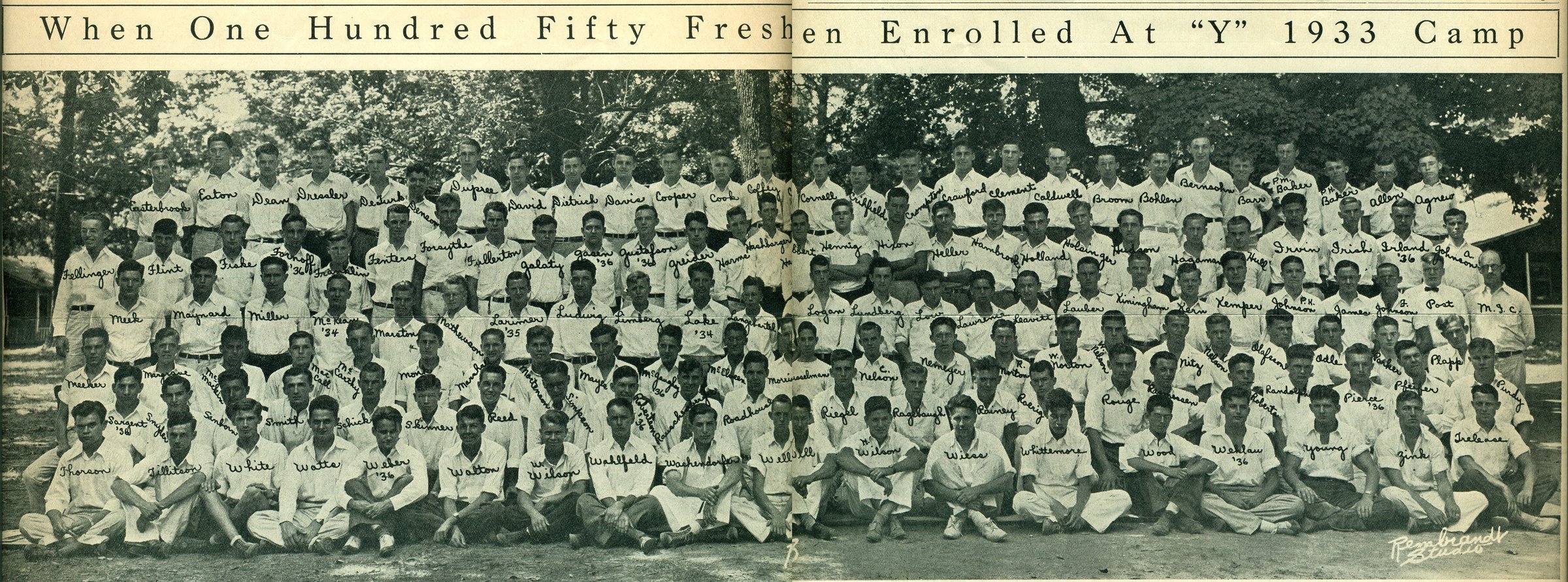
"When One Hundred Fifty Freshmen Enrolled at 'Y' 1933 Camp": the University YMCA's Freshman Camp in the fall of 1933, with the campers' and leaders' names written on the print. Upperclass leaders are marked with their class years, among them Jim Lake '34, the Y's president that year. The man at far right is marked "M.I.C.," probably Mic Coldwell. From The Y's Indian, October 1933.

The camp met at Camp Seymour in the fall of 1942, and in June 1943 a short camp was held at Camp Kiwanis on Lake Decatur.192014 Wartime travel restrictions then suspended it. In September 1946, after the restrictions were lifted, it resumed at Camp Seymour for 125 entering freshmen, organized by associate secretary William G. Black. The Daily Illini gave the dates as Sept. 16–19, four days, because of the short break between semesters.211422

After the war the camp often ran in two sessions each fall. In 1947 Black directed both, for 101 freshmen from 81 towns.23 In 1949 nearly 200 enrolled for Camp Seymour, one of the largest groups since 1928.24 A photograph of a 1949 camp, though, is labeled as taken at the Allerton 4-H Camp.25 By 1950 the camp had moved to the Memorial 4-H Camp at Robert Allerton Park, near Monticello, where the Y held its 27th annual camp in 1952 and its 28th in 1954.262728 In 1956 it met at Camp Kiwanis, near Mahomet.29 Mic Coldwell, who had organized the first camp, retired in June 1956 after 38 years on the staff.30
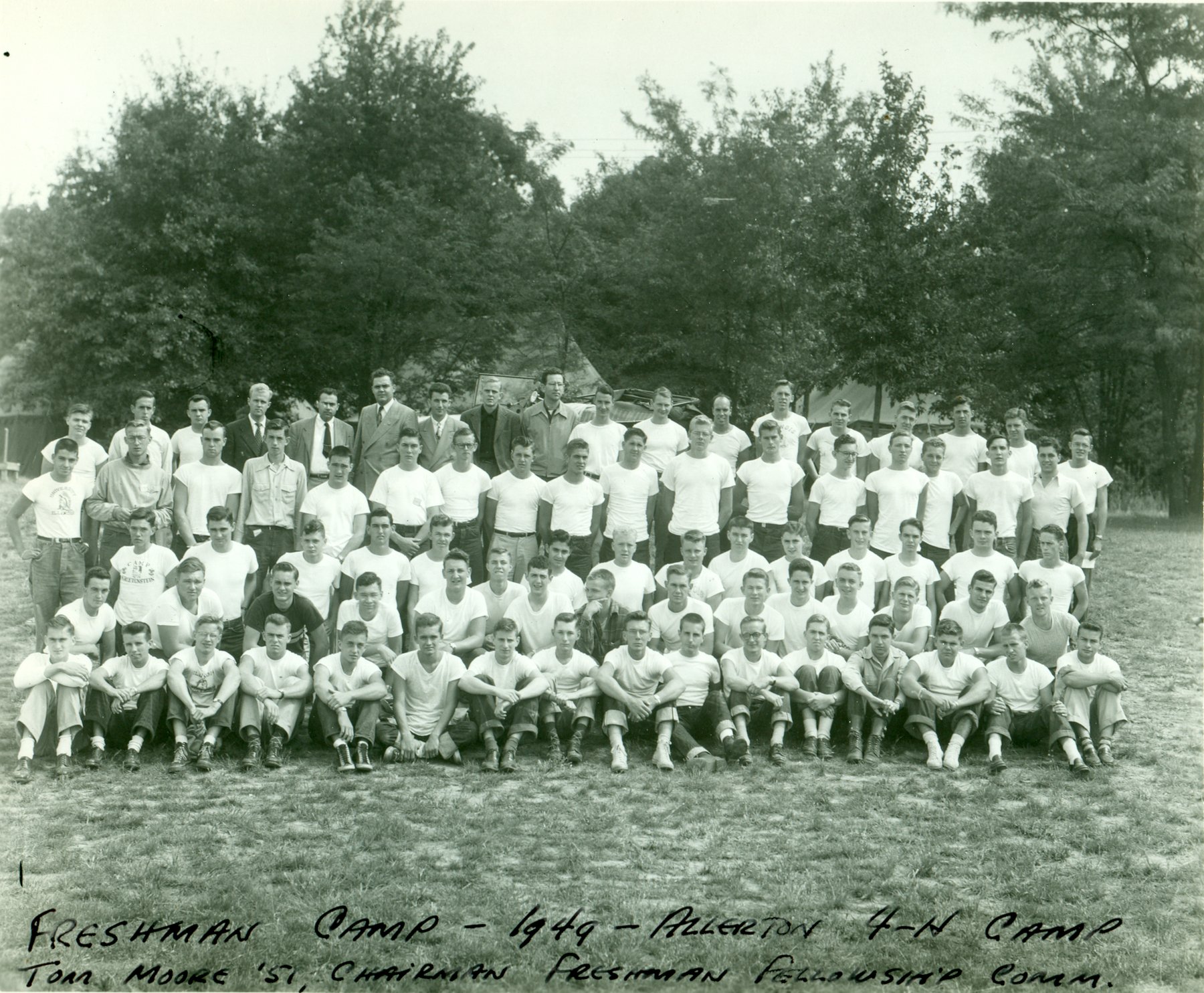
Freshman Camp at the Memorial 4-H Camp, Robert Allerton Park. The print is labeled "Freshman Camp – 1949 – Allerton 4-H Camp" and names Tom Moore '51, chairman of the Freshman Fellowship Committee. Photograph from the University YMCA's files.

The conference years, 1959–1973

A self-study of the Y finished in November 1957 judged its undergraduate work weak and recommended ending Freshman Camp, along with other programs held away from the building.31 No camp was held in 1957 or 1958.6 In its place the Y planned a series of weekend programs for freshmen, the first at Camp Howard, near Lake of the Woods, in October 1957.32

Fred Miller, general secretary from the fall of 1958, and Ed Nestingen, who joined the staff in April 1959 as associate secretary for program, revived it in 1959.31633 In 1960 it met again at Camp Seymour, Sept. 10–12, the weekend before Registration Week.3435
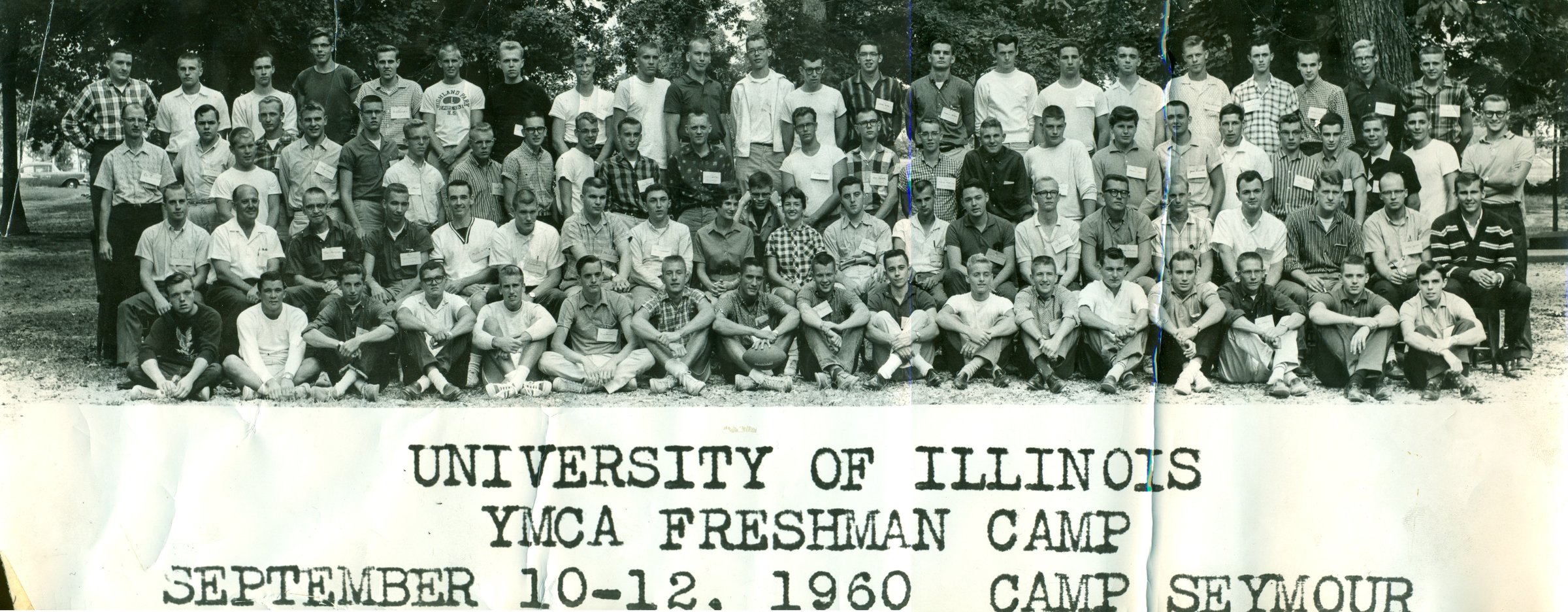
The University of Illinois YMCA Freshman Camp at Camp Seymour, Sept. 10–12, 1960, the year after Fred Miller and Ed Nestingen revived it. Photograph from the University YMCA's files, scanned in two halves and joined.

In the fall of 1961 it became the YMCA Freshman Weekend, for 300 freshman men, at East Bay Camp on Lake Bloomington.3637 The next year the YWCA became a co-sponsor and women were included: the first YMCA-YWCA Freshman Weekend met at East Bay Camp on Sept. 15–16, 1962.38396 (Peters dates the change to 1961.33) Each conference had two student co-chairs, one from the YMCA and one from the YWCA.4039
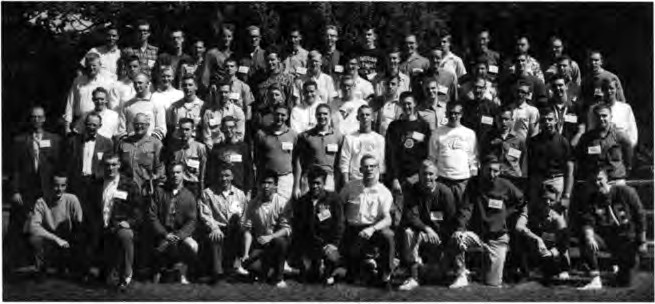
The YMCA Freshman Weekend at Lake Bloomington, fall 1961. In the second row from the left are Ed Nestingen, Dean Fred Turner and R. Rankin of the Danforth Foundation. From Scott J. Peters, The Promise of Association (1997).

In 1964 the program was renamed Freshman Conference. The change of name signaled a change of purpose. Rather than recreation and fun, the conferences were built around frank talk about students' concerns, fears, hopes and expectations of college, with many faculty members and older students taking part. Planners wanted students and faculty to explore one question together: "Education for what?"33 It met for three days during New Student Week, at East Bay Camp through the late 1960s. In 1966 about 350 freshmen attended, with 80 upperclass and 30 faculty counselors.4142

Achievements

Hannah counted more than 10,000 University of Illinois students who had attended by 1973. He judged its influence on their involvement in campus life, and on their outlook in later life, hard to measure but "tremendous."6

The idea spread well beyond Illinois. Over the next 35 years more than 40 colleges and universities started freshman camps of their own. A plaque honoring Coldwell and Schlenz as the originators of the freshman camp idea was dedicated at College Camp, Lake Geneva, Wisconsin, the YMCA's regional conference grounds.6

The camp also gave the Y a model for welcoming other new students. In the 1950s John Price, who led the Y's work with international students, organized an International Student Camp on the same lines. For a time it drew more than 200 students a year, often more than Freshman Camp, and it later became an International Student Welcome Weekend.43

Its leaders came from across the University. Hannah lists Freshman Camp alongside the Faculty Forum and the Y Board as places where deans, department heads, teachers and administrators from every college gave their time to the YMCA.44 Past presidents of the Y, answering a letter from General Secretary Harold Reinhart for Hannah's history, remembered the camp among the Y's most effective ways of reaching students.45

Changes and ending

Revived in the early 1960s, Freshman Conference grew to more than 400 participants a year.46 The 1968 conference drew 350 freshmen, 70 returning students and 80 faculty members.33 It was held as Project 500 brought several hundred new Black students to the University, and some of them attended the conference while others in their group were being arrested at the Illini Union.40 The conference's long and critical discussion of some University actions and policies upset some students and faculty members. Bruce Larson, chair of the YMCA's Board of Directors, asked whether it had become a training ground for activism rather than an orientation to the University. In Peters's judgment, it had become both.47

With more students arriving from junior colleges, and at the urging of the Dean of Students office, the program was renamed New Student Conference in 1971 and opened to transfer students.6 Hannah reports that the old name, Freshman Conference, was restored in 1972, and in early 1973 he listed it among the Y's major programs.648 The Daily Illini, though, calls it Freshman Conference throughout. In 1970 about 150 freshmen met at East Bay Camp, and in 1972 the conference met Sept. 10–12 at Robert Allerton Park. The Y still listed Freshman Conference among its programs in September 1973.495051

Interest fell away quickly. The last conference, in the fall of 1973, drew only 41 students. An attempt to revive it in 1978 failed. In Peters's words, after nearly 50 years it "no longer attracted enough interest to be continued."52

People

  • M. I. "Mic" Coldwell, YMCA staff from 1918 until he retired in June 1956, co-founder of the camp in 1926.5630
  • Harry E. Schlenz, chairman of the Freshman Program Committee in 1926 and co-founder.653
  • Henry E. Wilson, general secretary 1916–1946, who reported on the camps to the Board.5418
  • Dean Leeper, chairman of the 1939 planning group and Y president, 1940–41.15
  • Louis Hauptfleisch, Y president 1939–40, on the 1939 planning group.15
  • William G. "Bill" Black, associate secretary, who directed the camp after the war, 1946–47.2223
  • Fred Miller, general secretary from 1958, and Ed Nestingen, associate secretary for program from 1959, who revived the camp in 1959.631
  • Jim Young, counselor and later student co-chair of Freshman Conference, about 1967–69.40

Remembered

Robert Lauber, Y president in 1935–36, wrote to Hannah about what Freshman Camp had meant to him and about Mic Coldwell's leadership. Loren Beal, president in 1942–43, remembered the camp as one of the Y's most effective contacts with students, and recalled Professor Provine's talk "Foundations and Superstructures" and Coldwell's address "I've Got a Pocket Full of Dreams."45

Garrett Loy, a member of the 1939 planning group, wrote to Coldwell from New Guinea in 1944, for Coldwell's 25th year on the staff. His mind, he said, was back in Urbana among programs like Freshman Camp. Loy lost his life in the war, flying a "Black Widow" night fighter.1555

At Coldwell's retirement banquet, Paul Van Arsdell recalled Coldwell in the "firelight glow of Camp Seymour," urging thirty 18-year-olds not to forget their faith.5

Bill Black, who as associate secretary directed the camp after the war and later became a bishop, recalled bringing freshmen to Camp Seymour to meet the leaders of campus organizations and get a head start on campus life. Afterward each freshman was placed with a faculty member and his wife, who hosted 10 to 12 freshmen in their home through the first semester.56

Jim Young, who was a counselor and then a co-chair of Freshman Conference, remembered the 1968 conference, when several Project 500 students came to the conference while others in their group were being arrested at the Illini Union. That fall he and others started "White on White," taking films on Black history around the residence halls.40

Sources

  1. Hannah, p. 11, quoting the Y's Indian, June 1948.
  2. Hannah, p. 28.
  3. Hannah, p. 23.
  4. Hannah, pp. 50–51.
  5. Hannah, pp. 37–38.
  6. Hannah, pp. 42–43.
  7. "Freshman Camp Is Near Decatur," Daily Illini, July 1, 1926. https://idnc.library.illinois.edu/?a=d&d=DIL19260701.2.10
  8. "106 Incoming Men Leave for Camp," Daily Illini, Sept. 14, 1926. https://idnc.library.illinois.edu/?a=d&d=DIL19260914.2.10
  9. Hannah, p. 54.
  10. YMCA Freshman Fellowship Committee, Freshman Camp brochure, 1928, reproduced in Peters, photo section.
  11. Daily Illini, June 2, 1928, on the YMCA's program for 1928–29. https://idnc.library.illinois.edu/?a=d&d=DIL19280602.2.27
  12. Peters, p. 64.
  13. Peters, p. 164, note 20, citing an undated paper, "From Freshman Camp to Freshman Conference."
  14. "YM to Reinstate Frosh Training in September," Daily Illini, July 13, 1946. https://idnc.library.illinois.edu/?a=d&d=DIL19460713.2.34
  15. Photograph of the 1939 Freshman Camp planning group at Camp Seymour, in Hannah, photo section; also in Peters, photo section.
  16. University of Illinois Archives, YMCA Subject File, 1886–2009, record series 41/69/322. Freshman Camp files are in Boxes 4 (camp lists, 1926–62; 1928 and 1932), 18 (1960–69) and 34 (1968–72); Box 7 holds "Leadership Conference, Camp Seymour, Decatur, 1938–48." https://files.archon.library.illinois.edu/uasfa/4169322.pdf
  17. "Y.M.C.A. to Hold Freshman Camp," Daily Illini, May 19, 1935. https://idnc.library.illinois.edu/?a=d&d=DIL19350519.2.39
  18. Hannah, p. 77.
  19. Daily Illini, July 16, 1942, on the YMCA's plans for the fall freshman camp. https://idnc.library.illinois.edu/?a=d&d=DIL19420716.2.34
  20. "YMCA Freshman Camp Planned for June 7–9," Daily Illini, May 30, 1943. https://idnc.library.illinois.edu/?a=d&d=DIL19430530.2.6
  21. Hannah, p. 79, quoting the general secretary's report for 1946.
  22. "Frosh Will Attend Y Training Camp in September," Daily Illini, Aug. 15, 1946. https://idnc.library.illinois.edu/?a=d&d=DIL19460815.2.26
  23. "101 Frosh Enroll for Fall Camps," Daily Illini, Sept. 23, 1947. https://idnc.library.illinois.edu/?a=d&d=DIL19470923.2.29
  24. "Camp Enrollment Approaches 200," Daily Illini, Aug. 13, 1949. https://idnc.library.illinois.edu/?a=d&d=DIL19490813.2.15
  25. Photograph, "Freshman Camp – 1949 – Allerton 4-H Camp," University YMCA files.
  26. "Many Attend YMCA Camp for Frosh," Daily Illini, Sept. 14, 1950. https://idnc.library.illinois.edu/?a=d&d=DIL19500914.2.54
  27. "YM, YW Close Annual Camps," Daily Illini, Sept. 16, 1952. https://idnc.library.illinois.edu/?a=d&d=DIL19520916.2.57
  28. "New Students Are Invited to Camp," Daily Illini, July 9, 1954. https://idnc.library.illinois.edu/?a=d&d=DIL19540709.2.32
  29. "'Y' Begins Plans for Frosh Camp," Daily Illini, May 18, 1956. https://idnc.library.illinois.edu/?a=d&d=DIL19560518.2.60
  30. "Coldwell Leaves YM Post," Daily Illini, Feb. 17, 1956. https://idnc.library.illinois.edu/?a=d&d=DIL19560217.2.17
  31. Peters, pp. 108–109.
  32. "Change Program to Weekends," Daily Illini, Sept. 17, 1957. https://idnc.library.illinois.edu/?a=d&d=DIL19570917.2.35
  33. Peters, p. 115.
  34. "Camp Orients New Frosh," Daily Illini, Aug. 1, 1960. https://idnc.library.illinois.edu/?a=d&d=DIL19600801.2.158
  35. Photograph, "University of Illinois YMCA Freshman Camp, September 10–12, 1960, Camp Seymour," University YMCA files.
  36. "Expect 300 Freshmen at Weekend Sponsored by Y for Orientation," Daily Illini, Aug. 10, 1961. https://idnc.library.illinois.edu/?a=d&d=DIL19610810.2.35
  37. Photograph, "YMCA Freshman Weekend at Lake Bloomington, Fall 1961," in Peters, photo section.
  38. "150 Frosh to Attend YM-YWCA Camp," Daily Illini, Aug. 1, 1962. https://idnc.library.illinois.edu/?a=d&d=DIL19620801.2.173
  39. "New Students Attend Y Programs at East Bay Camp over Weekend," Daily Illini, Sept. 22, 1962. https://idnc.library.illinois.edu/?a=d&d=DIL19620922.2.46
  40. Jim Young, "Y Stories," University YMCA video, May 6, 2013. https://www.youtube.com/watch?v=BmLHq7YtyVI
  41. Daily Illini, April 13, 1965, YMCA-YWCA activity notes. https://idnc.library.illinois.edu/?a=d&d=DIL19650413.2.34
  42. "Open Fresh Conference," Daily Illini, Sept. 13, 1966. https://idnc.library.illinois.edu/?a=d&d=DIL19660913.2.24
  43. Peters, p. 83.
  44. Hannah, p. 92.
  45. Hannah, pp. 56–57.
  46. Hannah, p. 94.
  47. Peters, pp. 115–116, citing the minutes of the YMCA Board of Directors, Sept. 18, 1968.
  48. Hannah, p. 108.
  49. "150 at Frosh Conference," Daily Illini, Sept. 9, 1970. https://idnc.library.illinois.edu/?a=d&d=DIL19700909.2.23
  50. Daily Illini, Aug. 11, 1972, University YMCA-YWCA advertisement. https://idnc.library.illinois.edu/?a=d&d=DIL19720811.2.79.1
  51. Daily Illini, Sept. 13, 1973, University YMCA advertisement. https://idnc.library.illinois.edu/?a=d&d=DIL19730913.2.19.1
  52. Peters, p. 130.
  53. Hannah, p. 46.
  54. Peters, p. 12.
  55. Hannah, p. 78.
  56. Bill Black, "Y Stories," University YMCA video, Feb. 4, 2013. https://www.youtube.com/watch?v=qsrf1NdAeBg

Works cited

  • Hannah, Harold W. One Hundred Years of Action: The University of Illinois YMCA, 1873–1973. Champaign: University YMCA, 1973. Read the book (PDF)
  • Peters, Scott J. The Promise of Association: A History of the Mission and Work of the YMCA at the University of Illinois, 1873–1997. Champaign: University YMCA, 1997. Read the book (PDF)
Last reviewed
October 16, 2026

Timeline

1876
The Y begins welcoming new students
YMCA members meet incoming trains and help freshmen find rooms, the start of the Y's work with new students.
1923
Freshman Fellowship reaches 80 groups
Small weekly discussion groups for freshmen, led by upperclassmen.
Sept. 13, 1926
The first Freshman Camp
Mic Coldwell and the Freshman Program Committee, chaired by Harry Schlenz, plan the camp that spring. On Sept. 13, 106 entering men leave by bus for Camp Seymour, near Decatur.
Sept. 1927
About 140 freshmen at camp
A Daily Illini editorial says some 140 members of the class of 1931 will start college with a head start.
1937
3,000 applicants for 300 places
The camp is now two three-day sessions before Freshman Week.
1939
Camp at Camp Seymour
Dean Leeper chairs the planning group. Henry Wilson reports the camps "highly successful."
Sept. 1942
The last camp before the war
The camp meets at Camp Seymour. A short camp follows at Camp Kiwanis in June 1943; then wartime travel restrictions suspend it.
Sept. 1946
Camp resumes after the war
The first camp since 1942: 125 entering freshmen at Camp Seymour, Sept. 16–19, organized by associate secretary William G. Black.
1950
The camp moves to Allerton Park
Two sessions at the Memorial 4-H Camp at Robert Allerton Park, near Monticello, its home for most of the 1950s.
Nov. 1957
Self-study recommends ending the camp
No camp is held in 1957 or 1958. The Y tries weekend programs for freshmen instead.
1959
Camp revived
Fred Miller and Ed Nestingen bring the camp back.
Sept. 1961
Freshman Weekend at Lake Bloomington
The YMCA Freshman Weekend, for 300 freshman men, meets at East Bay Camp on Lake Bloomington.
Sept. 1962
Women join; the YWCA co-sponsors
The first YMCA-YWCA Freshman Weekend meets at East Bay Camp, Lake Bloomington. Peters dates the change to 1961.
1964
Renamed Freshman Conference
The emphasis moves from recreation to frank talk about college and the question "Education for what?"
Sept. 1968
The 1968 conference: 500 people, and controversy
350 freshmen, 70 returning students and 80 faculty. Critical discussion of University policies, held as Project 500 students arrived, troubles the Board.
1971
Renamed New Student Conference
Opened to transfer students, at the urging of the Dean of Students office. Hannah says the old name returned in 1972.
Fall 1973
The last conference
Only 41 students attend, and the program ends after nearly 50 years.
1978
A revival attempt fails
Know more about this program, or have photos or papers from it? Share what you know.