University YMCA · 1001 S. Wright St., Champaign, IL 61820
Visit universityymca.orgIn 1952 no barbershop near campus would cut a Black student's hair. That fall the University YMCA's Racial Equality Committee set out to change it, first with a petition and then with patient talks with the barbers. Over the next three years Black students, the Student Senate, a small interracial council, lawyers and pickets joined the fight. By the fall of 1954 nearly every campus shop had opened its doors. For a time the Y also considered opening a barbershop of its own.
In the early 1950s a Black student at the University of Illinois could eat in most campus restaurants and sit anywhere in the local theaters. Both were the result of fights won only a few years earlier.12 But no barbershop near campus would cut a Black student's hair. In February 1953 an assistant dean of men told a student meeting that no barbershop on the campus would serve Black customers.3 Bill Blaine, who chaired the YMCA's Racial Equality Committee, said that campus barbers served a Black student only "under unusual circumstances," when the barber was not sure of the student's race, or sometimes after hours.4 Lee Ingwersen, owner of the Campus Barber Shop, said that when a Black man came in, "we try to embarrass him so much he'll never come back."56 Some barbers simply closed their doors.5 "You're here at school," Paul Hursey Sr. remembered, at "one of the greater universities in the United States or in the world," and you couldn't get a haircut.7 Years later a student remembered having to walk three miles for one.8
The barbers gave reasons. They said a barber had the right to serve whomever he wished, that they would lose white customers, and that cutting Black customers' hair took tools and training they did not have.9 One said it would be like cutting steel wool and would ruin his clippers. Another asked who would support his wife and children while he went back to barber school.5 At one meeting the barbers' spokesman, George Attebery, warned that "as far as the law was concerned, we'd better remember that a man with a razor in his hand shouldn't be monkeyed with."10 Illinois law already said otherwise. Its civil rights statute guaranteed "equal enjoyment" of public accommodations and named barbershops, but no one in Champaign County had tested it.411
The University YMCA had worked on race relations since 1924, when it and the YWCA set up a joint committee on "interracial cooperation."12 After the war, students formed a Racial Relations Committee, and in 1949 it looked into rumors that the McKinley YMCA in Champaign kept Black swimmers out of its pool.13 By 1950, the Daily Illini later reported, it had become the Racial Equality Committee (Peters dates the new name to late 1952).1415 The barbershop problem was brought to it in the spring of 1952, under student president Robert Lauchner, and it took the problem on as its project.1416 That spring the Y elected Richard L. (Dick) Thies as its president for 1952–53, the year the campaign began in earnest. Thies went on to law school and became an Urbana lawyer.17161819 Looking back in 2013, Thies said the committee "really blossomed the year I was president."20 In May 1953 the University awarded Thies, Blaine and William Novak University Keys for their YMCA work.21
The committee's first tool was a petition. In the late fall of 1952 its members circulated sheets headed "Let's practice what we preach." The signers did not threaten a boycott. They promised only to keep using shops that would "serve all men regardless of racial background." The barbers' fear of losing customers was the obstacle the petition was meant to remove.149 By early March 1953 more than 800 students and faculty had signed, and soon more than 1,000.2223 On Feb. 25, 1953, the Student Senate voted unanimously "to back up the University YMCA's fight." Student senator Jim Montgomery, a Black student who was later a University of Illinois trustee and, Thies said, a key help in the campaign, warned that a test case would probably be needed before the law was enforced.419 Peters adds that the YWCA, several campus churches and religious foundations joined the effort.15
The Y wanted to win the barbers over, not shame them. Peters calls its method "moral persuasion."15 Through 1953 the committee met "off and on" with the barbers, and in March a student-faculty team set out to visit the shops.123 In May the committee held an open meeting in Latzer Hall. Blaine reported there that a Chicago barber who served customers of every race had answered the barbers' claims that they would lose money and could not do the work.2425
None of it moved the barbers. In April 1953 the committee admitted it had been "unable to make any progress in persuading barbers to cut Negro hair."26 The Daily Illini, which supported the goal, had already written that much of the committee's first year was spent "studying the condition," and that "remarkably little was accomplished."22 That April the Student-Community Human Relations Council (S-CHRC) joined the fight. It was an independent group of students and townspeople formed in 1951, and it had already opened local restaurants, theaters and the Crystal Lake Park pool. The council made the barbershops its top project for the fall.261
In the fall of 1953 the campaign changed. Black students, who thought S-CHRC was too cautious, "a mere discussion group," formed a committee of their own, the Committee to Abolish Discrimination in Barbershops.27 Three of its members persuaded J. C. Caroline, the star Illinois halfback, to ask for a haircut at Lee Ingwersen's Campus Barber Shop on South Sixth Street. The shop prided itself on its athletes and had Caroline's picture in the window. It refused him.2827 On Nov. 3, 1953, Caroline and another Black football player came to a meeting of the Y's Racial Equality Committee, and Caroline told how he had been turned away. He agreed to try the shop again and let his name be used.2829 The committee debated how. Some members wanted him to walk in unannounced, be refused and make "a big scandal." Most, with Tiebout, preferred a friendly approach: a regular customer of the shop would introduce him to the owner. The Rev. James R. Hine was asked first. When he could not, a teammate, Stan Wallace, offered to introduce the players and ask that their hair be cut. The plan fell through, "for causes over which neither S-CHRC nor REC had any control."29
On Nov. 7, the day of the Michigan game, students walking to Memorial Stadium were handed a leaflet headlined "J. C. Caroline Thrown For A Loss By Campus Barber." It was written by the Black students' committee and handed out with S-CHRC's help.227 "We can go each Saturday and cheer loudly and strongly for J. C.," one student wrote to the Daily Illini, "and can yet on Monday morning, simply because he is a Negro, deny him rights."2 Caroline later asked that his name not be used. He was said to be under pressure from people in the Athletic Association, and he never made the second test.2827 When the Saturday Evening Post called the episode a rumor in October 1954, Harry Tiebout, Bill Blaine and Raymond Fannings, one of the Black students, wrote to correct it. The Post agreed to retract the story and printed a letter from Caroline acknowledging that he had been refused.2827
The Y had no part in the leaflet. The day before it appeared, the Y wrote to Acting President Lloyd Morey disclaiming any connection with it.1 Harry Tiebout, an assistant professor of philosophy who worked with both the Y's committee and S-CHRC, later set the record straight: "the Y had nothing to do with the test or the leaflet," and the Caroline incident "was originally an all-Negro project."2827 The Daily Illini complained that the barbers no longer knew whom they were dealing with: the Y's committee took "a more conservative approach," the council "a more liberal, active one."1 Members of the two groups argued in its letters column over who had held back whom.30
On Nov. 21, 1953, Robert A. Johnson, a Black student from Chicago, sued Lee Ingwersen in Champaign County Court for refusing him a haircut on Oct. 24. Johnson had gone into the Campus Barber Shop with two other Black students, Thomas Scott and Roland Gibson. Scott went from chair to chair asking whether any barber would cut Johnson's hair; each said, "I don't think I can satisfy you." Ingwersen told Johnson, "You won't be served."31 Johnson's lawyer was Paul Thurlow of Joliet, a former state director of the NAACP. Thurlow had met beforehand with the Y's committee and with S-CHRC, and S-CHRC paid the court costs. Thomas A. Scott, who had been named co-chair of the Y's Racial Equality Committee that June, now chaired S-CHRC's legal action committee.32291133 To "aid the racial equality committee of the University YMCA in its battle," as Champaign's Black newspaper, the Illinois Times, put it, the Student Senate studied whether the University should open a barbershop of its own. On Dec. 16 it urged Morey and the Trustees to consider one. The Trustees had already received the Senate's resolution against barbershop discrimination at their Nov. 20 meeting and sent copies to every member, but took no action.34353637 Campaigners had already asked State's Attorney John Bresee, in October and November, to enforce the law. He would file suit, he said, only "as a last resort." By late December two barbers had served Black customers, and a representative of the barbers' international union had urged the rest to do the same, but most held out.7 Tiebout spoke on discrimination in Champaign-Urbana at the Y's Faculty Forum on Dec. 11, 1953.38
In February 1954 Black students began walking into campus shops to ask for haircuts. When senior Don Stokes sat down in John's Barbershop on Green Street, the proprietor announced he had to go to a funeral and closed for the day.39 On Feb. 18 four barbers closed for several hours rather than face a test.40 The Y's committee kept to its own methods. It proposed a mass meeting with the barbers and their lawyers and a "No Haircut" campaign among students in the campus military units, who drew demerits for long hair.4140 It held an all-University barbershop meeting in Latzer Hall on March 4. Bill Blaine gave "a history of the barbershop story" and Bob Randolph spoke on "what it feels like to be discriminated against." The barbers did not come.42 The barbers' union wrote to the Y that everything had been "peaceful and harmonious until the Y started making trouble." Tiebout answered in the Daily Illini that the trouble had been there all along. "The Negroes knew," he wrote; the rest of the campus "remained blissfully ignorant."6
The campaign cost the Y. In March 1954 the Champaign-Urbana Federation of Labor announced that, because of the YMCA's campaign against the barbers, it would withdraw its support from the Community Chest, the united fund drive (forerunner of the United Way) that helped support the Y. At an emergency meeting the Y's officers said the Y had no part in the lawsuit. They agreed to adopt a policy that would make its position clear.15 On March 15, 1954, the Board of Directors declared that "education, continuous persuasive effort and a willingness to seek creative solutions at points of difference are the most constructive ways to improve racial relations," and barred joint projects with groups whose methods differed from the Y's. The same day it reaffirmed the Y's "historic" policy "to maintain an open door and an open forum to all groups."43 When the statement was made public on March 22, the Daily Illini reported that it disclaimed "any affiliation" with S-CHRC and "any endorsement of legal action." Harold B. (Pete) Ingalls, the general secretary, said it stated the Y's position as an organization, not that of its members. The statement also declared that to discriminate against anyone because of race was "unchristian, and contrary to American democracy."44 Dick Thies remembered the cost in 2013: "this is a conservative town and there were people who didn't want the United Way to give money to the YMCA because of their liberal activities."20
The law moved first. On March 17, 1954, Judge Eugene Lierman ruled in Johnson's case that the civil rights statute covered barbers, not just their shops. That day S-CHRC voted to picket every shop that refused Black customers and notified George Meany, president of the AFL. The barbers' international union telegraphed President Morey to stop the picketing. S-CHRC had 35 signs and 750 volunteers ready ("Let's Cut Jim Crow and Hair," one read). On March 22, after meeting with Bresee and the University's Joe Ewers, it called off the picketing, and Bresee promised to act against any shop still refusing service after April 25.4546 The deadline passed, and S-CHRC reopened its campaign. In the last week of April it filed 17 complaints with Bresee. On Tuesday, April 27, the Rev. Theodore Frank, pastor of the First Congregational Church, went into John's Barber Shop on Green Street with S-CHRC's Archer Michael and Phil Young, a Black graduate student. When Frank refused to take the chair ahead of Young, the owner, John Barthelemy, allegedly threw him out of the shop. Barthelemy was arrested the next day.4746 Late that Friday the barbers' attorney, C. E. Tate, announced that they would serve Black students, and that weekend they did.48 Maurice Harwell received a haircut at Val Rund's shop on South Wright Street and "was accorded the full courtesies of the shop."48
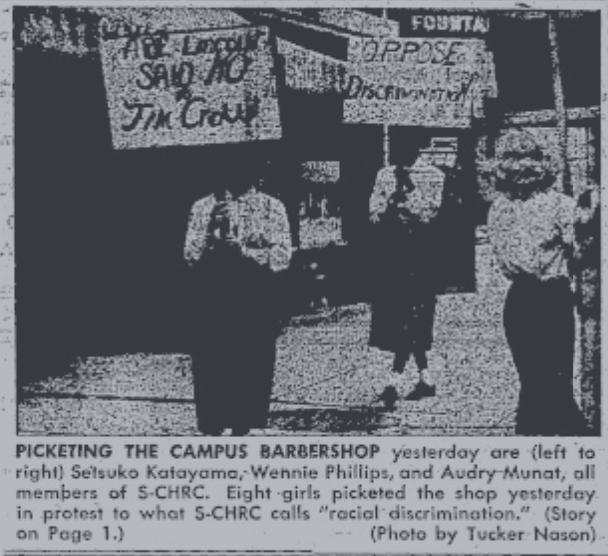
The barbers attached conditions. They posted "rules" in their shops, among them "We do not cut curly, kinky, wooly types of hair" and "Any party insisting on service assumes the liability of the result." Peters notes that these rules "would obviously function to prevent most African-Americans from receiving service."4843 Johnson's case went to trial in June before an all-white jury. A philosophy instructor who had been getting a shave that day testified that Ingwersen said afterward, "You can't mix white and colored trade," and that if a Black man sat in his chair, "I'd shave him bald."4931 The jury found that Ingwersen had not broken the law when he refused Johnson "because of his kinky and wooly hair."50 At the Campus Barber Shop on June 1, a white student, Robert Roush, protested the treatment of Thomas Scott and said a barber cursed him and struck him on the back.51 In September, Black students tested eleven campus shops. Ten served them, and most had taken their rules down; only Ingwersen's still refused.52 Tiebout's own history of the campaign says some shops had slipped back that fall, and that Bresee again declined to sue.46 From Oct. 1 to Nov. 5, 1954, S-CHRC picketed the Campus Barber Shop daily. Its pickets were all women, chosen to keep the peace. By Nov. 5 every campus shop except Ingwersen's served Black customers.535446 In October ten Black students who had been refused service, among them Jim Montgomery and Raymond Fannings, wired Governor William Stratton. Bresee had failed for over a year to enforce the law, they said, and they asked the governor to have the attorney general "clean up the mess in Champaign."55
For a time the Y considered solving the problem itself. Peters writes that "for a time, the YMCA considered opening its own barbershop in its building."15 The Daily Illini fills in the details. In the fall of 1954, Robert Baker, one of the first campus barbers to open his shop to Black students, met with officers of the Y, with S-CHRC's Harry Tiebout and with the University's security officer, Joe Ewers. They discussed "opening a shop for students" in the part of the building that became the Friendship Lounge. Baker had lost the lease on his Green Street basement shop, he said, because his landlord resented his serving Black students. When the other barbers agreed to serve Black students, "the plan was forgotten."56
A year later Baker said publicly that the Y and S-CHRC had broken a promise to him. John Price of the Y staff and Ewers said the talks "never amounted to a promise." "We talked about the problem and the possibility of installing a shop," Ewers said, "but no definite plans were made." Tiebout said Baker "was just one of the barbers considered for the job."56 No record found so far shows a barbershop ever operating in the building.
The fight did not end in 1954. In July 1955 S-CHRC's members revived the local chapter of the NAACP, with Thomas A. Scott as president and Raymond Fannings as secretary.57 That fall the chapter charged that a campus barber had discriminated by giving a Black student a poor haircut, and it offered to finance new lawsuits. In December Fannings filed one himself.565859 Two of Champaign's Black barbers told the Daily Illini that they themselves rarely cut Black customers' hair. One said that a barber had to run "either a White shop or a Negro shop" or lose his business.60 In 1961 the University chapter of the NAACP said that more than half of the barbershops in the community still refused Black and non-white foreign students. It called the issue "a persistent problem for 10 years" and asked the University to put a barbershop in the new Illini Union addition.61
For the Y, the campaign marked a change. Ed Nestingen, who joined the staff in 1959, looked back on the 1950s as the years when the Y became the center of the effort to open barbershops, restaurants and student housing to Black students. "This emphasis on Christianity in action on social structures," he wrote, "was a significant change from the '30s and '40s."62 Peters notes one irony: not a word about the barbershop campaign, or anything else the Racial Equality Committee did, appeared in the Y's own newsletter, the Y's Indian.43
As the Y told the story in later years, it grew simpler. Y publications from 2009 to 2022 say the Y "opened an alternative barbershop" or "welcomed a barbershop" when local barbers refused Black students.636465 A 2010 newspaper story placed that barbershop in the late 1960s.66 The record shows a plan in 1954 that was never carried out. Dick Thies remembered, 60 years on, that the Y set up a barber chair in its basement and seated J. C. Caroline in it for publicity, and that "shortly thereafter why the barber shops opened up here in town."20 He told the News-Gazette the same story: Caroline was the chair's "first and only customer."19 No account from 1953 to 1955 found so far describes such a chair. What the record does show is close to it: in November 1953 the Y's committee planned a friendly haircut for Caroline and a teammate that never took place, and a year later the Y talked about a shop in its own building. The Y's own file on the campaign, now at the University Archives, may settle it.295667 Caroline's actual test was the work of the Black students' committee, and the Y kept its distance from it. Memory has merged three things into one story: the Y's patient committee, the Black students who risked the tests, and the plan for a shop in the Friendship Lounge. The record keeps them apart, and each deserves its own credit.
The petition of the YMCA Racial Equality Committee, 1952–53: "Let's practice what we preach."14
Harry Tiebout, 1954: "If making people face up to the facts is stirring up trouble, then we are indeed guilty. But somehow I don't feel very bad about it."6
Dick Thies, 2013: "it's hard to believe today."20
