University YMCA · 1001 S. Wright St., Champaign, IL 61820
Visit universityymca.orgFor most of its history the University YMCA has been a place where a few students lived as well as met. From 1899 it rented rooms in its first house at Wright and John. In 1908 it opened Association Hall, later Illini Hall, with dormitories for 88 men, and found running a hotel harder than its work with students. Henry Wilson vowed the Y would never house students again, and the 1938 building opened without a bedroom. Since 1954 students have lived under its roof anyway, and the third floor is still a small residence hall.
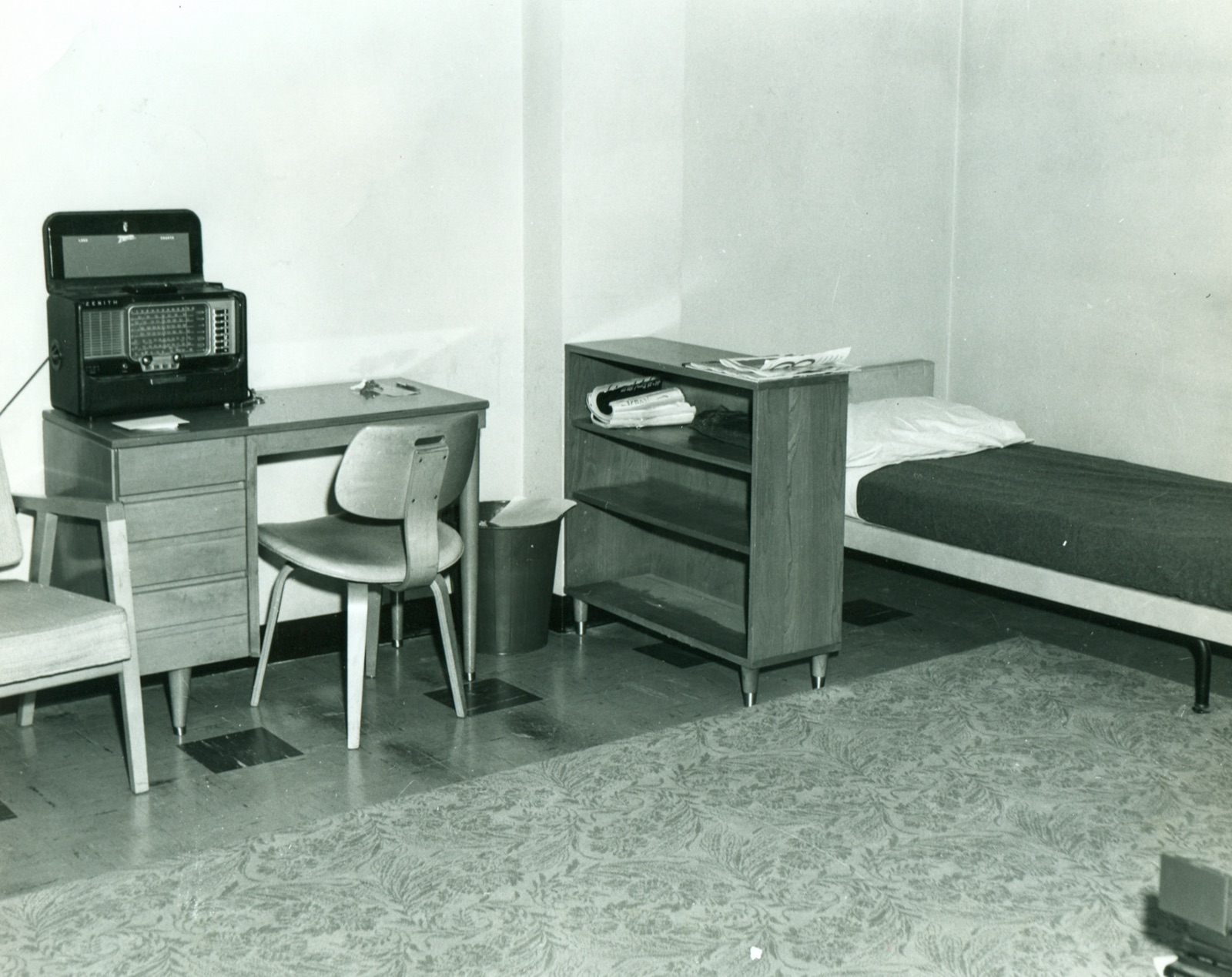
When the University opened in 1868, it housed its students itself. The top two floors of its main building, which students called "the Elephant," were dormitories, and students brought their own beds, bedding and stoves.1 That building was wrecked by a storm in the early 1880s, and afterward most students rented rooms and took their meals in private houses in Champaign and Urbana.2 Finding a room became one of the first services the Y offered. By 1902 it had kept lists of rooms and boarding places "for more than 25 years." Its members met the trains carrying new students, and upperclassmen called on freshmen in their rooms.34 The YWCA kept a list too, and both helped new students find roommates.5 In 1914 the Y's Rooming Bureau helped 1,000 students find rooms. A year later it advertised itself as "the only extensive Rooming Bureau in the University community," and the form it sent to landlords asked, "Will You Take Foreign Students?"67
For some students the Y did more than point the way. Three times it has let rooms in its own buildings: in the Association House from 1899 to 1908, in Association Hall from 1908 to 1917, and on the third floor of 1001 S. Wright St. since 1954 (Our Building tells the story of the buildings themselves).
In the spring of 1899 the Y and the YWCA bought their first home, the house the economist David Kinley had lived in the year before. It was a twelve-room frame house on a lot 170 feet square at the southwest corner of Wright and John streets, across the square from the Library. Hannah calls it Curry Cottage. The two Associations, who moved in that fall, called it the Association House.891011 The first floor held offices, parlors and a reading room, and the YWCA used two of the parlors. "The second floor is rented to students," the Daily Illini reported, "thus making the house self-supporting." The Y's president and its general secretary had rooms there.812 The student handbook of 1899–1900 already spoke of "those who have made their home among us."9
The house had a matron, Mrs. Fay, who kept it from about 1899 until 1906 and was credited with making it "the attractive college home that it is." Mrs. Clark, the mother of a 1904 graduate, followed her.131415 Loring H. Provine of the class of 1903, later a professor of architectural engineering and a member of the Y's board, lived there for a year with eight or ten other students. "We used to get up at 6:30 a.m. when reveille was played by a retired missionary and we had a housemother, which was unheard of in those days, to take care of us," he remembered. No meals were served in the house, and the men ate in the dining room on the ground floor of University Hall.16 Most of the roomers were the Y's own leaders. W. A. McKnight, later its general secretary, was ill "at the Y.M.C.A. house" as a student in 1904.17
The Y had long wanted a building of its own, and in 1906 it bought the corner across John Street.2 Its general secretary, Neil McMillan Jr., wanted the new building to have a dormitory. Men who lived together at the Y, he argued, "will become permeated with the Association idea," as had "been clearly shown in the present limited quarters."18 The men stayed in the old house until the new one was ready, and then the YWCA took over the house, with its secretary and "a number of young ladies" living upstairs.1920
The cornerstone of Association Hall was laid on June 11, 1907, and the building was dedicated on Oct. 4, 1908. It cost $107,500 with its land and furnishings.212223 Its model was the city YMCA buildings going up across the country, without their pool and gymnasium. The basement held a barber shop, a restaurant and lunchroom, a smoking room and bowling alleys. The first floor had a lobby, a game room, a lounge, an auditorium and a library. On the second floor were eight rooms for student organizations, fourteen dormitory rooms and two guest rooms, and the third floor held 28 more dormitory rooms. The rooms were single, double or en suite, with telephones and shower baths and some with private baths, and they were let "furnished, heated, lighted and cared for."2425261121 Peters calls it the first dormitory on the University of Illinois campus. A Daily Illini editorial of 1912 put it more exactly: the dormitories of the campus district began "with the Y.M.C.A. building about five years ago." The University laid the cornerstone of its own first residence hall, for women, in 1916.252728
The general secretary, W. A. McKnight, knew the building would test the Y. "It should not be simply a place for eighty-eight men to stay," he wrote in his report for 1908–09, "but should be a home for these men who live in the dormitories."22 The house committee, chaired in 1911 by Dean Thomas Arkle Clark, let the rooms each May for the next year, and there was often a waiting list.2930 In December 1909 the residents organized, with a committee member from each section of the dormitory, and their Y Club held sleigh rides, dances and an annual house party at which guests toured the rooms. For one party, the Daily Illini reported, "all the dust was swept under the beds."313233 Pete Nilsen, the Y's president in 1914–15, lived there with a roommate. They had a living and study room on the second floor and slept in the third-floor dormitory. Women callers were confined to the first-floor lounge, where Lloyd C. Douglas, the general secretary who later wrote The Robe, preached a short sermon every Sunday. "Discipline was satisfactory and observance of rules and regulations was taken for granted," Nilsen wrote. He delivered The Illini and washed dishes in a fraternity to pay his way.3435
The Board's minutes tell another story. Peters, who read them, found them "filled with discussions of problems related to the building." The residents were rowdy and noisy and ignored the house rules, and the cafeteria, leased and then run by the Y itself, lost money.36 On April 14, 1913, the men in the north dormitory woke at 1:30 a.m. to smoke from the Bradley Arcade fire next door, and Y students helped the firemen fight it until morning.37 That fall the residents adopted house rules of their own, and dropped their initiations after men were hurt in them the year before.38 In May 1915 five musicians living in the building held a rehearsal in the small hours that brought "pajama clad figures" to the transoms. "The Y. is infested with a large number of musicians," the paper concluded.39 Townspeople assumed that the men living in the building were members of the Y, Hannah adds, which "didn't add to its reputation."40
Yet the rooms stayed full. In the summer of 1915 the Y gave more of its committee rooms to the dormitory, and that fall it housed 110 men, twenty more than the year before.4142 By the time Henry E. Wilson arrived as general secretary in June 1916, though, the Association owed about $40,000. Hannah writes that Wilson "didn't believe that university YMCAs should operate rooming and boarding establishments. They had more important responsibilities."4344
The war decided the matter. The United States School of Military Aeronautics opened in the building on May 21, 1917, and by late June 130 aviators were living there.4546 On July 26 the Y turned over every room above the basement as barracks for about 200 cadets and moved its offices to the president's empty house at Wright and Green. For a time it fed the cadets at a dollar a day.474844
The Y never went back. It had leased the building to the University until June 1919, and when the aviation school closed, the University turned the barracks back into a dormitory. "The name of 'Y Inn' has been suggested," a local paper reported in January 1919. Singles rented for $12 and $14 a month that spring.4950 By September it was "Illini Hall, formerly the Y Inn," and it was full.5152 The Illinois Union took over the whole building in 1921 and bought it from the Y in 1923–24.5354 The men who lived there were no longer the Y's tenants, but the building the Y had built went on housing students for almost thirty more years. When the University took title in 1939, Illini Hall became its only men's dormitory, with rooms for 62 men, and when its residents organized in 1940 they were called the first University dormitory residents "since the chapel days back in 1870."555657 By 1947 it housed 96 women, and that year the University began turning it into offices.58 Illini Hall was torn down in 2023. From its cornerstone the Y recovered its own annual report and constitution of 1907.5960
Wilson made the lesson part of the plan for the Y's next building. In March 1922 its building committee agreed that "both dormitory and cafeteria features should be eliminated." After the Y's wartime Hut burned in December 1923, the Board recorded that "all agreed the new building should not have a cafeteria or residence."6162 Every version of the plan said so. In 1924 the Daily Illini reported that the building would have no swimming tank, cafeteria, dormitory or gymnasium, and the statewide campaign of 1930 sought a building "not as a dormitory, or a meeting place, but as a center where men may be trained."6364
The architects' drawings of March 1937 did include a small dormitory of five rooms under the roof, moved there at the building committee's suggestion that January. The third floor was left unfinished when the building went up, and the five rooms were never built.656667 When the Y moved in on April 28, 1938, the Daily Illini called its new home "unique among University Y.M.C.A.s" because it had no dormitory or cafeteria.68 At the dedication in April 1939 Wilson read the Board's statement: "We do not have dormitories nor restaurant, nor other commercial enterprises. We have set ourselves to the tasks which fulfill our purpose."69 For more than fifteen years the third floor stayed an empty attic.70
The Y still helped students find rooms. In 1924–25 its International Friendship Committee listed "finding rooms, boarding places and employment" first among its services to foreign students, and its members called on them in their rooming houses.71 Some students could not find a room at all. Until 1945 the University's housing records did not mention Black students at all; they "fended for themselves with the help of other local blacks," as one historian put it. Nearly all of them lived with Black families in Champaign's North End, a mile or more from campus, or in the houses of the Black fraternities and sororities.7273 Some of the help they found near campus came from the Y's own staff. Fred and Otha Witwer, the Y's caterers from 1945 to 1962, lived at 1111 South Fourth Street. They hired large numbers of Black students for the catering service, lent money to students in need and gave them "temporary housing until they could get located." Hannah judged the couple "more progressive than the Y itself in the area of race relations."74 Even after the war, tests by students in 1952–53 found that none of fourteen rooming houses would rent to Black American students.75 In April 1953, in the middle of its campaign against the campus barbershops, the Y's racial equality committee published a Black student's call to "make the same appeal on the basis of segregated housing."76 In 1957 the Y's effective citizenship committee joined the Young Democrats and other groups in a student referendum asking the University to stop approving private houses that excluded students by race, by September 1960.77 In December 1960 a Y representative told the Champaign Human Relations Commission that the Y was "concerned" about reports of discrimination in housing and had been investigating them.78
The Trustees finished the third floor in 1954 as a memorial to Fred A. Poor, the chairman of the Trustees, who had died in 1953. About 350 of his friends paid for it. Besides a library and historical room and a program room, it held two double bedrooms for students who worked part time for the Y and a guest room for visiting speakers. The Poor Memorial was dedicated on Oct. 9, 1954, and by February 1955 student employees were living in the bedrooms (The rooms and their names).798081 A later Y newsletter says the rooms also housed newly arrived international students until they could find housing on campus. In 1962, when John W. Price ran the Y's foreign student work, "many find the Y a convenient place to stay when they first arrive," the Daily Illini reported.8283 Some stayed a single night and others a semester or a year.84 Shahid "Shad" Khan, who came from Pakistan in January 1967, at 16, to study engineering at Illinois, spent his first night at the Y in a room that cost him two dollars. When 60 Minutes brought him back to the building in 2012, by then the owner of the Jacksonville Jaguars, he pointed out the side where his room had been.8584
Peters points out the irony. Less than ten years after Wilson's death, the building he had insisted would never have a cafeteria or a dormitory had both, the Kaeser Room coffee shop in the basement and bedrooms on the third floor.86 They stayed small. In 1960 a statement for the Board noted that the YMCA at the University of Wisconsin earned a large income from its dormitory, "whereas we do not."87
The change came about 1970, when the Y needed money to keep up the building. The little-used Poor library was made into two more rooms for residents. Peters is careful to say that this "was not done out of a desire to be in the resident business," which was still thought inappropriate. It was done "to squeeze more income out of the building so it could continue to be used to support the Association's mission."88 By January 1971 the Y was advertising in the Daily Illini: "CHEAP ROOM on campus. Opening at University YMCA, $52.12/month. Air conditioned, laundry facilities, furnished." The next year's notices offered "Air conditioned rooms for men at YMCA, 1001 S. Wright. Across from Lincoln Hall."8990 Room and work still often went together. A notice of December 1973 offered men "Housing and employment for 2nd semester at University YMCA." In 1978 a junior told the Daily Illini that he paid his rent by working the Y's front desk and had saved more than $1,000. The rooms were large, he said, and each had a balcony.9192
By 1986 the Y was advertising "certified" housing, and the third floor had become a small residence hall in the University's program of private certified housing. The Y had a house director on its staff and a student head resident.939495 In February 1992 the house director, Joyce Shields, wrote to a prospective resident that the Y housed thirteen University of Illinois and Parkland College students. "We feel our small number is really an asset to an incoming Freshman or Transfer student," she wrote. A room cost $180 a month in a triple and $190 in a double, utilities, air conditioning and laundry included, on an eight-month contract.96
The residents' handbook of the early 1990s, adapted from the University's own, was strict. All guests had to be cleared by the house director or head resident. No alcohol was allowed in the building, and no pets, though tropical fish were permitted. Lofts were forbidden, and residents were told to stay off the roof.95 The rooms had no meal plan. Residents ate lunch at the Y Eatery on the first floor, bought University meal contracts, or worked for their meals at nearby sororities and fraternities, and some worked at the Y's own information desk.9798
The brochure of 2001 called the twelve places "the perfect amount to capture a family-like atmosphere." Residents shared two triple and three double rooms, a lounge with a television and a computer on the University network, and a walk-in attic for storage, and the brochure invited them to take part in the Y's governance because they had "a 'special interest' in the building." Applicants had to be men enrolled at the University or Parkland and to bring three letters of recommendation.98 Through the 2000s the Daily Illini ads read "Private certified housing for male students," at $220 a month in a triple and $245 in a double in 2002.99100 The brochure's selling point was the location. "Residents living at the YMCA cannot get any closer to the Quad without sleeping on it!!!"98
The men who lived there remembered something more. In 2012 six of the residents of 2004 to 2008 met for a night in Chicago, and one of them, Ryan Stanis, wrote it up for the Y. They had "recounted our favorite YMCA memories: the unique roommates that came and...stayed, the personalities that evolved, and the feeling of having a whole building left to 12 guys each night the YMCA closed." One of their roommates had come from China to study at 16, and "the guys on the floor always saw themselves as his second family." Out on the town four years after graduation, Stanis wrote, it felt as if they were in just another bar on Green Street, with home at the Y three blocks away.101
The residents left their mark on the Y in other ways. The attic filled with furniture and belongings left behind by men who had lived on the third floor. Betty Earle, the director of operations, with Joyce Shields and Rebecca Crummey, proposed a sale to clear it, and asked Y members for donations so that the residents and the student programs would have money for treats at their meetings. Steve Shoemaker enlarged the Y's annual garage sale into the first Dump & Run, in 2002.102103 In her 24 years at the Y, Betty Earle was a friend and counselor to the students who lived upstairs, and the invitation to her retirement party said she had "often served as 'house mother' at the University Y."104105
In 2009 the residence nearly closed. The Y was planning an elevator, and in February the City of Champaign ruled that the project also needed a second fire-rated stair. An inspection on May 11 found that the third-floor dormitory had only one exit. On July 15 the city stayed an order to vacate it, on condition that a new stair be built by Aug. 15, 2010. In the meantime a rented scaffold stair, about 28 feet tall, hung on the building's west wall as the residents' second way out.106107108 The new stair went into the brick tower on the west side, with the elevator, in 2010–11 (Our Building).
With the stair built, the Board of Governors endorsed "the continued use of the 3rd Floor as student residences for the foreseeable future" on March 31, 2011. Staff had argued that housing, and perhaps a living-learning program, fit the Y's mission better than more offices.109 That fall the third-floor lounge was remodeled, "now as beautiful as it was ugly," and two of the rooms were upgraded. New storage rooms for residents were built off the attic corridor.110111 The 2012 brochure still offered twelve places for men at the University, with a shared kitchen and a promise that "You can't live any closer to campus unless you're sleeping on the quad!"112
When Betty Earle retired in 2014, the Trustees began the Betty Earle 3rd Floor Fund in her honor. Its first aims were heat for the cold lounge and a new bathroom, and in 2015 it paid for a study of how the bathroom could be rebuilt.104113114
By 2018 the Board was asking whether the Y should stay in housing at all. A changing market and an abundance of new student housing made it harder to fill the rooms, and the University's certified housing program had begun to require even small residences to serve meals. One idea was a living-learning community built around one of the Y's program areas: the environment, social justice, interfaith work or global engagement. That April the Board registered no objection to giving up the residence, but agreed that whatever the floor became had to serve the Y's mission.82115 In September 2019 the Board was "quickly moving to the decision not to have dorms after the spring" and to make the floor into offices.116 Two months later it changed course. The prospective office tenant had withdrawn, and the Y decided to keep renting the rooms for 2020–21. They would no longer be certified housing, so they could not take freshmen, but residents would not have to buy a meal plan. City code limited the floor to one sex, and in December 2019 the Building Committee talked about opening it to women only, since women-only housing on campus had grown scarce.117118 The floor stayed, as it always had been, a residence for men.84 The Y spent about $20,000 from its Major Funds Campaign to retile, paint and cable the floor and remodel its kitchen and lounge, and in 2020 it advertised "newly renovated" rooms at $410 to $470 a month, all utilities included.118119120
COVID-19 left only two or three residents on the floor in the spring of 2020. In the fall of 2022 it was full for the first time in years.121 In 2023, its 150th year, the Y said it shared its building with "twelve student organizations, seven tenants, and nine student residents."122 The floor has had no house director since Carol Nunn died in 2019. The staff, chiefly Ann Rasmus, have looked after it with a student resident advisor, and since 2025 Isaac Ackerman, then University Place Christian Church's campus and community connector and since October 2026 its pastor, has lived on the floor as resident director.84123 Today the third floor houses up to a dozen men, students of the University and Parkland College, and every bed is taken for 2026–27.124121
Henry Wilson's fear was that a building full of roomers would turn the Y into a landlord and leave it no time for its work with students. Kept to a dozen beds, the residence has never come close to that. The students upstairs live in the middle of the Y's life, a flight of stairs above the Friday Forum and the student offices, and across the street from the Quad.
